
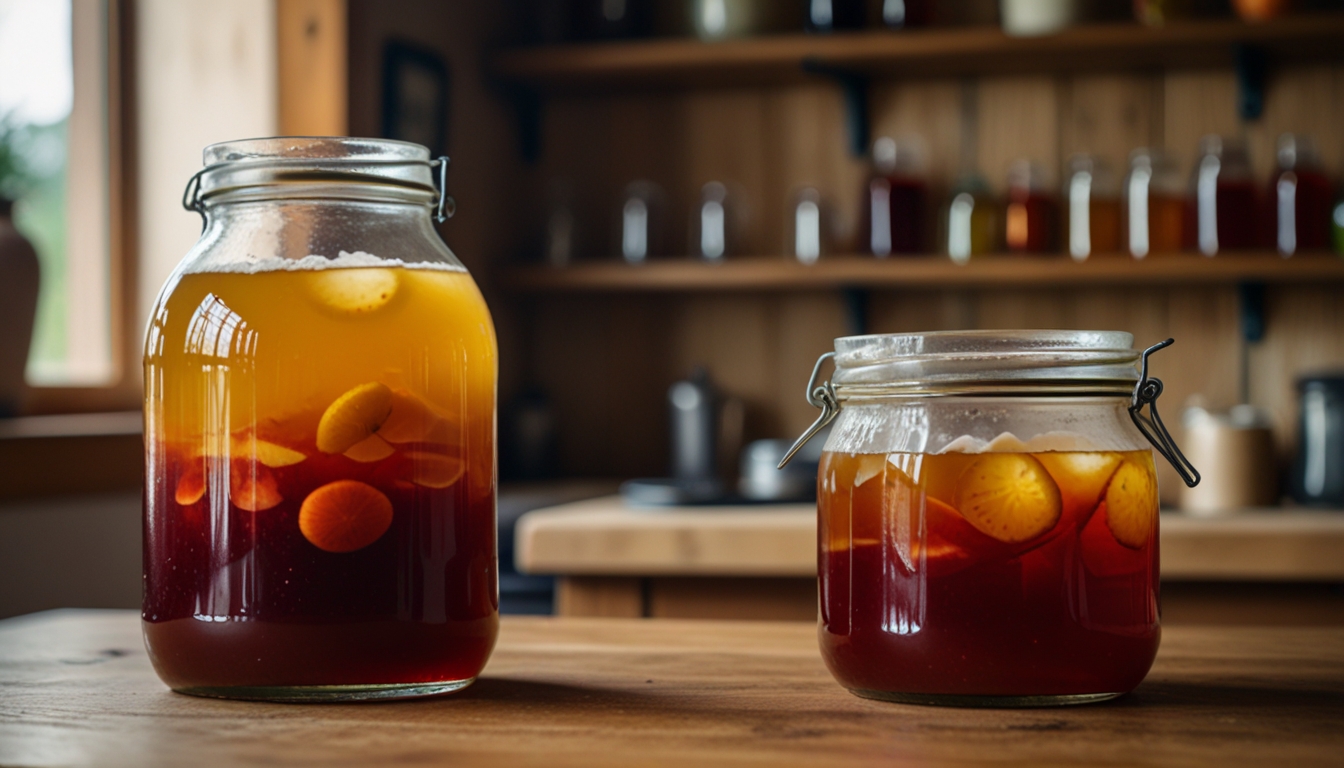
Kombucha starts from 1 cup of granulated sugar and 3 tablespoons of black tea per gallon of water, brewed at 160–170°F (71–77°C), cooled below 95°F (35°C), then fermented 7 to 10 days at room temperature of 68–77°F (20–25°C). A second, sealed ferment in bottles is what creates the fizz.
What Do the Published Numbers Say?
Two published methods cover home kombucha in detail, written for different readers: one for home cooks working from a single recipe, one for small producers who have to document what they did.
| Parameter | NCHFP | BC Centre for Disease Control |
|---|---|---|
| Sugar | 1 cup per gallon of water | 50–150 g/L (a 5–15% concentration) |
| Tea | 3 Tbsp (6 bags) black, or ⅓ cup + 2 Tbsp (13 bags) green | 4–5 g/L, steeped at least five minutes |
| Brew temperature | 160–170°F (71–77°C) | Cool from 60°C to 20°C within 2 hours, no longer than 6 |
| Before adding culture | Cool below 95°F (35°C) | Ambient, roughly 20°C (68°F) |
| Fermentation temperature | 68–77°F (20–25°C) | 10–26°C (50–79°F), optimal 20–22°C (68–72°F) |
| Fermentation time | 7–10 days | 10–21 days |
| pH | Starter liquid must be 4.0 or less | Ferment to pH 4.2 or lower; not below 2.5 |
| Storage | Refrigerate promptly; use within 30 days | Refrigerated; most contain live culture |
The time difference is the interesting one. The longer window reflects the wider temperature range: at 10°C the same culture works far more slowly than at 22°C.
Ingredients & Equipment
- 8 cups water
- ½ cup sugar (plain white sugar is best for the culture)
- 4 bags black or green tea (about 2 tbsp loose)
- 1 SCOBY (paid link)plus 1 cup starter liquid (unflavored mature kombucha)
- A large glass jar (paid link)a tightly-woven cloth and a rubber band
- Bottles with tight lids for the second ferment
One item is worth being fussy about: the starter liquid. NCHFP is explicit that you measure its pH first — if it is 4.0 or less you proceed, and if it is greater than 4.0 the instruction is “do not make kombucha.” That makes a pH meter or test strips part of the equipment list, not an optional extra.
What Are the Two Ferments?
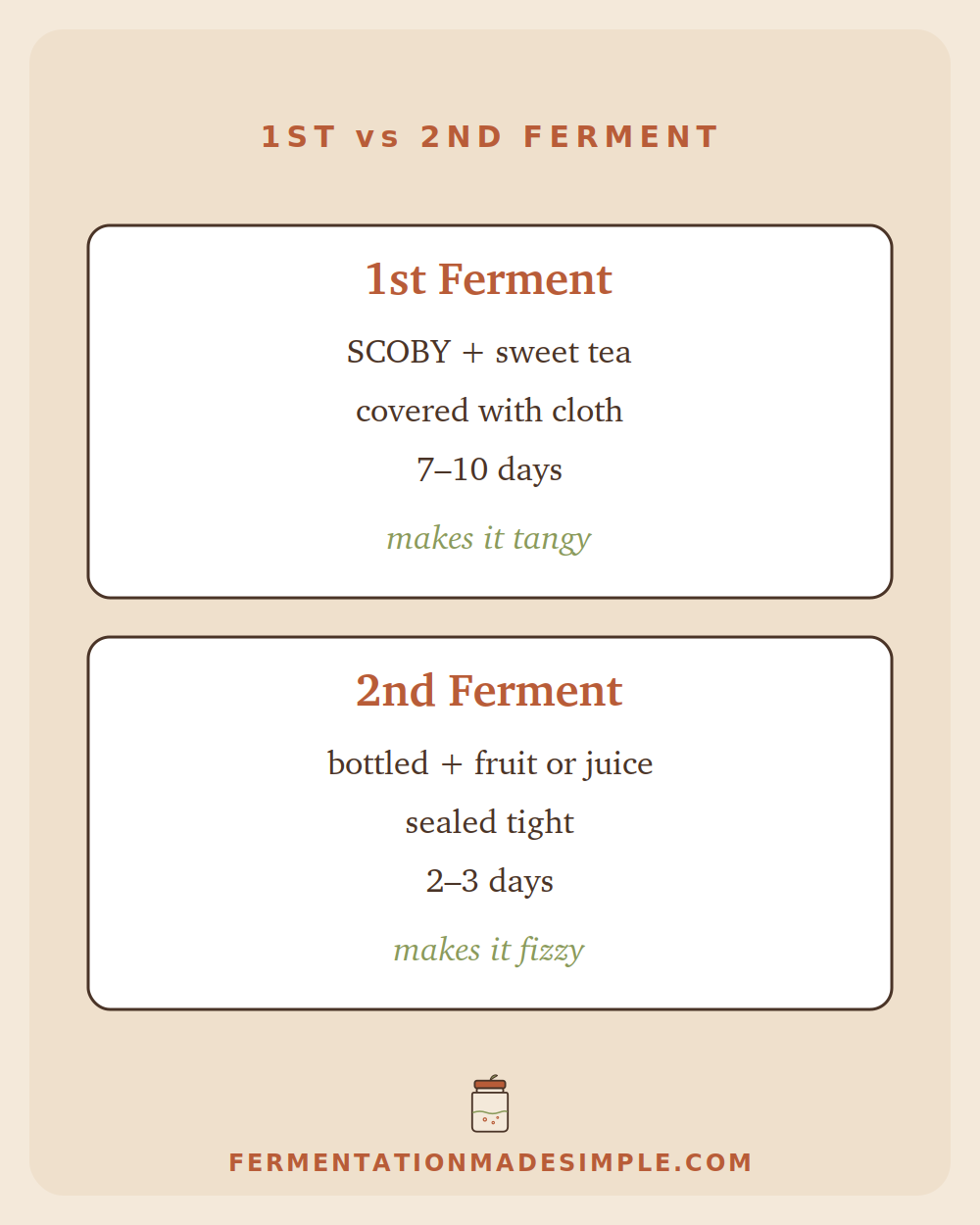
This is the idea that makes kombucha click. The first ferment is open to the air, covered with cloth, and turns sweet tea into tangy kombucha. The second ferment happens in sealed bottles with a little fruit or juice, and that is where the carbonation comes from — CO₂ produced in a closed container has nowhere to go but into the liquid.
Most beginner confusion follows from that distinction: flat kombucha is almost always a second-ferment problem. Our guide to the second fermentation covers it, and flavor combinations all belong at that stage.
Step-by-Step
- Brew sweet tea. Steep the tea in hot water, stir in the sugar, and remove the tea.
- Cool completely. Let it cool to room temperature — hot tea will harm the SCOBY.
- Add SCOBY and starter. Pour into your jar, add the SCOBY and starter liquid.
- Cover and wait. Cover with cloth (not a lid) and ferment 7–10 days, tasting from day 7.
- Bottle for fizz. Bottle with a spoon of fruit or juice, seal, and leave 2–3 days before refrigerating.
Two points deserve emphasis. Cooling is a real step: below 95°F (35°C) before the culture goes in, and a cool-down from 60°C to ambient within two hours, six at the outside. And the first ferment stays under cloth, never a sealed lid.
How Do You Know It’s Done?
Taste from day seven, then daily. A finished first ferment tastes tangy with only a hint of sweetness; if it still tastes like sweet tea, the sugar has not been consumed. BCCDC sets a floor as well as a ceiling — ferment to pH 4.2 or lower, but not below 2.5 — and a batch left far too long tastes unmistakably of vinegar. If that happens, see kombucha that has gone too sour.
Temperature moves this timeline more than anything else. At the cool end of the 10–26°C range, ten days may not be enough; near the 20–22°C optimum, 7 to 10 days is realistic.
Storage and Bottle Pressure
NCHFP directs you to pour finished kombucha into clean, sanitized jars or bottles, refrigerate promptly, and use within 30 days. It also carries a warning worth repeating in full: “Storing kombucha in airtight containers can cause accumulation of CO2 (carbonation), potentially leading to an explosion.”
The second ferment is therefore the stage to watch. Bottles left sealed at room temperature keep building pressure; refrigeration slows that down sharply. Burping a bottle daily and moving it to the fridge once it is lively are the habits that keep this manageable.
Common Mistakes
- Adding the culture to hot tea. Cool below 95°F (35°C) first.
- Skipping or guessing the starter liquid. The 4.0 pH check is a gate, not a suggestion.
- Sealing the first ferment. It is covered with cloth; the second ferment is the sealed one.
- Fermenting too cold. The optimum is 20–22°C (68–72°F); a cold kitchen stretches everything out.
- Panicking at a new layer. A fresh pellicle forms each batch. Mold versus SCOBY shows the difference.
None of this is an assessment of your particular jar. We can set out what the published guidance says; we cannot see what is in front of you. If a batch smells wrong, shows fuzzy growth, or you are simply unsure about it, discard it.
FAQ
Where do I get a SCOBY?
From someone who already brews, or online. Each batch grows a new layer you can pass on. Our guide to caring for a kombucha SCOBY covers keeping it between batches.
Does kombucha contain caffeine or alcohol?
Both, in small amounts. Caffeine comes from the tea; alcohol is produced by the yeasts during fermentation. The cited alcohol content is less than 1.1% ABV for federal compliance in Canada, and provincial requirements vary.
Why isn’t my kombucha fizzy?
Fizz is made in the sealed second ferment, so the usual causes are bottles that do not seal tightly, not enough residual or added sugar to feed the yeasts, or too little time at room temperature. See why kombucha goes flat.
Can I use less sugar?
The sugar feeds the culture rather than sweetening the drink, and most of it is consumed. The published range is 50 to 150 g/L, so there is room to move — but cutting below a published ratio slows fermentation rather than simply making the result less sweet.
Sources: National Center for Home Food Preservation — Kombucha Tea · BC Centre for Disease Control — Fermented Foods Guideline: Kombucha and Jun
Related: Kombucha Second Fermentation · How to Care for a SCOBY · Why Isn’t My Kombucha Fizzy? · Kombucha Flavors to Try