
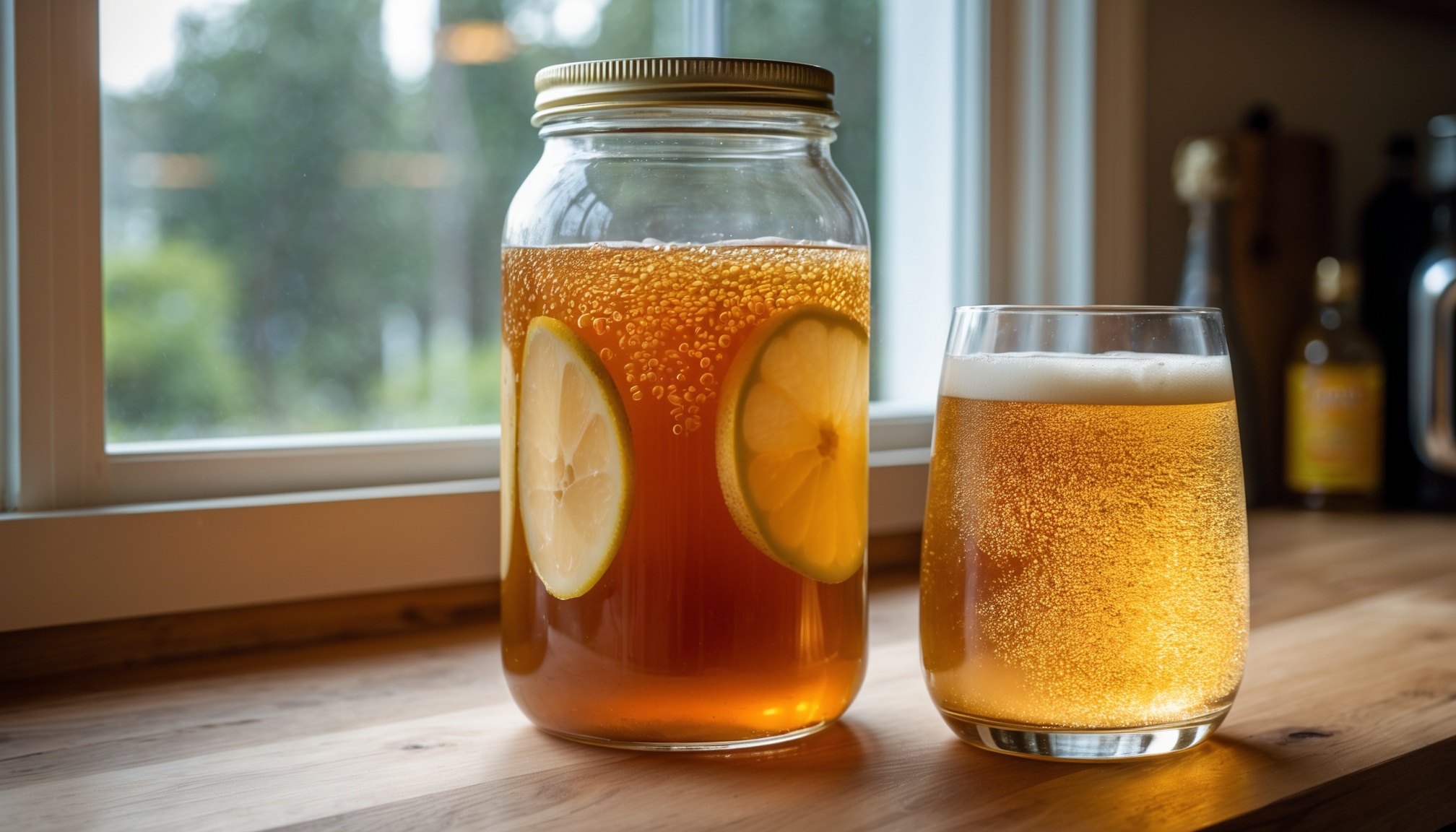
Flat kombucha almost always means the bottle had no sugar left to work with, the seal let the gas out, or the bottle went cold too soon. Second fermentation runs 1 to 3 days at room temperature after bottling, and refrigerating immediately prevents carbonation from developing at all.
What Actually Makes Kombucha Fizzy?
Carbon dioxide produced by yeast, trapped in a sealed bottle. A typical culture carries yeasts such as Brettanomyces, Saccharomyces, Zygosaccharomyces and Torulaspora alongside acetic acid bacteria such as Acetobacter, Gluconobacter and Komagataeibacter. The yeasts consume sugar and release CO2; the bacteria produce the acids that give kombucha its bite.
That matters for troubleshooting, because fizz is a sugar-and-pressure problem, not a culture problem. If there is no sugar left to ferment, or nothing holding the gas in, a perfectly healthy SCOBY will still give you flat kombucha. Our SCOBY care guide covers the culture side separately.
Why Is My Second Fermentation Not Carbonating?
Work through the three variables the published guidance actually names — sugar, seal, and time at temperature — in that order. Most flat batches resolve at the first or third.
| Cause | What to change |
|---|---|
| No sugar left for the yeast | Add fruit, juice or sugar at bottling, or shorten the first fermentation so less sugar is consumed |
| Gas escaping | A bottle rated to hold pressure with a working seal, not a loosely lidded jar |
| Too little time after bottling | Leave it sealed at room temperature before chilling |
| Too cold | Move the bottles somewhere warmer; a cold kitchen stretches the timeline |
| Chilled straight away | Let it sit sealed at room temperature first |
How Long and How Warm Should the Bottles Sit?
The window is 1 to 3 days at room temperature after bottling, then refrigeration. That is shorter than most people expect, and it is one reason flat batches and over-pressurized batches often come from the same kitchen a week apart.
Temperature sets how fast those days pass. The working range is 64–79°F (18–26°C); the tighter reading puts the optimum at 20–22°C (68–72°F), with an upper limit of 26°C (79°F) and a lower limit of 10°C (50°F). A bottle on a 62°F counter in winter is not failing, it is running at the bottom of the range.
Does the First Fermentation Affect the Fizz?
It sets how much sugar is left when you bottle. The published figures for a first fermentation run 7 to 10 days at 68–77°F (20–25°C), or 7 to 14 days with some batches taking up to a month, or 7 to 21 days and typically 10, with a finished pH below 4.2 and a floor of 2.5.
Run the first fermentation to the long end of those ranges and the culture has consumed more of the starting sugar — a gallon batch starts with 1 cup, within a starting range of 50 to 150 g/L (5 to 15%) — leaving less behind for the bottles. A very sour, very long first ferment and a flat second ferment usually have the same cause. The full sequence is in our second fermentation guide.
What Should You Add at Bottling?
Something fermentable, because the yeasts need a fresh source. Fruit, fruit juice and plain sugar all supply it. The published documents do not specify a per-bottle addition for home second fermentation, so treat any exact spoon figure you see elsewhere as a starting point rather than a rule, and judge by what the bottle does over 1 to 3 days.
NCHFP also asks you to check the starter liquid before brewing: pH 4.0 or less to proceed, otherwise discard it and get fresh starter. That is a first-fermentation check rather than a carbonation one, but it is the step most often skipped by people whose batches behave unpredictably. Our home kombucha method walks through the full brew.
This page summarizes the published extension and public-health guidance provides about kombucha fermentation and carbonation. It is not an assessment of any particular bottle. If a batch looks or smells wrong to you, discard it rather than working through this list.
FAQ
How long does second fermentation take?
1 to 3 days at room temperature after bottling, then refrigeration. The same 1 to 3 days applies to the sealed secondary stage of jun, kombucha’s close relative. Cooler rooms stretch that; the working range is 64–79°F (18–26°C).
Why did my kombucha go flat after refrigerating?
Cold stops the yeast from producing more CO2. Refrigerating immediately after bottling prevents carbonation from developing, which is why the room-temperature window comes first and the fridge comes after.
Can I just leave the bottles out longer for more fizz?
NCHFP warns that airtight containers can accumulate CO2 and potentially explode if not regularly monitored, and the same caution applies to bottles capped at room temperature for longer periods. Extra days are not a cost-free way to add carbonation.
Does a weak SCOBY cause flat kombucha?
Carbonation depends on fermentable sugar and a sealed container, not on culture appearance. The check on the culture side is the starter liquid pH, which should be 4.0 or less before brewing; if it is higher, the guidance is to discard it and obtain fresh starter.
Sources: NCHFP — Kombucha Tea · Colorado State University Extension — Understanding and Making Kombucha · BC Centre for Disease Control — Kombucha and Jun Guidance
Related: How to Make Kombucha at Home · Kombucha Second Fermentation Guide · How to Care for a Kombucha SCOBY