
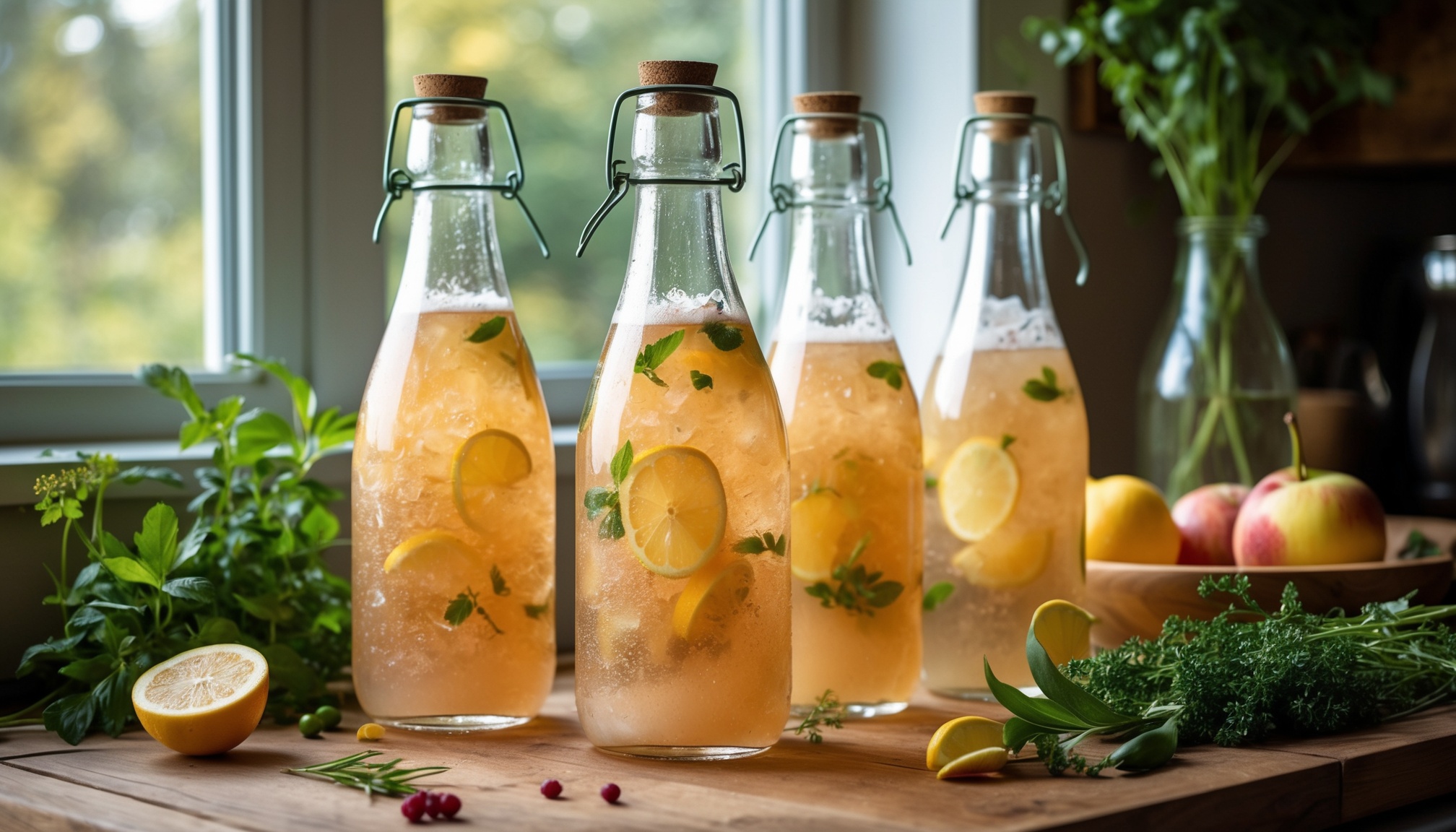
Second fermentation is a short sealed-bottle stage after primary brewing, run to build carbonation and flavor. Flavor with 10 to 20% juice or clean fruit, cap tightly, and leave 1 to 3 days at room temperature before refrigerating, with about one inch of headspace and an airtight seal.
What Second Fermentation Actually Does
Primary fermentation converts sweet tea into kombucha. The BC Centre for Disease Control puts that stage at 7 to 21 days, typically 10, at 10–26°C (50–79°F) with an optimum of 20–22°C (68–72°F), and sets the target acidity below pH 4.2 but not under 2.5. The organisms doing it are acetic acid bacteria — Komagataeibacter, Gluconobacter, Acetobacter — alongside yeasts such as Brettanomyces, Zygosaccharomyces and Saccharomyces.
Second fermentation happens after that, in a sealed bottle, with no SCOBY present. Its only jobs are dissolving CO2 into the liquid and infusing flavor. If you have not run the primary stage yet, start with our kombucha recipe.
What You’ll Need
Flip-top swing bottles (paid link) designed to hold pressure are essential — standard mason jar lids aren’t built for carbonation and either leak gas or, more rarely, build too much pressure.
Step-by-Step
- Strain finished first-fermentation kombucha into clean swing-top bottles, leaving 1-2 inches of headspace.
- Add 1-2 tablespoons of fruit, juice, or sugar per 16 oz bottle.
- Seal tightly and leave at room temperature for 2-4 days.
- “Burp” once daily to release excess pressure and check progress.
- Refrigerate once fizzy to slow fermentation and lock in carbonation.
How Does Pressure Build Inside the Bottle?
Yeast eats the sugar you added and converts it, in a fixed ratio, into gas and ethanol. UF/IFAS gives the conversion directly: for every 1 gram of sugar fermented, about 0.46 grams of CO2 and 0.48 grams of ethanol are produced. In an open vessel that gas leaves. In a sealed bottle it dissolves into the liquid until the liquid is saturated, and everything after that raises the pressure in the headspace.
That is why every published instruction for this stage controls four variables at once: how much sugar goes in, how big a vessel it is sealed in, how long it stays sealed, and when it goes cold.
| Variable | Published figure |
|---|---|
| Flavoring added | 10–20% juice or clean fruit |
| Headspace | About 1 inch, sealed airtight |
| Bottle | "Appropriately pressure-rated bottles must be used to achieve high carbonation levels" |
| Time sealed at room temperature | 1–3 days, or refrigerate immediately |
| Secondary fermentation length | 1–3 days |
| Carbonation ceiling | Absolute maximum recommended: 8 volumes CO2 |
| Detection threshold | ~0.6 volumes CO2 |
| Storage after bottling | Refrigerate at 4°C or lower (≤41°F) |
Read down that column and the procedure writes itself. Bottles rated to hold pressure, a measured inch of headspace, a flavoring dose in the 10–20% band rather than by eye, one to three days sealed, then refrigeration — the step that stops further fermentation. Colorado State Extension states the consequence of skipping it: a longer period capped at room temperature "could result in carbon dioxide accumulation and even explosion."
How Long Should It Run?
One to three days is the published figure, and the same window covers the secondary fermentation of jun. Room temperature is the variable that moves it, and published definitions of it differ: 60–70°F in one guide, 64–79°F (18–26°C) for kombucha fermentation generally, with a full workable range of 10–26°C (50–79°F) and 20–22°C (68–72°F) as optimal.
A kitchen near the top of those ranges works through the added sugar faster than one at 60°F, which is why the same recipe carbonates in two days in August and takes longer in a cold house. Temperature also affects how much CO2 stays dissolved: cold liquid holds more gas, which is part of why bottles are chilled before opening rather than after.
Where Does the Alcohol Figure Come In?
It rises with the carbonation, from the same sugar, at that same ratio. The US legal limit for kombucha alcohol content is 0.5% by volume, and under some conditions the level in homemade kombucha may exceed it. The Pennsylvania Department of Agriculture’s brewing and bottling guidelines put typical unbottled kombucha under 1% and note it can rise to 3% with extended fermentation. A longer, sugar-rich second ferment moves fizz and alcohol in the same direction.
Nothing above is an assessment of the bottles on your counter. These are the published ranges and procedures from the agencies cited; they describe process, not any particular batch. If a bottle looks or smells wrong, shows fuzzy colored growth, or behaves unexpectedly when opened, discard it rather than taste it.
FAQ
How long should second fermentation take?
Published guidance gives 1 to 3 days at room temperature, and the same window covers jun’s secondary stage. Cooler kitchens sit at the long end of it. That window comes paired with an alternative — cap and leave 1 to 3 days, or refrigerate immediately — so the fridge is a valid endpoint at any moment, not only once the target fizz appears.
Can I use a mason jar instead of a pressure-rated bottle?
Appropriately pressure-rated bottles must be used to achieve high carbonation levels, and the bottle has to be sealed airtight so carbonation can develop. A standard mason lid is designed to vent rather than hold gas, which is why it makes a poor carbonating vessel in both directions — it loses the fizz you are trying to build.
How much fruit or juice should I add?
The published dose is 10 to 20% juice or clean fruit by volume. That dose is what the 1-to-3-day window and the headspace figure are calibrated against, since added sugar is the direct input to the CO2 conversion. Our kombucha flavor ideas work within that range.
Why is my second ferment flat?
Usually the seal, the temperature or the sugar. A lid that vents lets the CO2 out instead of dissolving it; a kitchen at the bottom of the 10–26°C range works slowly; and without added sugar in the 10–20% flavoring band there is little left for the yeast to convert. Chilling the bottle before opening also matters, since cold liquid holds more dissolved gas.
Sources: Colorado State Extension — Understanding and Making Kombucha · Kansas State Research & Extension — Kombucha Fermentation (MF3672) · UF/IFAS — A Guide to Carbonating Beverages at Small Scale · BC Centre for Disease Control — Kombucha and Jun Guidance (3.11)
Related: Kombucha Recipe · Kombucha Flavor Ideas · Why Isn’t My Kombucha Fizzy? · How to Care for a SCOBY