
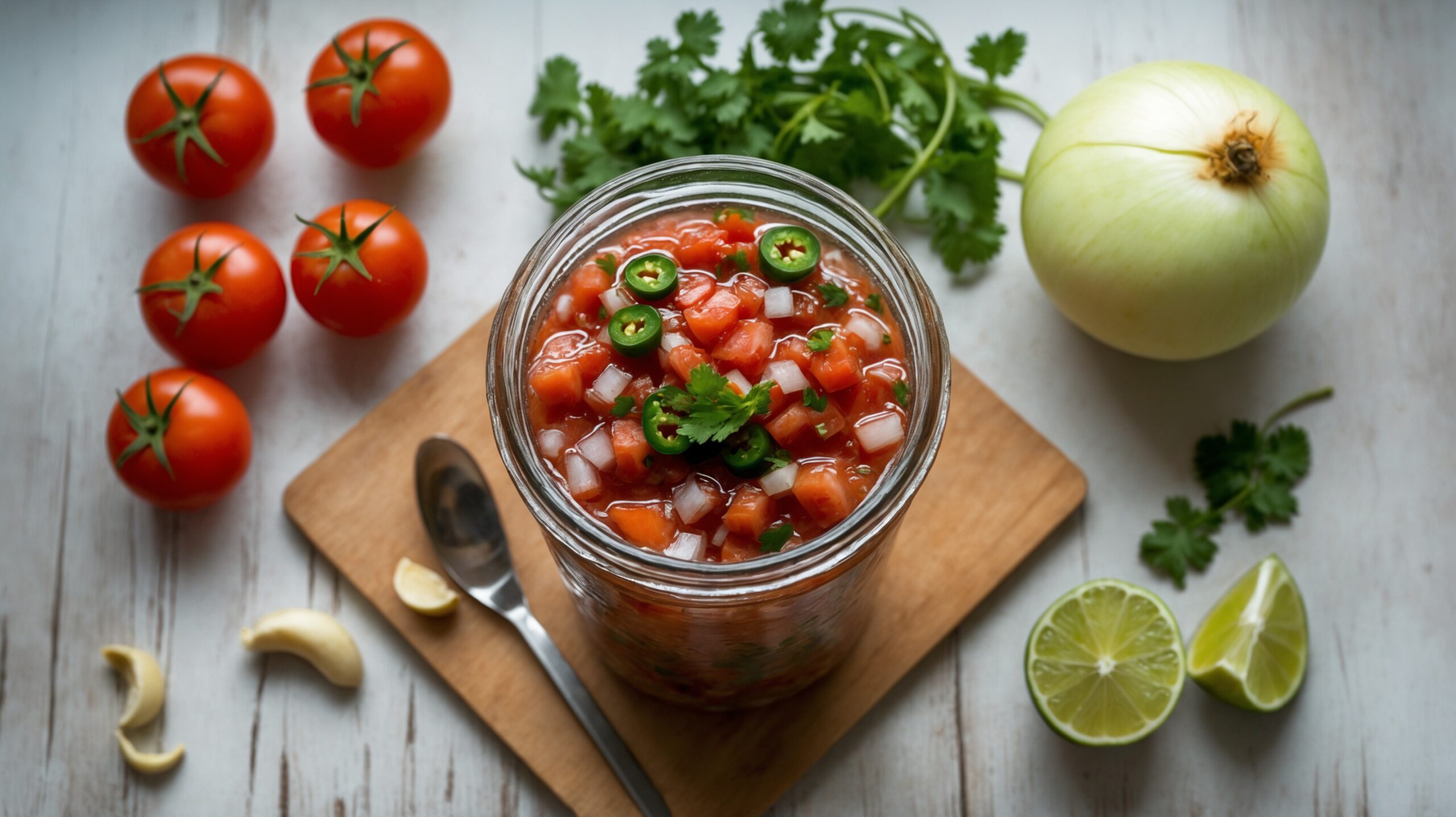
Fermented salsa uses a 2% salt ratio and ferments at room temperature for 2 to 4 days, far faster than peppers or sauerkraut. Tomatoes release their own juice to form the brine, so no added water is needed, and the finished salsa moves straight to the fridge once it tastes tangy.
Fermented salsa is a raw tomato, onion, and pepper mix salted at 2% of total weight and left to ferment for 2 to 4 days at room temperature. The vegetables release enough liquid on their own to form a brine, so this recipe skips the submersion-brine step used for pickles or sauerkraut. Tomatoes sit at a natural pH of 4.3 to 4.9, right at the edge of the safe-canning threshold, which is why fermentation (which drives the pH below 4.6) and refrigeration afterward both matter. Once the salsa tastes sour and smells clean, it moves to the fridge, where it keeps for several weeks.
Ingredients
- 4 cups chopped ripe tomatoes (about 2 lbs / 900 g), cored and diced
- 1/2 cup diced white or red onion
- 2–3 jalapeños or serranos, diced (seeds in for more heat, out for less)
- 3 cloves garlic, minced
- 1/4 cup chopped fresh cilantro
- 2 tablespoons fresh lime juice, added after fermentation
- 1 tablespoon fine sea salt (about 2% of the vegetable weight; use a salt calculator for larger batches)
Step-by-Step
- Dice the tomatoes, onion, peppers, and garlic to a uniform, salsa-sized chop. Smaller pieces release juice faster and ferment more evenly than large chunks.
- Combine everything except the cilantro and lime juice in a non-reactive bowl. Add the salt and mix thoroughly for 1–2 minutes, pressing gently so the tomatoes start releasing juice.
- Pack the mixture into a clean quart-sized glass jar, pressing down until the released juice rises above the solids. Leave at least 1 inch of headspace below the rim.
- Weigh the vegetables down with a glass fermentation weight (paid link) or a smaller jar filled with water, so everything stays under the liquid line.
- Cover loosely with a fermentation lid, airlock lid, or a cloth secured with a rubber band. A tight, airtight lid can let pressure build up from the gas tomatoes produce.
- Set the jar at room temperature (68–75°F / 20–24°C), out of direct sunlight, for 2 to 4 days. Check once a day; you’re looking for cloudiness, small bubbles, and a sour smell replacing the raw tomato smell.
- Taste on day 2. Once the salsa tastes pleasantly sour rather than sharp and raw, it’s ready — most batches peak around day 3.
- Stir in the cilantro and lime juice, transfer to the refrigerator, and use within a few weeks.
What Salt Ratio Keeps Fermented Salsa Safe?
Fermented salsa needs salt at 2% of the total vegetable weight, measured on a kitchen scale for accuracy. That works out to about 1 tablespoon of fine sea salt per quart of chopped vegetables.
This 2% Salsa Ratio sits lower than the 3–5% brine used for fermented peppers or the 2.25% optimal for sauerkraut, because tomatoes carry far more natural water and sugar than cabbage or peppers do on their own. Too little salt (under 1.5%) lets spoilage organisms outcompete the lactic acid bacteria that make fermentation safe; too much salt (above 3%) slows fermentation down and can leave the salsa tasting flat rather than tangy. The National Center for Home Food Preservation recommends never scaling salt below the tested minimum for a given vegetable mix, since salt concentration is the main lever controlling which microbes win in the jar.
Because tomatoes release so much of their own liquid once salted and pressed, this recipe does not need a separately mixed brine poured over the vegetables, unlike sauerkraut or fermented carrots. The salt draws water out of the tomato flesh through osmosis, and that released juice becomes the brine within an hour or two of mixing.
Watery, low-pulp tomatoes (like beefsteak or heirloom slicers) separate liquid fast and can look almost soupy by day 2 — that’s normal, not a sign of too much salt. Meatier, paste-style tomatoes (Roma, San Marzano) hold their shape better and release less visible liquid, so the jar may look drier even at the same 2% salt ratio. Judge readiness by smell and taste, not by how much free liquid you see pooling on top.
How Long Does Fermented Salsa Take to Ferment?
Fermented salsa typically takes 2 to 4 days at room temperature, with most batches tasting ready around day 3. That is far shorter than fermented peppers (1–2 weeks) or sauerkraut (3–4 weeks), because the finer chop and higher natural sugar in tomatoes and onions give lactic acid bacteria more surface area and fuel to work with.
Warmer kitchens (above 75°F / 24°C) push fermentation closer to the 2-day mark and raise the risk of the salsa turning mushy or overly sour before you catch it. Cooler rooms (below 68°F / 20°C) can stretch fermentation past 4 days, which is fine for flavor but increases the window where mold has a chance to establish on any exposed surface. Checking daily matters more for salsa than for slower ferments like sauerkraut, since the window for best texture and flavor is narrow.
Does Fermented Salsa Need Refrigeration After Fermenting?
Yes. Fermented salsa must move to the refrigerator once it tastes ready, because cold temperatures slow the lactic acid bacteria down and stop the pH from drifting further. Unlike shelf-stable canned salsa, this is a raw, unpasteurized ferment, and the National Center for Home Food Preservation does not have a tested canning process for lacto-fermented salsa.
Tomatoes sit at a natural pH of 4.3 to 4.9 — right at the border between high-acid and low-acid food, which is why canning guides treat them carefully. Fermentation needs to bring that pH below 4.6 (the general safety target cited by the BC Centre for Disease Control for fermented vegetables) before the salsa is safe to eat, and refrigeration afterward is what keeps it there. Do not can fermented salsa at home without a tested recipe from NCHFP — this is a fridge ferment, not a shelf-stable product. If you ever see fuzzy mold (not the thin white kahm yeast film) or smell anything putrid rather than sour, discard the batch.
How Do You Know If Fermented Salsa Has Gone Bad?
Fermented salsa has gone bad if it grows fuzzy mold in any color, smells rotten or sulfurous instead of sour, or turns slimy rather than just soft. A thin, flat white film is usually harmless kahm yeast, covered in detail in our Kahm Yeast vs. Mold guide, but raised, fuzzy, or colored spots (green, black, pink, or blue) mean the batch should go in the trash, not back in the fridge.
Cloudy brine in the first two days is expected and comes from the same lactic acid bacteria that make the salsa safe — see Cloudy Brine in Your Ferment for what’s normal across vegetable ferments generally. If you’re unsure whether a batch has crossed the line from “fermented” to “spoiled,” our full How to Tell If Your Ferment Has Gone Bad checklist walks through sight, smell, and texture checks in order. When in doubt, the safest move is always to throw the batch out rather than taste-test it.
💬 My Take
Most of the salsa recipes I see online treat fermentation like an optional garnish on a regular pico de gallo — salt it a little, wait a day, done. Tomatoes don’t work that way. They’re wetter and more acid-borderline than almost anything else people ferment at home, which is exactly why the usual “ferment it for a week like sauerkraut” advice doesn’t apply here. Salsa moves fast, goes soft fast, and needs the fridge the moment it tastes right, not a few days later “to be safe.” Treating it more like a 3-day quick pickle than a long kraut is the mental shift that actually matches how tomatoes behave.
- Salt fermented salsa at 2% of total vegetable weight — about 1 tablespoon fine sea salt per quart
- Ferments in just 2 to 4 days at 68–75°F, far faster than peppers (1–2 weeks) or sauerkraut (3–4 weeks)
- No separate brine needed — the salted vegetables release their own liquid within 1–2 hours
- Tomatoes’ natural pH (4.3–4.9) means fermentation must drop it below 4.6 before the salsa is safe
- Refrigerate as soon as it tastes ready; this is a fridge ferment with no tested home-canning process
Frequently Asked Questions About Fermented Salsa
Can you make fermented salsa verde with tomatillos instead of tomatoes?
Yes. Tomatillos ferment the same way as tomatoes — dice them, salt at the same 2% ratio, and expect a similar 2- to 4-day ferment. Tomatillos are slightly more acidic and firmer than tomatoes, so the finished salsa verde often has a sharper tang and holds its chop a bit better.
Does fermented salsa need to stay fully submerged like sauerkraut?
Fermented salsa benefits from staying under its own released liquid, but it is more forgiving than sauerkraut because the mixture is finely chopped rather than packed in large pieces. A fermentation weight still helps keep solids down and reduces the surface area exposed to air, which lowers the chance of mold.
Can you use canned tomatoes for fermented salsa?
No. Canned tomatoes are already heat-processed and typically contain added citric acid, both of which interfere with the live lactic acid bacteria that drive fermentation. Fermented salsa needs fresh, raw tomatoes to work.
Is fermented salsa spicier than fresh salsa?
Fermented salsa often tastes more intensely flavored, including more heat, because fermentation breaks down cell walls and concentrates flavor compounds as the vegetables soften. The capsaicin level itself doesn’t increase, but the overall taste comes across as sharper and more complex than a same-day fresh salsa.
Can fermented salsa be canned for shelf-stable storage?
No tested home-canning process exists for lacto-fermented salsa through the National Center for Home Food Preservation. Treat it strictly as a refrigerated product, and use fresh, unfermented tomatoes if you want a shelf-stable canned salsa recipe instead.
Sources and Further Reading
- BC Centre for Disease Control — Fermented Foods Guidance for Fermented Vegetables: salt concentration ranges by vegetable, pH ≤4.6 safety endpoint, and spoilage vs. normal fermentation signs.
- National Center for Home Food Preservation (NCHFP) — Guidance on tomato acidity classification (pH 4.3–4.9) and the absence of a tested home-canning process for fermented, unpasteurized salsa.
- Nourished Kitchen — Practical salt measurement and fermentation-time benchmarks for small-batch fermented salsa (1 tablespoon fine salt per quart, 2–4 day ferment).
- Fermentation Made Simple — internal salt-ratio benchmarks for peppers and sauerkraut, used for consistency across this site’s recipes.