
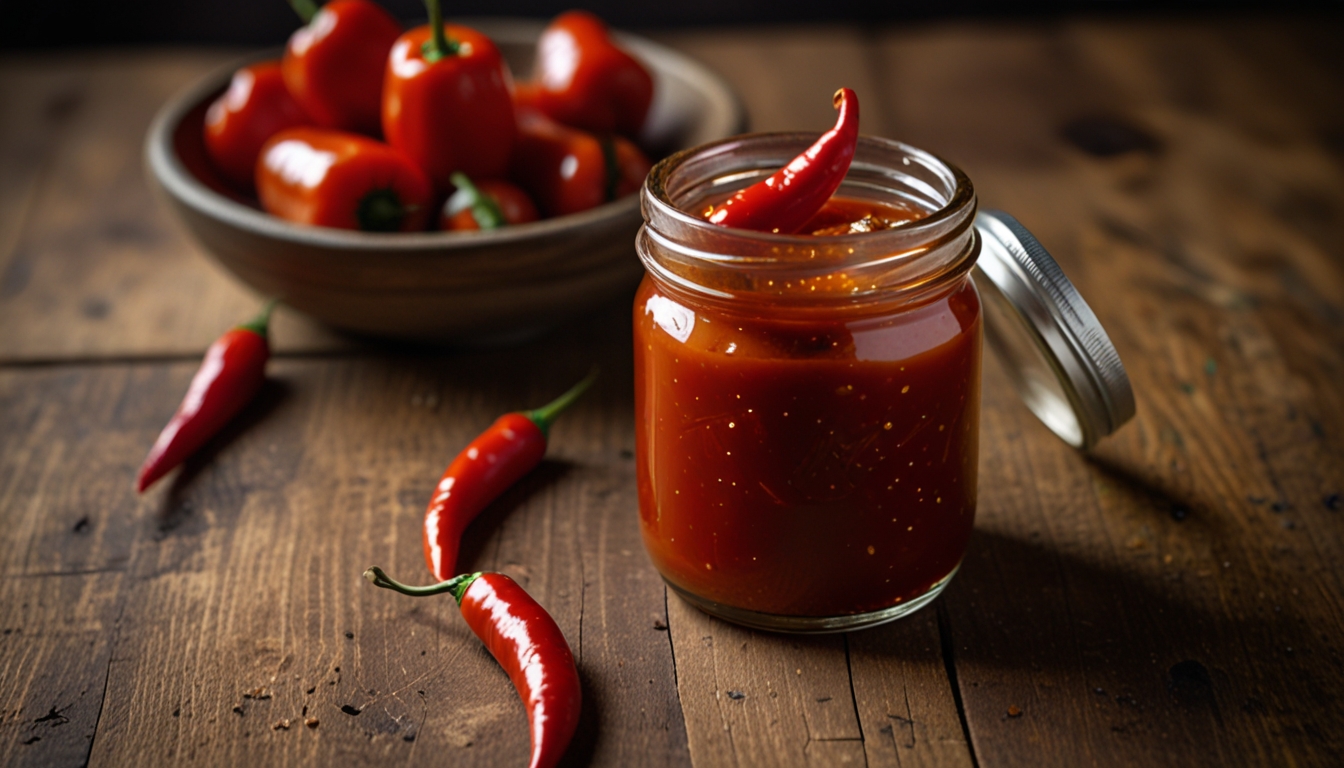
Fermented hot sauce starts as chilies in a salt brine, blended only after the ferment is done. Chopped chilies and garlic ferment for 5 to 7 days depending on kitchen warmth; the working range for vegetable ferments is 68–72°F (20–22°C).
How Salty Should the Brine Be?
Home guidance is published two ways: as a weight of salt per quart of water, or as a percentage. The conversions run as follows, and the general wet-brine range for vegetables is 1 to 3 tablespoons of salt per quart of water, going up to 5 tablespoons for cucumbers, onions and radishes.
| Brine | Salt per quart (1 L) water |
|---|---|
| 3 percent | 2 tbsp (1 oz / 27 g) |
| 5 percent | 3 tbsp (1.6 oz / 45 g) |
| General vegetable range | 1 to 3 tbsp |
Oregon State Extension’s fermented hot sauce takes a different route: rather than a separate brine, it salts the chilies directly, using 6 tablespoons of kosher salt for 2 pounds of seeded, coarsely chopped red chilies such as Fresno, cherry peppers or Hungarian wax, plus 4 smashed garlic cloves. The chilies release their own liquid. Our salt and brine calculator converts either approach to whatever jar you have.
What You’ll Need
- 1 lb fresh red chilies (any variety, stems removed)
- 3-4 garlic cloves
- 2 cups water + 1 tbsp fine sea salt (2% brine)
- 1 tbsp white vinegar (added after fermenting, for tang and shelf life)
- A clean 1-quart jar (paid link)a fermentation weight (paid link)and a blender
Chili choice drives everything downstream. Mixing a mild bulk pepper with a small proportion of a hot one gives a sauce you can actually finish — the Fresno, cherry and Hungarian wax peppers in this recipe sit at the moderate end deliberately.
Step-by-Step
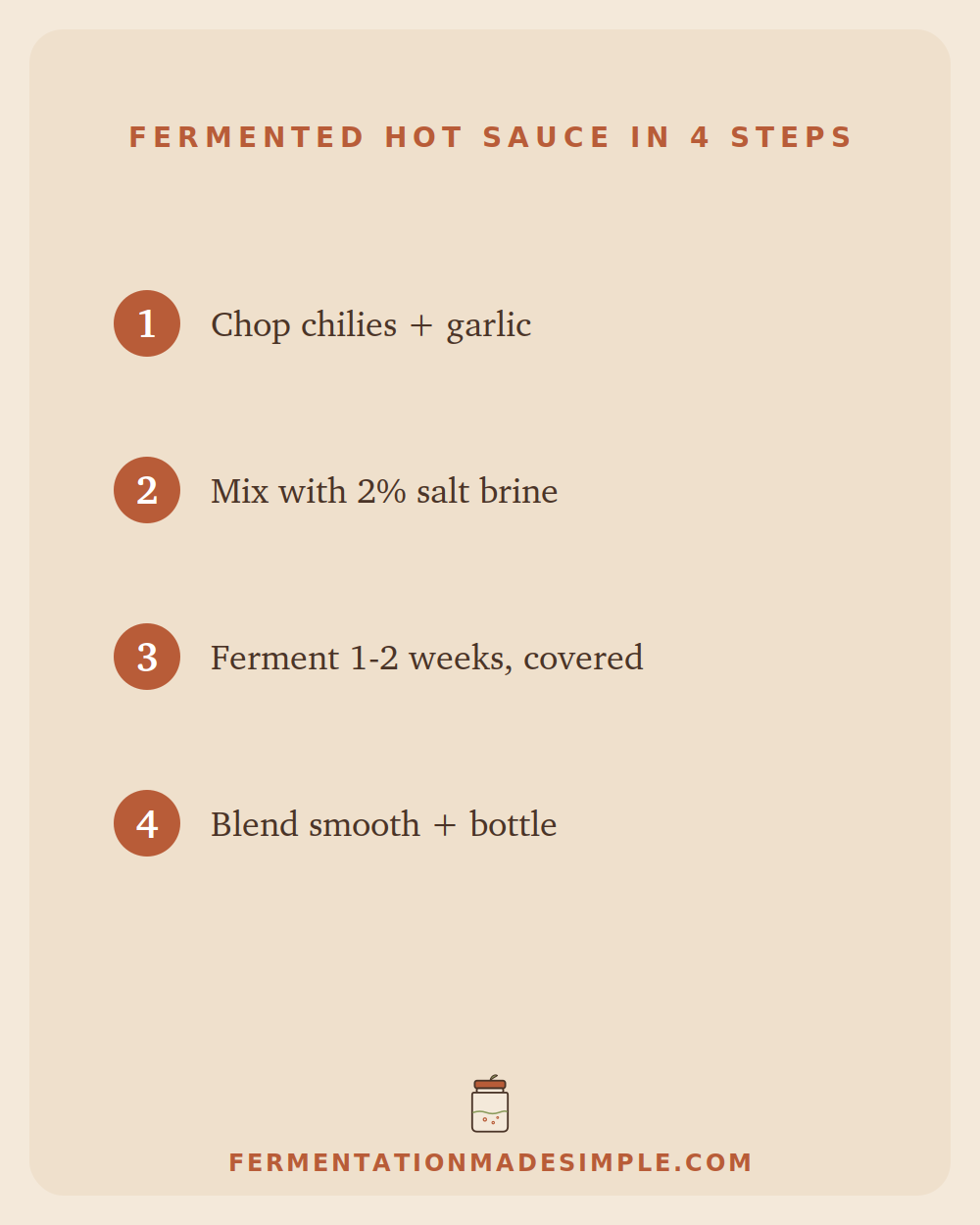
- Chop. Roughly chop the chilies and garlic.
- Brine. Dissolve the salt in water to make the brine.
- Pack and submerge. Pack chilies and garlic into the jar, cover with brine, and weigh everything down.
- Ferment. Cover loosely and ferment 1-2 weeks at room temperature, away from direct sun.
- Blend. Blend the chilies with a splash of the brine and the vinegar until smooth. Adjust consistency with more brine as needed.
Keeping the chilies under the liquid is the part people get wrong. Keep vegetables 1 to 2 inches below the surface of the brine; the same requirement is also given as 3 cm or more of brine above the solids, with a weight to prevent floating. Chili pieces are buoyant, so a weight earns its keep here.
How Long Should Chilies Ferment?
Shorter than most vegetable ferments. The chilies take 5 to 7 days, explicitly depending on how warm the kitchen is, then a few more days after the sugar and vinegar go in. That is well short of the 3 to 4 weeks quoted for a full cabbage or cucumber ferment, because a chopped, salted mash acidifies faster than whole vegetables in brine.
| Temperature | What happens |
|---|---|
| Below 60°F (16°C) | Fermentation is inhibited |
| 68–72°F (20–22°C) | The working range |
| Above 78°F (26°C) | Over-fermentation |
| Above 77°F (25°C) | May result in spoilage |
Minnesota Extension describes a finished vegetable ferment as one where bubbling has stopped and the pH has reached 4.60 or lower; 4.6 is the standard endpoint for fermented vegetables generally. If you own a pH meter, that is the number to watch. If you do not, watch the bubbling and taste.
What Is Actually Happening in the Jar?
Vegetable fermentation is a relay rather than one organism doing all the work. The gas-producing Leuconostoc mesenteroides acts first, which is where the early bubbling comes from. As acidity climbs it hands over to more acid-tolerant lactobacilli, Lactobacillus plantarum among them, which produce mostly lactic acid and little gas. The desirable band is 18 to 22°C (64–72°F), optimum around 21°C (70°F).
Does the Vinegar Go In Before or After?
After. In this method the chilies ferment on salt alone, and 3/4 cup of vinegar (apple cider or coconut vinegar are both suggested) goes in with 6 tablespoons of sugar once fermentation is underway, followed by a few more days before blending. Adding acid at the start would slow the lactic acid bacteria you are trying to encourage.
How Do You Store It?
Pour the sauce through a fine sieve into bottles and keep it refrigerated; the window is best if used within six months, and the heat mellows with age. Published guidance gives up to 9 months refrigerated for fermented vegetables generally, and notes freezing keeps them indefinitely at the cost of texture — less of a concern for a blended sauce.
This article summarizes published guidance on fermenting chilies. It is not an assessment of any particular batch. If a ferment looks, smells, or tastes wrong to you — fuzzy growth, an off odour, anything you are unsure about — discard it.
FAQ
How long does fermented hot sauce take?
Allow 5 to 7 days for the chilies, depending on how warm your kitchen is, plus a few more days after the sugar and vinegar are added. Warmer rooms run faster; below 60°F (16°C) fermentation is inhibited altogether.
Can I ferment the chilies whole?
The recipe seeds and coarsely chops them first, which is what lets the salt draw liquid out and speeds the whole thing up. Whole chilies in a separate brine work too, but they ferment more slowly and less evenly, closer to the cucumber timeline.
How do I know when it is finished?
Minnesota Extension describes a finished ferment as one where bubbling has stopped and the pH has dropped to 4.60 or lower; the same endpoint applies to fermented vegetables generally. Without a meter, the practical markers are that the bubbling has slowed to nothing and the flavour has stopped changing day to day.
Do I need to wear gloves?
Worth doing with anything hotter than a jalapeño. Capsaicin transfers readily from fingers to eyes and lips and does not rinse off with water alone. Blending hot chilies also throws aerosol into the air, so open a window and keep your face away from the blender lid.
Sources: Oregon State Extension, Fermented Hot Sauce · Illinois Extension, Fermenting · Minnesota Extension, Fermentation · NC State Extension, Lactic Acid Fermentation
Related: Simple Fermented Chili Paste · Salt & Brine Calculator · Fermentation Temperature Guide · Kahm Yeast vs Mold