
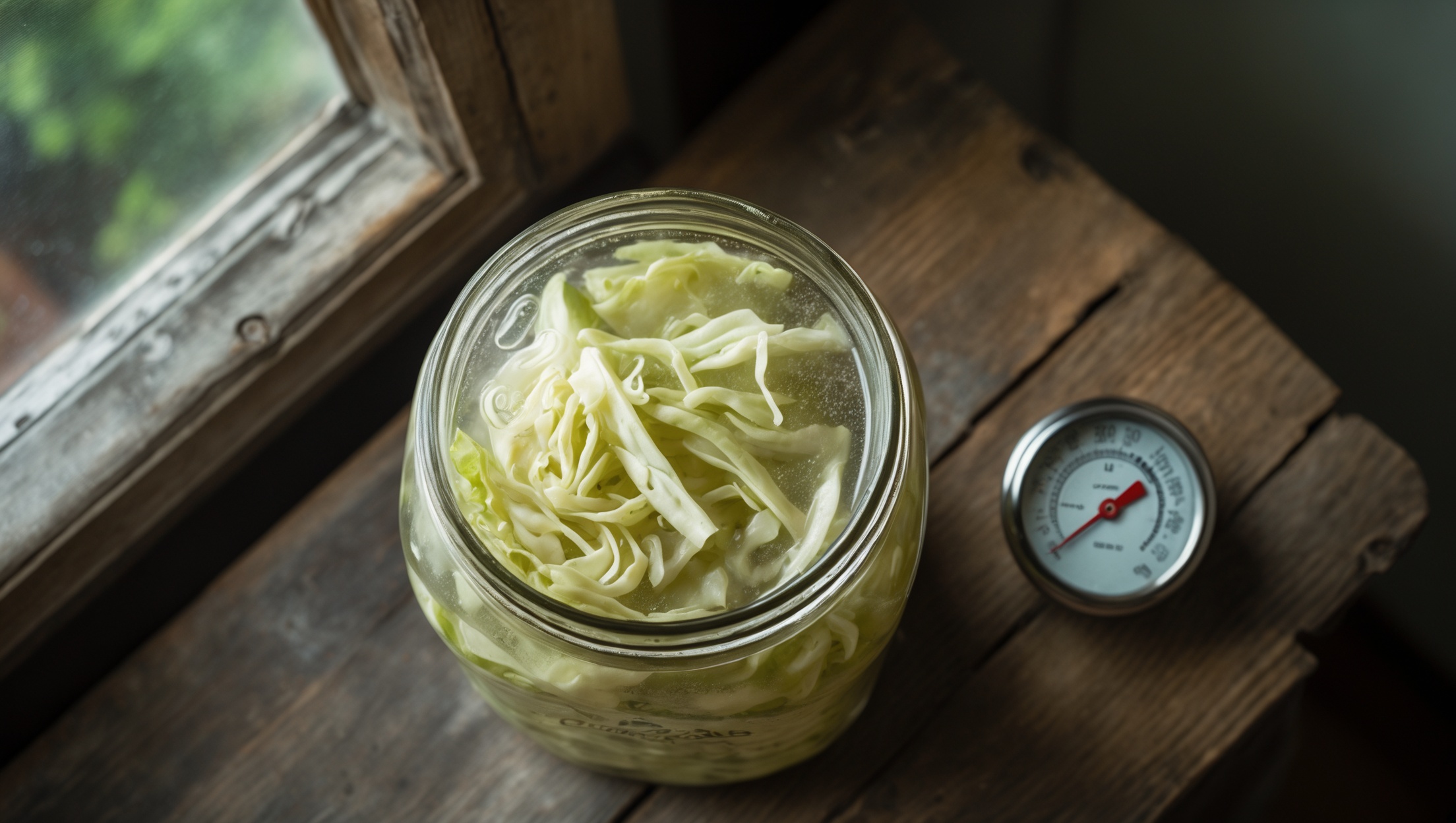
Vegetables ferment best between 60–75°F (15–24°C), with 68–72°F (20–22°C) as the sweet spot for flavor and texture. Below 60°F, fermentation slows to a crawl or stalls. Above 80°F, kraut and pickles turn soft fast and spoilage bacteria get a real shot at competing with the lactic acid bacteria that are supposed to win.
What Is the Ideal Fermentation Temperature for Vegetables?
The ideal fermentation temperature for vegetables is 68–72°F (20–22°C), the range where lactic acid bacteria grow fastest without sacrificing texture or flavor.
NC State Extension puts the optimum even narrower: 18–22°C (64–72°F) for Leuconostoc mesenteroides, the bacteria that kicks off almost every vegetable ferment. Leuconostoc mesenteroides is a lactic acid bacterium naturally present on raw vegetables; it tolerates salt, thrives in the first few days of fermentation, and produces the mild acidity and carbon dioxide that push oxygen out of the jar before other, more acid-tolerant bacteria take over. Virginia Tech Cooperative Extension frames the same range slightly wider — 68–72°F as ideal, 60–78°F as acceptable — and Penn State Extension recommends 70–75°F for a fermentation that finishes in three to four weeks.
All three land in the same neighborhood for a reason: this is the temperature band where L. mesenteroides hands off cleanly to the more acid-producing Lactobacillus plantarum, the bacterium responsible for most of the final sourness. Stray far outside 60–75°F and that hand-off gets messy. For the full mechanics of how salt and these bacteria turn vegetables sour in the first place, see What Is Lacto-Fermentation? A Simple Explanation.
What Happens When It’s Too Cold?
Below 60°F, vegetable fermentation slows dramatically and can stall out completely; between 55–65°F, Penn State Extension reports fermentation takes five to six weeks instead of three to four.
A cold ferment isn’t a failed one. Slower fermentation at 55–65°F generally produces a firmer, crunchier product with a more complex, rounded sourness, because the bacterial succession has more time to run its full course. Root cellars and basements that sit naturally in this range are why traditional sauerkraut in cooler climates often tastes better than a batch rushed on a warm kitchen counter. The trade-off is patience: check for the sour smell and taste you expect at week three, and if it’s still mild, give it another one to three weeks rather than assuming something went wrong.
Below roughly 50–55°F, activity slows so much that a ferment can sit for months with barely any change. A refrigerator at around 38–40°F effectively pauses fermentation — useful once a batch has reached the sourness you want, not useful while you’re trying to start one.
What Happens When It’s Too Warm?
Above 75°F, sauerkraut and pickles can turn soft; above 80°F, Penn State Extension warns that pickles become too soft to enjoy and the odds shift toward spoilage bacteria outcompeting the lactic acid bacteria.
Heat speeds everything up, including the parts you don’t want sped up. A ferment held above 80°F can finish souring in as little as one to two weeks, but the pectin in the vegetable cell walls breaks down faster than the fermentation acidifies, so the texture goes mushy before the flavor catches up. Warm conditions also favor yeasts and less desirable bacteria that produce off, sometimes sulfurous or yeasty flavors instead of clean sourness.
A ferment sitting above 80°F for several days is more likely to develop surface mold or an off, spoiled smell before it fully acidifies. If you see fuzzy mold (not the harmless white film called kahm yeast), smell something rotten instead of sour, or the vegetables have turned slimy or discolored, throw the batch out. When in doubt, don’t taste it.
Does Every Vegetable Ferment at the Same Temperature?
Yes — sauerkraut, kimchi, pickles, and most other vegetable lacto-ferments share the same 60–75°F core range, because they rely on the same lactic acid bacteria succession.
What changes between vegetables is speed, not the ideal range itself. Dense, low-surface-area vegetables like whole cucumbers or beet chunks can take a few days longer than shredded cabbage at the same temperature, simply because brine and bacteria need more time to penetrate. Kimchi recipes often list a shorter, cooler first ferment (a day or two at room temperature, then refrigeration) because the target is a milder, still-crunchy result rather than the fully sour endpoint of a three-week sauerkraut. For a vegetable-by-vegetable breakdown of typical fermentation windows, see How Long to Ferment Vegetables: A Simple Chart.
How Do You Keep a Steady Fermentation Temperature at Home?
The most reliable way to hold a steady fermentation temperature is to pick one consistent, out-of-the-way spot — away from stoves, windows, and direct sun — and check it with a simple room thermometer for the first few days.
A kitchen counter near a window or oven can swing 10°F or more between morning and afternoon, which is worse for consistency than a slightly cooler but stable spot. Interior closets, cabinets away from appliances, and basements are usually the most stable options in a home. In hot climates or during summer, an unused wine fridge or a small fermentation-specific cooler set to 68–70°F solves the problem outright; in cold climates, moving the jar to a warmer interior room (not a drafty spot near an exterior wall) usually closes the gap.
The single biggest temperature mistake I see isn’t picking the wrong number — it’s picking a spot that swings. A jar that bounces between 65°F overnight and 78°F by mid-afternoon ferments less predictably than one held steady at a flat 74°F all day. My own kimchi batches go on a low shelf in an interior hallway closet, not the kitchen counter, specifically because that spot barely moves more than 2–3°F over 24 hours. Consistency beats chasing the “perfect” number.
Fermentation Temperature Chart
| Temperature | Typical Time to Finish | What to Expect |
|---|---|---|
| Below 60°F (15°C) | Very slow, may stall | Minimal souring; move somewhere warmer if nothing happens after 1–2 weeks |
| 60–65°F (15–18°C) | 5–6 weeks | Firm texture, well-rounded flavor; classic slow sauerkraut |
| 68–72°F (20–22°C) | 3–4 weeks | The recommended target for most home recipes; balanced speed and quality |
| 70–75°F (21–24°C) | 3–4 weeks, faster end | Still good quality; check a few days earlier than at 68–72°F |
| Above 80°F (27°C) | 1–2 weeks | Fast, but higher risk of soft texture, off flavors, and spoilage — not recommended |
For the right salt-to-water ratio to pair with whatever temperature you’re working at, the Fermentation Salt & Brine Calculator works out the brine strength for your jar size. And if fermentation stalls even inside the right temperature range, the first thing to check is usually the salt — see Why Isn’t My Sauerkraut Sour? for the other common causes.
Frequently Asked Questions
Can I ferment vegetables in the refrigerator?
No, not to start. Refrigerator temperatures (roughly 38–40°F) are far below the 60°F floor lactic acid bacteria need to get going. Start fermentation at room temperature and move the jar to the fridge only once it has reached the sourness you want, to slow things down for storage.
Is normal room temperature good enough?
Most homes sit between 68–72°F, which is exactly the ideal range. The exception is a kitchen that runs warmer near appliances or gets direct afternoon sun — check with a thermometer rather than assuming “room temperature” automatically means 70°F.
Does a warmer ferment mean it’s unsafe?
Not automatically, but it raises the risk. A properly salted ferment (2–2.5% salt by weight) held above 80°F for a short time isn’t guaranteed to spoil, but the odds of soft texture, off flavors, or visible spoilage go up the longer it stays that warm. If it smells sour and looks normal, it’s fine; if it smells rotten or grows fuzzy mold, discard it.
What if my kitchen doesn’t have a stable spot?
Interior closets, cabinets away from appliances, and basements are the most common fixes. A dedicated small cooler or an old wine fridge set to 68–70°F is the most reliable option if no room in the house stays consistently in range.
Sources
- NC State Extension – “Lactic Acid Fermentation” (content.ces.ncsu.edu): optimum 18–22°C (64–72°F) for Leuconostoc mesenteroides growth.
- Virginia Tech Cooperative Extension – “Vegetable Fermentation,” VCE Publication FST-328: 68–72°F ideal, 60–78°F acceptable range, softening above 75°F.
- Penn State Extension – “Let’s Preserve: Fermentation – Sauerkraut and Pickles”: 70–75°F for 3–4 weeks, 55–65°F for 5–6 weeks, avoid above 80°F.
- Sandor Ellix Katz, The Art of Fermentation: general reference on temperature’s role in bacterial succession during vegetable fermentation.