
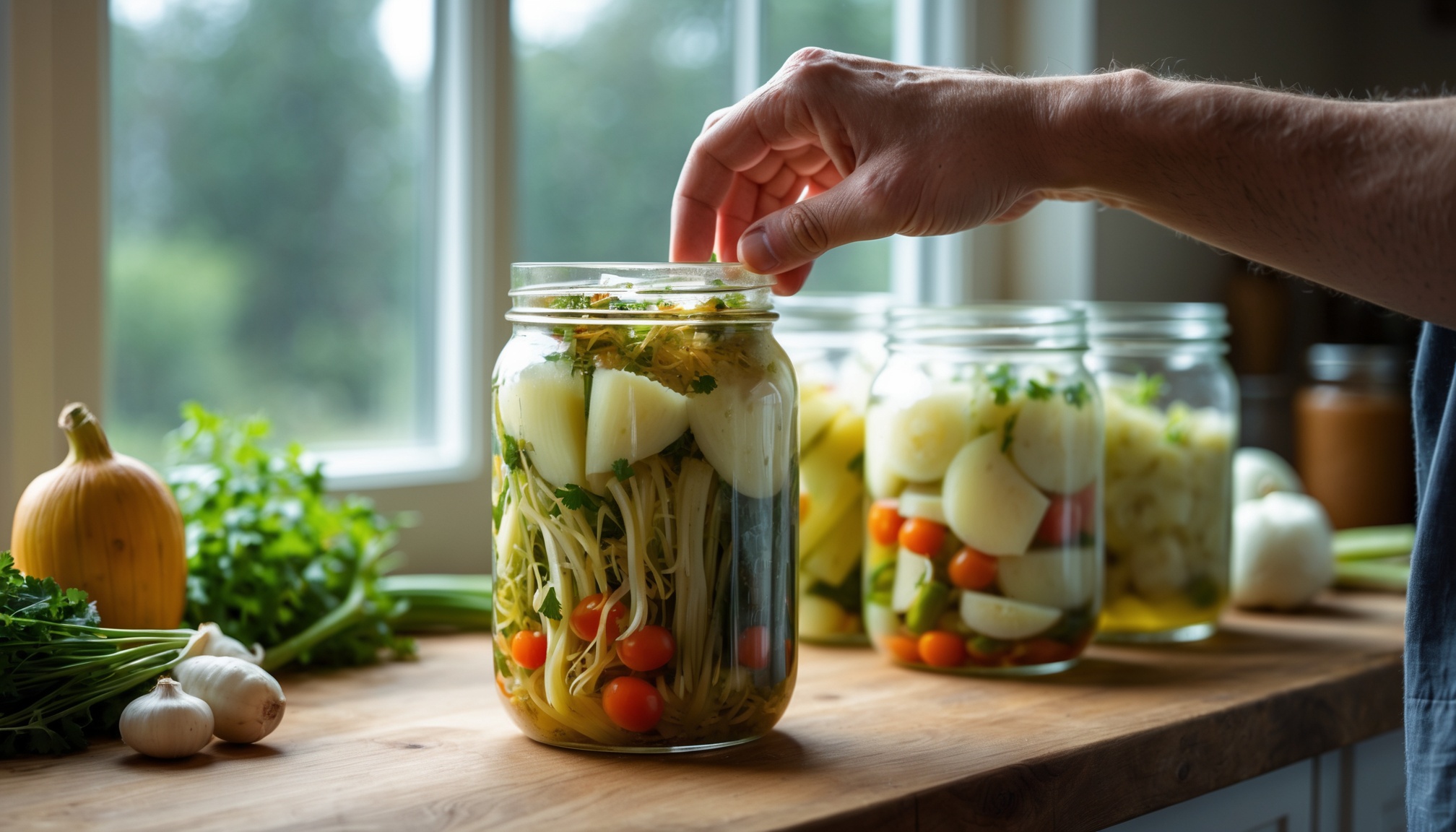
A ferment that has gone wrong shows fuzzy raised mould, a slimy or ropy texture, or a putrid smell rather than a sour one. Cloudy brine, a flat white film, strong tang and softening are all normal. The clearest structural warning sign is a batch whose acidity never developed — BCCDC treats a fermentation that has not reached pH 4.6 within one week as a failed fermentation.
The Three-Point Check
Work through sight, smell, then texture, in that order. Most doubtful jars resolve at the first step.
| Normal | Discard the batch | |
|---|---|---|
| Sight | Cloudy brine, sediment, a flat white film, colour fading toward pale or olive | Fuzzy growth raised off the surface in any colour — blue, green, black, pink, or white and three-dimensional |
| Smell | Sharp, sour, vinegary, yeasty, pungent in the case of kimchi | Putrid, rotten, cheesy in a way that does not belong, or reminiscent of decay |
| Texture | Softer than raw, gradually losing crunch | Slimy or ropy strands in the brine, mush that falls apart, or a coating that clings to a fork |
The Difference That Trips Everyone Up
Kahm yeast versus mould is the single most common false alarm in home fermentation. Kahm yeast forms a flat, thin, wrinkled film that sits on the surface of the brine like a skin. It is unattractive and can push the flavour yeasty, but it is not mould. Mould grows upward, with visible fuzz and structure, and usually appears in patches rather than as an even sheet.
The BC Centre for Disease Control notes that mould appears readily on surfaces where vegetables are not submerged, which is why the fix and the prevention are the same thing: keep everything under the brine. Our side-by-side comparison in kahm yeast versus mould covers what each looks like up close.
The Warning Sign Most Guides Skip
A batch can look and smell unremarkable and still have failed, because the thing that makes fermentation work is acidity, and acidity is invisible. BCCDC sets out concrete expectations:
- pH 4.6 is the critical threshold for fermented vegetables.
- That drop should happen within 48 hours at room temperature, or within 4 days under refrigeration.
- If pH has not dropped to 4.6 within one week, the document says to consider it a failed fermentation.
- For unpasteurized products held refrigerated, the more stringent target is below pH 4.4.
In a home kitchen you will not usually be measuring this, and the practical proxies are the ones you already use: is it bubbling, is the brine turning cloudy, is it tasting sour by day three? A jar that sits inert for a week with no bubbling and no tang has not started. That is a more meaningful signal than any amount of staring at the surface.
The most common reason is simply temperature. BCCDC describes room-temperature vegetable fermentations at 20–22°C, and NCHFP notes that below 60°F (about 15°C) sauerkraut may not ferment at all. A cold kitchen stalls a batch rather than souring it.
What Is Normal and Alarms People Anyway
- Cloudy brine. Expected during active fermentation. BCCDC notes brine that is cloudy early on typically clears by around week four.
- White sediment at the bottom. Settled bacterial matter, normal.
- Vigorous bubbling and a hissing lid. Carbon dioxide from the early fermentation phase.
- A strong smell on opening. Pungent is not the same as putrid. Sour and sharp belong; decay does not.
- Colour change. Bright cabbage fading to pale, red cabbage going vivid pink, garlic turning blue or green. All documented and cosmetic.
When in Doubt, Throw It Out
This is worth stating plainly rather than hedging. A jar of vegetables costs very little. If something about a batch bothers you and this page has not resolved it, the sensible move is to discard it and start again with a fresh batch that you watch from day one.
This article summarises published guidance on distinguishing normal fermentation from spoilage. It is not an assessment of any particular batch, and it is not a substitute for advice from a food-safety authority. If a ferment looks, smells, or tastes wrong to you, discard it.
FAQ
How can I tell if fermented pickles have gone bad?
Same three-point check. Fuzzy raised growth, slimy brine, or a putrid smell mean discard. Cloudy brine and softening cucumbers are ordinary. Hollow or mushy pickles usually point to a fermentation that ran warm rather than to spoilage.
Does a strong smell always mean spoilage?
No. Sour, sharp, vinegary and yeasty all belong to healthy fermentation, and kimchi in particular is strongly pungent by design. The distinction is between sour and rotten, not between mild and strong.
Can I scrape mould off and keep the rest?
Published home-preservation guidance says no for fermenting vegetables in brine. What is visible on the surface is not the full extent of the growth, and the liquid distributes it.
My ferment never bubbled. Is it ruined?
It may simply be too cold rather than ruined. Below roughly 15°C, fermentation can stall. Move the jar somewhere in the 20–22°C range and give it a few more days. If a week passes with no bubbling, no cloudiness and no tang, BCCDC’s one-week benchmark suggests starting over.
Sources: BC Centre for Disease Control, Fermented Vegetables Guidance · National Center for Home Food Preservation, General Information on Fermenting
Related: Kahm Yeast vs. Mould · Fermented Food Safety Guide · Mould on My Ferment · Cloudy Brine