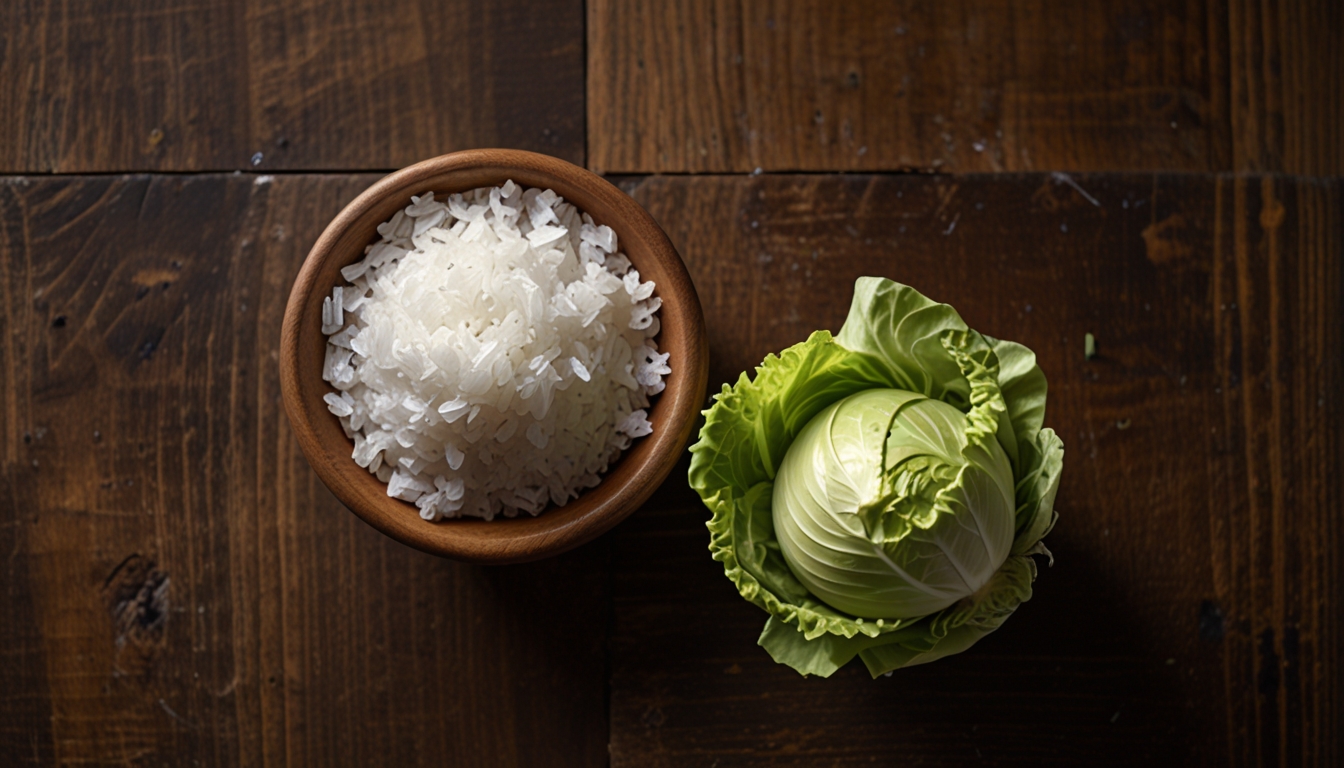
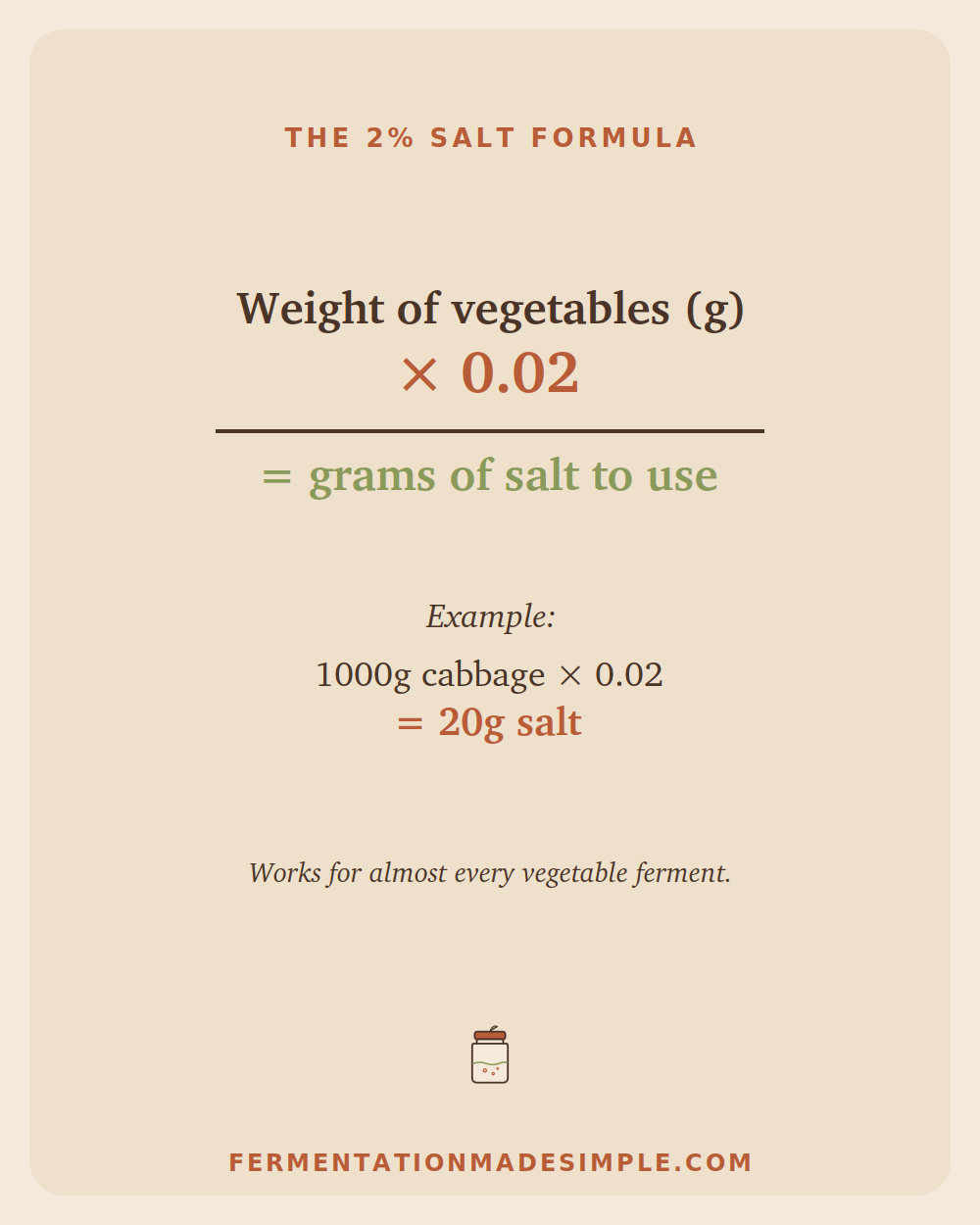
Weigh the vegetables, multiply by 0.02, use that many grams of salt. Two percent is the working default for home vegetable ferments, and it sits inside the band the BC Centre for Disease Control gives for cabbage — 1 to 3 percent, with 2.25 percent listed as optimal. Everything else on this page is a variation on that one calculation.
The Formula
1,000g of shredded cabbage × 0.02 = 20g of salt. That is the whole thing. The percentage is salt as a share of the vegetable weight — the convention nearly every home recipe uses, ours included.
NCHFP’s sauerkraut recipe reaches the same place by another route: 3/4 cup of canning or pickling salt to 25 lbs of cabbage, about 3 tablespoons per 5 pounds. BCCDC gives 1 to 3 percent, 2.25 percent optimal. Two percent sits comfortably inside both and is easy to remember.
Why Weight, Not Volume?
Because a tablespoon is a measure of space and salt crystals differ wildly in how much of that space they fill. NCHFP is explicit about the consequence: “flake salt varies in density, it is not recommended for making pickled and fermented foods.” The same document says to use canning or pickling salt, because “noncaking material added to other salts may make the brine cloudy.”
A tablespoon of salt can vary quite a bit depending on the type — fine table salt packs differently than coarse sea salt. Weighing removes that guesswork entirely, which is why a basic digital kitchen scale (paid link) is one of the few tools genuinely worth having for fermenting regularly.
Weighing sidesteps density entirely: 20g is 20g, whatever the crystal size.
Does the Ratio Change by Vegetable?
Substantially, once you leave cabbage behind. BCCDC’s Table 3, “Examples of LAB salt/brine concentrations and processes for vegetable fermentations,” sets out how far apart different vegetables sit:
| Vegetable | Salt / brine concentration | Notes from the same table |
|---|---|---|
| Cabbage (sauerkraut) | 1 to 3%, 2.25% optimal | — |
| Carrots | 5% | Lye wash and added starter culture |
| Cucumbers (pickles) | 3 to 15%, depending on variety | Brine-fermented two to three weeks, then de-salted |
| Pickled garlic | 8% | Blanched, inoculated, seven days, pasteurised |
| Olives (green Spanish-style) | 10 to 12% | Lye wash; fermented two to twelve months |
| Peppers (Mexican style) | 18 to 20% | A further 1% salt weekly; 4 to 6 weeks |
Source: BC Centre for Disease Control, Fermented Foods Guidance 3.1: Fermented Vegetables, Table 3.
Salt by Vegetable Weight vs Salt by Brine Weight
This is where most ratios go wrong. The two measurements answer different questions:
| Salt by vegetable weight | Salt by brine weight | |
|---|---|---|
| What you weigh | The vegetables | The water |
| Typical phrasing | “2% salt” | “a 5% brine” |
| Used for | Dry-salted ferments | Whole vegetables under liquid |
| Worked example | 1,000g cabbage → 20g salt | 1,000g water → 50g salt |
The trap: a 5 percent brine does not give you a jar that is 5 percent salt. The vegetables in it are mostly water, and that water joins the system. BCCDC states the mechanism plainly — “as fluids are released from cells, the percentage of salt decreases in the fermentation.”
So a jar packed with cucumbers and topped with a 5 percent brine equilibrates downward over the following days, toward something closer to the 2 percent band. That is by design — and it is why a “5%” in a brine recipe and a “2%” in a kraut recipe do not contradict each other. They have different denominators.
If you want the arithmetic done for you, our salt and brine calculator handles both directions.
Dry-Salting or Brine: Which Method for Which Vegetable?
- Dry-salt anything shredded or finely sliced — cabbage for sauerkraut, kimchi vegetables, grated carrot. The salt pulls liquid out and the vegetables make their own brine.
- Use a brine for anything whole or chunky — cucumbers, beans, cauliflower, garlic cloves. Too little exposed surface for dry salt to draw out enough liquid.
NCHFP’s fermented dill pickles give a concrete brine: 1/2 cup salt, 8 cups water and 1/4 cup of 5 percent vinegar, over 4 lbs of cucumbers per gallon. Its sauerkraut recipe uses a lighter top-up brine — 1-1/2 tablespoons of salt per quart of water — when the cabbage does not release enough of its own.
Either way, everything stays under the liquid: BCCDC asks for “at least 3 cm or more of liquid brine between the fermented vegetables and the top.” Weights exist for exactly this.
What Happens If You Get It Wrong
- Too little salt: faster fermentation and softer texture. NCHFP is unusually blunt here — “do not attempt to make sauerkraut or fermented pickles by cutting back on the salt required.”
- Too much salt: fermentation slows sharply — why commercial brines at the high end of BCCDC’s 3–15 percent range need de-salting afterwards.
- Volume instead of weight: invisible until the texture is wrong. See soft pickles.
Temperature Changes What a Given Ratio Does
Salt sets the conditions; temperature sets the pace. NCHFP puts sauerkraut at 70–75°F (21–24°C) as fully fermented in 3 to 4 weeks, and at 60–65°F (16–18°C) as taking 5 to 6 weeks. BCCDC gives 20–22°C (68–72°F) as optimal for cucumbers and notes that fermentation above 25°C (77°F) may result in spoilage.
The finish line is acidity, not time: BCCDC treats pH 4.6 as the critical threshold for fermented vegetables, and below 4.4 for unpasteurised products held refrigerated. More on this in our notes on fermentation temperature.
This page summarises published guidance on salt concentrations in vegetable fermentation. It is not an assessment of any particular jar. If a ferment looks, smells or tastes wrong to you, discard it.
FAQ
Is 2 percent salt by vegetable weight or by total weight?
By vegetable weight. Weigh the prepared vegetables alone, before any added water, and take 2 percent of that figure. If a recipe instead specifies a brine percentage, that number is measured against the water.
Why do commercial pickle brines use so much more salt than 2 percent?
Because they measure against the brine, not the vegetables, and include steps a home jar does not. BCCDC lists cucumbers at 3 to 15 percent and notes that de-salting follows fermentation, the brine being too concentrated for consumption as-is.
Can I use table salt instead of pickling salt?
NCHFP recommends canning or pickling salt, noting that non-caking agents in other salts may make the brine cloudy. Flake salt is specifically not recommended: its density varies too much for volume measures to be consistent.
Can I reduce the salt to make a lower-sodium ferment?
NCHFP’s guidance is not to: “do not attempt to make sauerkraut or fermented pickles by cutting back on the salt required.” Salt in these recipes is doing structural work on texture and on which organisms dominate, not seasoning.
Sources: BC Centre for Disease Control, Fermented Foods Guidance 3.1: Fermented Vegetables · NCHFP, General Information on Fermenting · NCHFP, Sauerkraut · NCHFP, Fermented Dill Pickles
Related: Fermentation for Beginners · Sauerkraut for Beginners · Jars and Weights · Salt and Brine Calculator