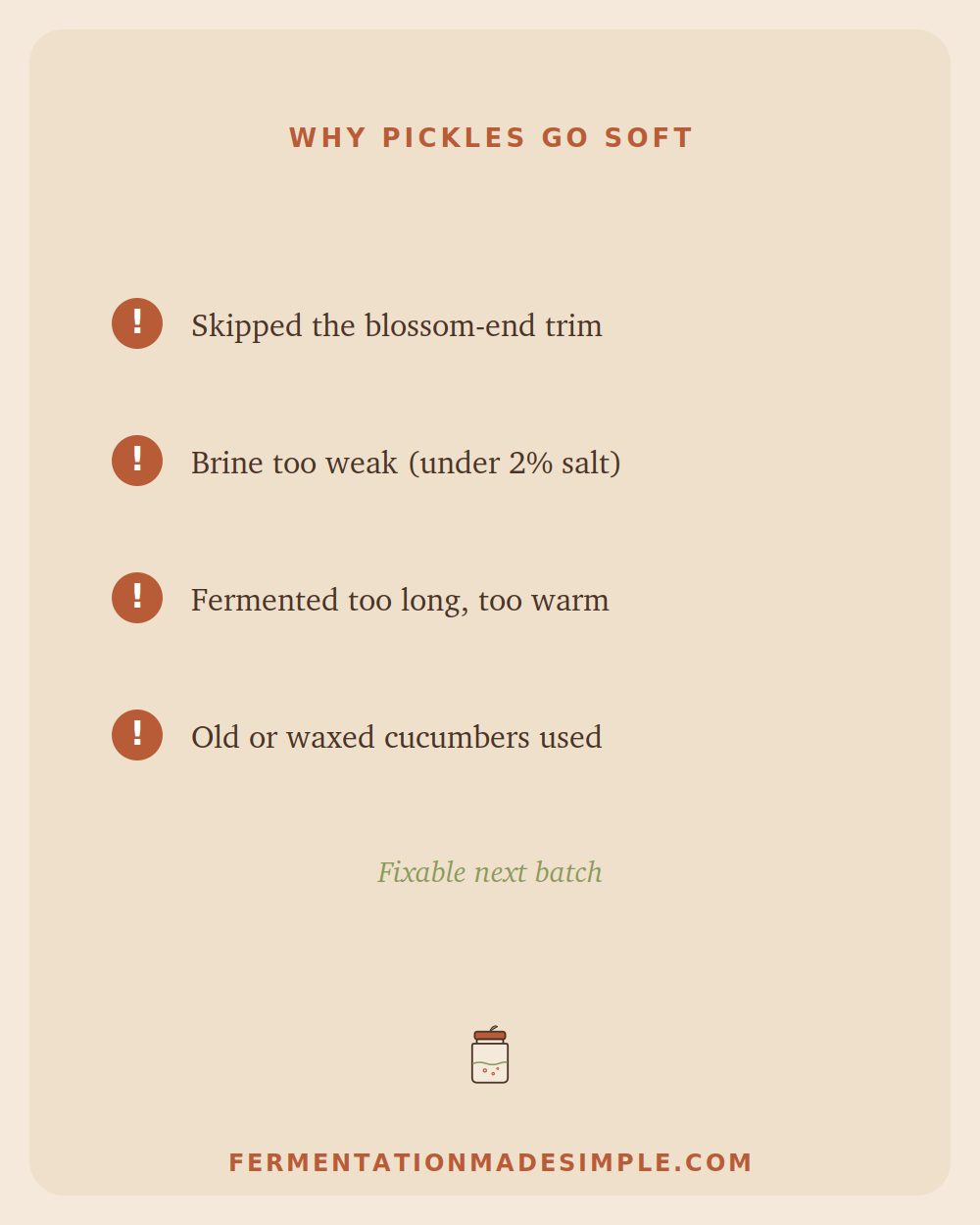
Four causes account for nearly every soft fermented pickle: the blossom end was left on, the brine was too weak, the jar fermented too warm, or the cucumbers sat too long before brining. Enzymes from the blossom cause softening, and fermentation above 75°F is listed among the culprits. None of it is fixable after the fact, but all of it is preventable.
What Actually Makes Fermented Pickles Go Soft?
Softening is enzymatic and starts early. Pectin holds a cucumber’s cell walls rigid; enzymes break pectin down. Some ride in on the cucumber itself, concentrated at the blossom end. Others come from surface yeasts and molds that establish themselves when the brine is weak, warm, or open to air.
| Cause | What to do next batch |
|---|---|
| Blossom end left on | Slice at least 1/16 inch off the blossom end and discard |
| Brine too weak | Use 3–15% for cucumbers depending on variety |
| Too warm | Store cucumbers between 70 and 75°F (21–24°C) |
| Not enough brine | At least 3 cm (1¼ in) of brine above |
| Scum left on the surface | Skim as it appears |
| Delay before brining | Ferment the day you buy or pick |
| Moldy spices or garlic | Always use fresh spices |
One figure in that literature needs context. NC State lists brine below 10 to 12 percent salt as a soft-pickle cause, but that number belongs to the traditional long-brine cure for salt-stock pickles, not the short fermentation most home cooks run. For a fermented dill, BCCDC’s 3 to 15 percent by cucumber variety is the relevant reference, and most home recipes sit at the low end of it.
Why Does the Blossom End Matter So Much?
Because it is the one cause a knife eliminates completely. The blossom end is opposite the stem scar; on a cucumber with no stem attached, it is usually the paler, more rounded end. The published instruction is specific: slice at least 1/16 inch off that end and discard it, a step credited with inhibiting the enzymes that make pickles soft. If you cannot tell the ends apart, trim both.
What You’ll Need for a Crisper Batch
A classic fix: add a couple of grape leaves (paid link) to the jar. Their natural tannins help slow the enzyme that softens cucumbers, a trick pickle-makers have used for generations.
Beyond that the kit is short: a jar tall enough to leave brine above the cucumbers, a weight that holds them under, a scale for salt, and small, freshly picked pickling cucumbers. Smaller cucumbers are the recommendation for brining anyway, since oversized ones are also listed as a hollow-pickle cause.
Does Temperature Really Change the Texture?
Substantially. Fermentation above 75°F (24°C) is named as a cause of both soft and hollow pickles. The same point turns up on the kraut side: optimal is 70–75°F (21–23°C), and above 80°F (26°C) kraut may become soft and spoil.
The practical reading: a cooler, slower ferment is the texture-friendly one. The working band for cucumbers is 20–22°C (68–72°F) over roughly 3 to 4 weeks, with anything above 25°C (77°F) flagged as a spoilage risk.
Can You Rescue a Batch That Is Already Soft?
No. Pectin breakdown is not reversible, and nothing added later re-firms the cell walls. Soft pickles still work chopped into relish, which is the published suggestion for hollow cucumbers.
Be careful about what softness signals, though. NCHFP attaches a direct instruction to its soft-or-slippery entry: if spoilage is evident, do not eat. Penn State goes further for fermented pickles — if the pickles become soft, slimy or develop a disagreeable odor, discard them. Softness alone is a texture defect; softness with sliminess, an off odor or surface growth is treated differently. Our kahm yeast vs. mold guide covers what surface growth looks like.
What Does a Crisp Batch Look Like Going In?
- Cucumbers brined within 24 hours of picking — the published cut-off, cited for soft, hollow and shriveled pickles alike.
- 1/16 inch trimmed off the blossom end of every cucumber.
- Salt weighed, not scooped, using canning or pickling salt. Additive-free salt is the recommendation, and iodized salt may slow fermentation.
- Everything submerged under a weight, at a stable 70–75°F (21–24°C), away from windows and appliances.
- Tasting from day three and refrigerating once the flavor is where you want it.
Our fermented pickles recipe walks through the full method, and the beginner’s guide covers salt ratios and submersion in general terms.
This article summarizes published extension guidance on pickle texture defects. It is not an assessment of any particular jar, and nothing here can tell you what is in yours. If a batch looks, smells or tastes wrong to you, discard it.
FAQ
Do grape or oak leaves actually keep pickles crisp?
It is a long-standing home practice attributed to the tannins in the leaves. Extension troubleshooting lists focus instead on blossom-end trimming, brine strength and temperature, and commercial firming agents such as alum or lime. Treat leaves as a supplement to the trimming step, not a replacement for it.
Why are my pickles soft only in the middle?
That pattern usually points to hollow or oversized cucumbers rather than to enzyme softening. Oversized cucumbers and delayed brining are the listed hollow-pickle causes, and hollow cucumbers tend to float during washing, which makes them easy to cull.
Does the fermentation weight affect crunch?
Indirectly but meaningfully. A weight keeps cucumbers under the brine, and too little brine, with cucumbers not immersed, is among the listed soft-pickle causes. It also limits the surface film that is tied to softening.
Should I use more salt to keep them firmer?
Only within the published range. The published figure is 3 to 15 percent for cucumbers depending on variety, but a curing brine stronger than 12 percent salt is listed as a cause of shriveled pickles — and excess salt is also named as a mold cause, since it holds back lactic acid production.
Sources: NCHFP, Causes and Possible Solutions for Problems with Fermented Pickles · Clemson HGIC, Common Pickle Problems · NC State Extension, Pickle and Pickle Product Problems · BC Centre for Disease Control, Fermented Vegetables Guidance
Related: Fermented Pickles Recipe · Kahm Yeast vs. Mold · Fermentation for Beginners