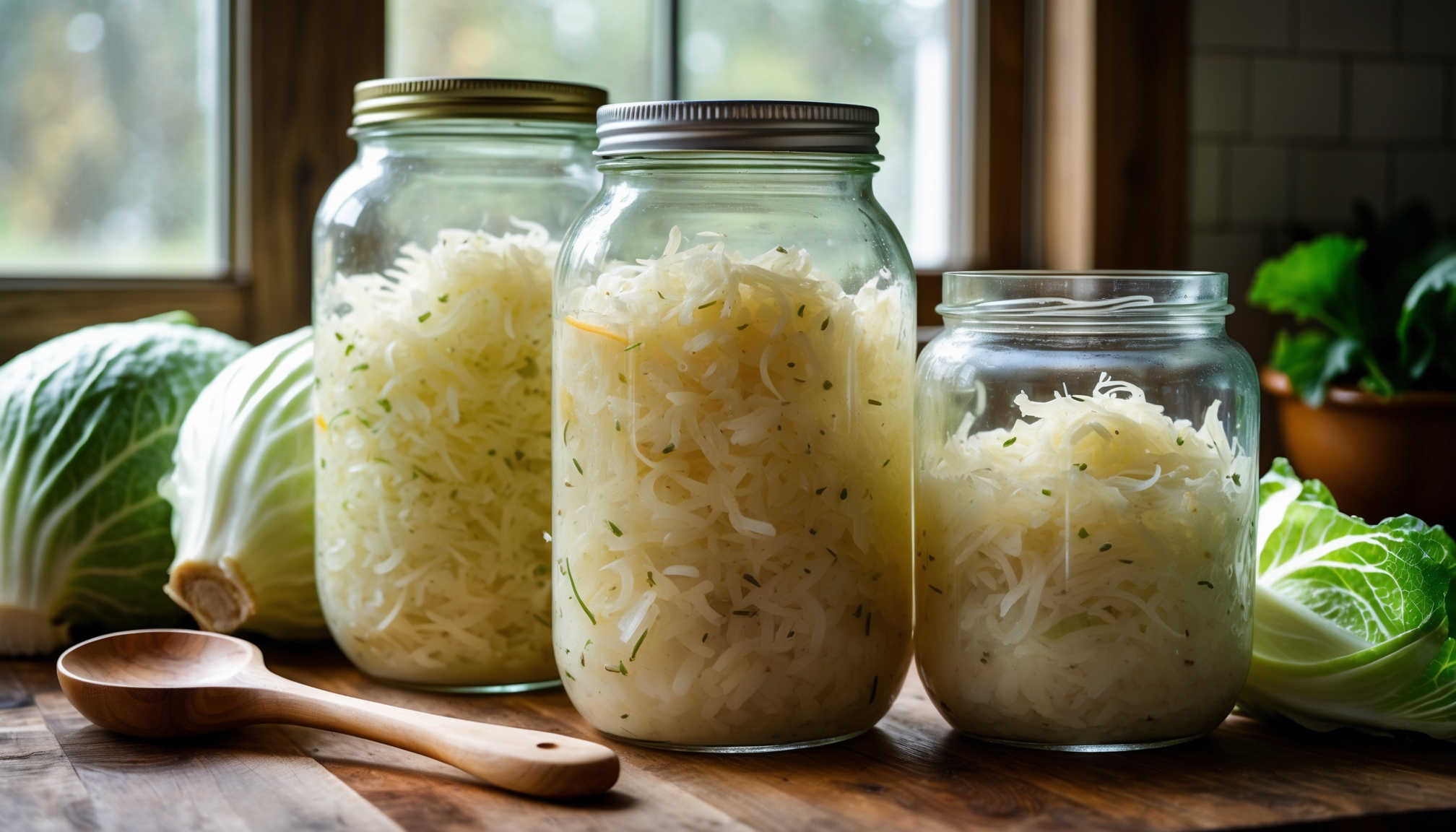
Sauerkraut takes about 3 to 4 weeks to ferment at 70–75°F (21–24°C), and 5 to 6 weeks at 60–65°F (15–18°C). Below 60°F it may not ferment at all. Temperature drives the timeline far more than jar size or cabbage variety, which is why the same recipe finishes in half the time in a warm kitchen.
How Long Does Sauerkraut Take to Ferment?
The honest answer is a range, not a number, because fermentation is driven by bacterial activity and bacteria work faster when they are warm. The National Center for Home Food Preservation publishes these temperature bands:
| Fermentation temperature | Time to fully ferment | What happens |
|---|---|---|
| Below 60°F (15°C) | May not ferment | Bacterial activity stalls; the jar can sit for weeks with little change |
| 60–65°F (15–18°C) | 5 to 6 weeks | Slow and steady; often the best texture |
| 70–75°F (21–24°C) | 3 to 4 weeks | The recommended range |
| Above 75°F (24°C) | Faster, but | Kraut may become soft |
Those figures describe a fully fermented kraut, the point where souring has essentially finished. Plenty of people stop earlier on purpose, which is where the week-by-week picture below comes in.
What to Expect Week by Week
- Days 1–3: Brine rises and turns cloudy, bubbles appear along the side of the jar. The cabbage still tastes mostly salty and raw. Gas production is at its peak here, so jars can overflow if packed to the rim.
- Days 4–7: A clear tang arrives. Texture is still crisp and the color shifts from bright to pale. Bubbling slows noticeably toward the end of the week.
- Week 2: Distinctly sour, still with bite. A common stopping point for anyone who finds long-fermented kraut too sharp.
- Weeks 3–4: The classic finished flavor at 70–75°F. Fully sour, softer, aroma settled from sharp to round.
- Beyond 4 weeks: Souring continues slowly and the texture keeps softening. Cool storage largely halts this.
Why Temperature Matters More Than Anything Else
Sauerkraut ferments in a rough succession. Leuconostoc mesenteroides dominates the opening days, producing carbon dioxide alongside lactic acid, which is where the early bubbling comes from. As acidity climbs, it gives way to more acid-tolerant species such as Lactiplantibacillus plantarum, which produce mostly lactic acid and very little gas. That second phase is the slow part, and it is the one temperature stretches or compresses.
This is also why a warm kitchen is not simply faster. Kraut goes soft above that band, because the cabbage’s own pectin-degrading enzymes stay active longer when acidity builds at a different pace than texture loss.
Does Salt Change the Timeline?
Yes, and it is the one variable worth measuring rather than eyeballing. The standard is 3 tablespoons of canning or pickling salt per 5 pounds of shredded cabbage, scaled up to 3/4 cup per 25 pounds. Both work out to roughly 2 to 2.5 percent of the cabbage weight.
More salt slows fermentation and firms the texture. Less salt speeds it up and softens it. The proportions should not be reduced, since salt concentration is part of what shapes which bacteria dominate the jar. If you want to adjust flavor, adjust fermentation time, not the salt.
How Do You Know When It Is Done?
Taste, on a schedule. Try a forkful at day 7, then weekly. Done is not a fixed chemical endpoint but the point where it tastes the way you want it. Three practical markers that the active phase has ended:
- Bubbling has stopped. No new gas rising when you tap the jar.
- The brine has cleared. Cloudiness settles once the early gas-producing phase finishes.
- The flavor stops changing week to week. The clearest signal of all.
Once it tastes right, move it to the fridge. NCHFP notes that fully fermented kraut may be kept tightly covered in the refrigerator for several months. Cold does not stop fermentation entirely, it just slows it to a crawl, so a jar you liked at week three will still be drifting slowly sourer at month two.
When the Timeline Goes Wrong
Two failure patterns account for most stalled batches. If nothing has happened after a week, the room is probably below 60°F, the band where kraut may not ferment at all. Move the jar somewhere warmer before assuming the batch failed. If the cabbage is not fully submerged, the exposed top can develop surface growth while the brine below ferments normally — our guides on not enough brine and kahm yeast versus mold cover what each looks like.
This article describes what home fermentation guidance from NCHFP and Penn State Extension says about timing. It is not a food-safety assessment of any particular batch. If a ferment looks, smells, or tastes wrong to you, discard it.
FAQ
How long does sauerkraut take to ferment at room temperature?
At 70–75°F, full fermentation takes 3 to 4 weeks. At 60–65°F it takes 5 to 6 weeks. Many people stop at week 2 for a milder result.
Can sauerkraut ferment too long?
It keeps getting more sour and softer rather than reaching a hard stop. The change is gradual, and refrigeration slows it considerably. Judge each batch by how it looks, smells, and tastes.
Why is my sauerkraut not bubbling after three days?
Most often the room is too cool. Below 60°F kraut may not ferment. Move the jar to a warmer spot and give it another few days before troubleshooting further.
Does a bigger jar take longer to ferment?
Only slightly. Jar size affects how quickly the centre reaches room temperature, but the published timelines are driven by ambient temperature and salt ratio, not volume.
Sources: National Center for Home Food Preservation, Sauerkraut · Penn State Extension, Let’s Preserve: Fermentation
Related: Sauerkraut Recipe · How Long Does Sauerkraut Last? · Fermentation Temperature Guide · Kraut Not Sour?