
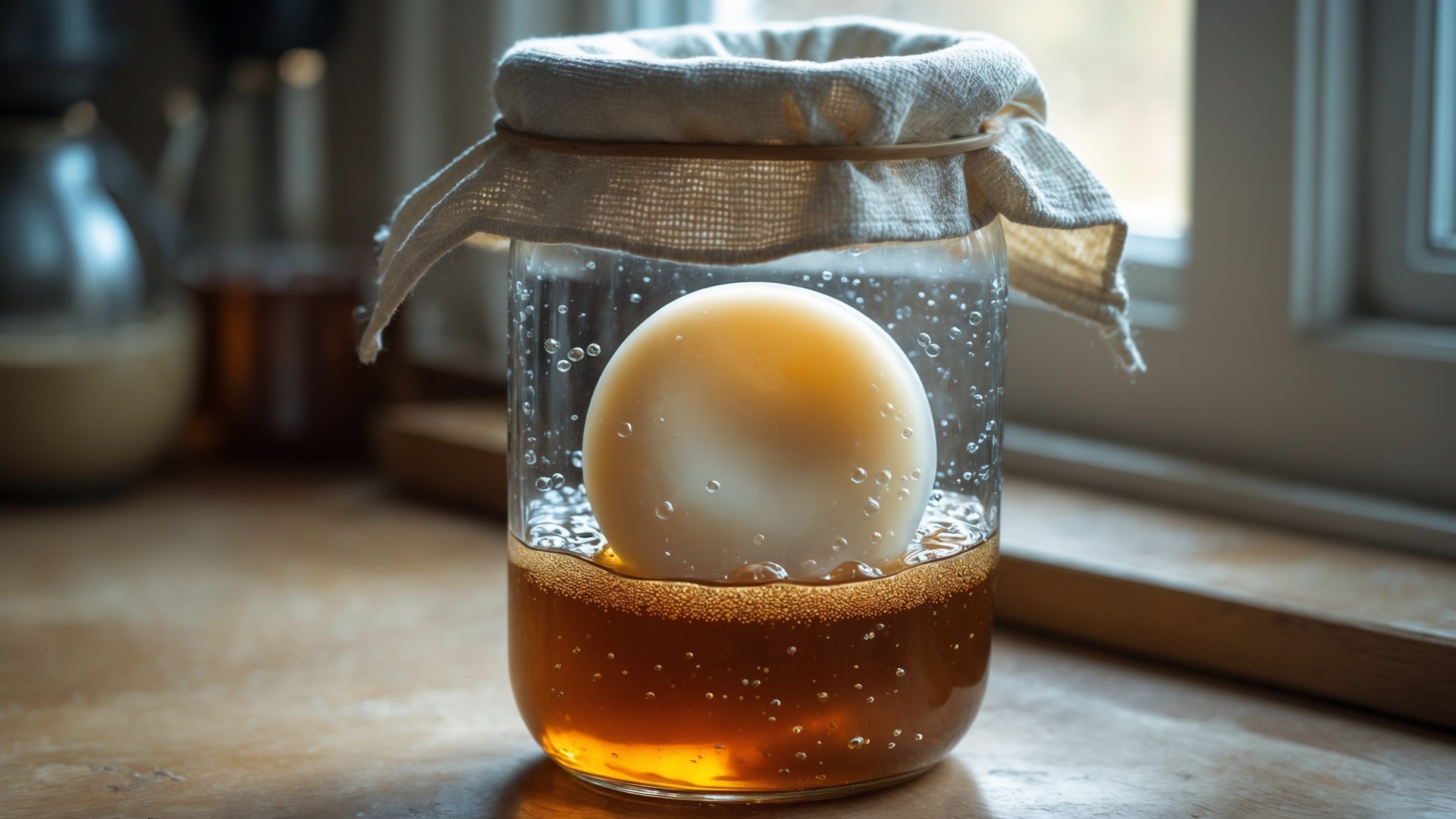
A sunken or partly submerged SCOBY is normal in most kombucha jars, especially in the first few days of a new batch. Komagataeibacter xylinus, the cellulose-producing bacteria in the culture, builds a new pellicle wherever conditions favor it — at the bottom, mid-jar, or on top — and its position alone says nothing about whether fermentation is working.
Is It Normal for a Kombucha SCOBY to Sink Instead of Float?
Yes. A new SCOBY can form and sit anywhere in the jar — submerged, mid-level, or floating — and a sunken culture still ferments the tea normally. Only a fuzzy, dry, raised patch of mold signals an actual problem, not the position of the pellicle itself.
A kombucha SCOBY (symbiotic culture of bacteria and yeast) isn’t a single organism. Komagataeibacter xylinus is the bacterium responsible for spinning the rubbery cellulose mat itself, while yeast strains such as Saccharomyces and Brettanomyces work alongside it, breaking down sugar and feeding the bacteria byproducts they need. Where that cellulose mat ends up forming has more to do with gas and disturbance than with the culture being healthy or not.
A pellicle floats when carbon dioxide bubbles get trapped underneath it and lift it toward the surface — the same gas that makes the tea fizzy. Early on, before much gas has built up, there’s nothing to hold the mat up, so it simply rests wherever it formed. Our Kombucha Mold vs. SCOBY guide covers how to tell a sunken culture apart from a genuine problem — this one focuses on why the position itself varies.
Why Does a New SCOBY Sink Instead of Floating on Top?
Five conditions explain almost every sunken or off-center SCOBY, and none of them mean the batch has failed.
| Reason | What happens |
|---|---|
| The culture is young | A brand-new pellicle hasn’t produced enough carbon dioxide yet to lift it, so it rests wherever it started forming |
| The kitchen is cool | Yeast activity — and the gas it produces — slows down noticeably below about 68°F (20°C) |
| The jar was disturbed | Pouring starter tea directly onto the culture, moving the jar, or stirring can knock a forming mat down or sideways |
| The culture is old and dense | A thick mother culture reused for many batches absorbs liquid and gets heavier, so it sits lower even once gas is present |
| Fermentation is finishing | As available sugar runs low near the end of a batch, gas production drops and a previously floating pellicle can settle |
What to Check Instead of SCOBY Position
Four signals say more about fermentation progress than whether the culture is floating.
- Bubbles rising through the tea. Small streams of carbon dioxide moving up from the bottom or from around the SCOBY mean yeast is actively working, floating culture or not.
- Haze or fine strands in the liquid. Brown, stringy yeast strands drifting in the tea are normal byproducts of fermentation, not a sign of spoilage.
- A sharper, more vinegar-like smell. As acetic acid builds, sweet tea gives way to a tangier, more sour aroma over several days.
- A thin new film anywhere in the jar. A new pellicle doesn’t have to be on top to count — a pale, smooth, translucent film forming at any level is Komagataeibacter xylinus doing its job.

How Long Does It Take for a New Pellicle to Form?
Timing depends mostly on temperature, and sources differ slightly on the ideal range.
| Temperature | What to expect |
|---|---|
| 68–77°F (20–25°C) | The National Center for Home Food Preservation lists this as the standard fermenting range, with a full batch typically taking 7 to 10 days |
| 75–85°F (24–29°C) | Utah State University Extension recommends this warmer range for a faster first fermentation, also over 7 to 10 days |
| Below about 65°F (18°C) | Fermentation continues but slows noticeably; a new pellicle can take several extra days to become visible at any level |
A starter tea that measures at or below pH 4.0 before you begin, per National Center for Home Food Preservation guidance, is a better readiness check than the SCOBY’s position — and it works the same whether the culture sank, floated, or formed somewhere in between.
If you’d rather confirm progress with a number instead of waiting on a visual cue, kombucha pH test strips (paid link) read the tea directly, which matters more for judging doneness than where the pellicle happens to be sitting.
When Is a Sunken SCOBY Actually a Problem?
When what’s growing is fuzzy, dry, and raised above the liquid instead of smooth and flat against it. Mold sits on top of the surface rather than floating in or under the tea, and it typically shows up as blue, green, black, or pink fuzzy spots — distinctly different from the pale, slick texture of a forming or sunken SCOBY. Our Kombucha Mold vs. SCOBY guide has side-by-side detail on telling the two apart.
A rotten, sulfurous, or distinctly unpleasant smell — rather than sharp and vinegary — is a separate warning sign worth taking seriously on its own, regardless of what the SCOBY is doing. See Help, There’s Mold on My Ferment for what to do next.
This article summarizes published guidance on kombucha fermentation and troubleshooting. It is not an assessment of any particular batch, and nothing here can tell you what is in your jar. If a ferment looks, smells, or tastes wrong to you, discard it.
FAQ
Should I push a sunken SCOBY back to the top?
No. Moving or touching it adds disturbance without changing how fermentation proceeds. Leave the jar undisturbed and judge progress by smell, taste, and the pH of the tea instead.
Will a new SCOBY ever form if the starter culture sank?
Yes. A new pellicle typically forms at the surface of the liquid regardless of where the starter SCOBY ended up, since that’s where the tea meets the air. A sunken starter culture doesn’t prevent a fresh layer from forming above it.
Can a healthy SCOBY sit sideways or at an angle instead of flat?
Yes. An uneven jar shape, a narrow neck, or bumping the container while it’s forming can leave a pellicle tilted or folded. Shape and angle don’t affect whether it’s fermenting correctly.
How many SCOBYs should be in the jar at once?
One starter culture is enough. A second, new pellicle forming during the same batch is normal and simply means a healthy fermentation — not a sign that something needs fixing.
Sources: National Center for Home Food Preservation, Kombucha FAQ · Utah State University Extension, Kombucha · Oregon State University, SCOBY Microorganisms Research
Related: Kombucha Mold vs. SCOBY: How to Tell the Difference · How to Care for a Kombucha SCOBY · How to Grow a Kombucha SCOBY From Scratch