
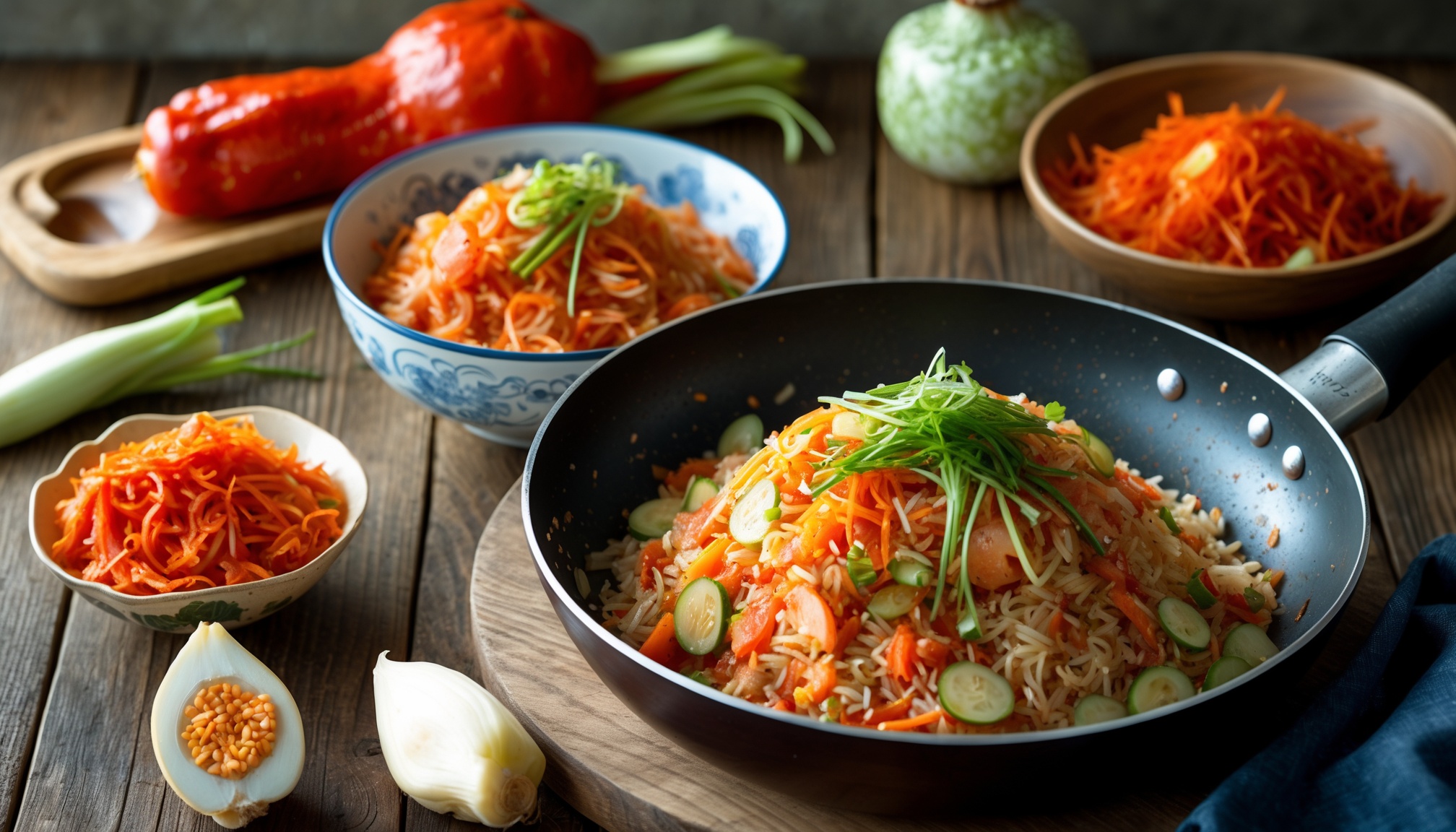
Kimchi keeps souring for as long as its bacteria stay active, and they stay active in the fridge, just slowly. Sourness climbs fastest above 20°C and in a fridge running warmer than about 4°C. Over-soured kimchi is not a failed batch — in Korean cooking it is the preferred ingredient for stews, fried rice and pancakes, where the acidity is the point.
Why Does Kimchi Keep Getting Sourer?
Kimchi ferments in a succession, and the handover between stages is what you taste as souring.
- Leuconostoc mesenteroides dominates the opening days. It produces carbon dioxide alongside lactic acid, which is the fizz stage, and gives kimchi its characteristic early freshness.
- Weissella species work alongside it, favoured by the garlic in a typical paste.
- Lactiplantibacillus plantarum takes over as acidity rises, because it tolerates a lower pH than the others. It produces lactic and acetic acid with very little gas, and it is the organism responsible for kimchi going from tangy to sharply sour.
That third phase never fully stops at fridge temperature. It only slows. This is why a jar you were happy with in October tastes markedly different in December.
What Pushes It Sour Faster
| Factor | Effect on souring | What to do |
|---|---|---|
| Fridge above 4°C | Large. A door shelf can run several degrees warmer than the back | Move the jar to the back of a middle or lower shelf |
| Days left at room temperature | Large. BCCDC describes 20–22°C as the active fermentation band | Chill after 1–3 days rather than a week |
| Low salt | Moderate. Less salt lets fermentation run faster | Keep to 2–3% after brining |
| Added sugar or fruit in the paste | Moderate. More fermentable sugar means more acid | Reduce pear, apple or sugar for a slower jar |
| Headspace and repeated opening | Small but cumulative | Press the kimchi below its liquid, use a smaller jar as it empties |
What to Do With Kimchi That Has Gone Too Sour
This is the part worth reframing. Well-soured kimchi, mugeunji, is not a consolation prize in Korean cooking. Several dishes specifically call for aged kimchi because young kimchi lacks the depth they need.
- Kimchi jjigae. The classic destination. Sour kimchi, pork belly or tofu, a little of the brine. The acidity is what makes the stew taste like a stew rather than soup with cabbage in it.
- Kimchi fried rice. Heat mellows acidity considerably. Over-sour kimchi is genuinely better here than fresh.
- Kimchijeon. The batter carries the sharpness; sour kimchi gives the pancake its backbone.
- Braises and soups. A spoonful of sour kimchi and its liquid works the way a splash of vinegar does in a European braise.
- Rinse and dress. For eating cold, a quick rinse under water plus a little sesame oil and sugar takes the edge off without cooking.
Our round-up of what to do with kimchi has more, but those five cover most of a sour jar.
Can You Reverse It?
No, and it is worth being direct about that, because plenty of advice online implies otherwise. Acidity that has developed does not go back. Adding sugar does not neutralise acid, it masks it briefly and then feeds the bacteria producing more. Baking soda neutralises chemically but wrecks flavour and texture.
What you can do is slow the rate of further change, using the table above, and cook with what you have.
Making the Next Batch Slower
- Chill after one to two days at room temperature instead of three to five.
- Keep salt at the upper end of the usual 2 to 3 percent after brining.
- Cut back the pear, apple or sugar in the paste.
- Make smaller batches more often rather than one large jar that sits for months.
- Portion into several small jars at the start, so opening one does not disturb the rest.
This article describes flavour development in kimchi and published guidance on fermentation temperature. It is not an assessment of any particular jar. If a ferment looks, smells, or tastes wrong to you, discard it — our guide on telling a spoiled ferment from a sour one covers the distinction.
FAQ
Is very sour kimchi still good to eat?
Sourness on its own is a flavour change, not a spoilage signal. In Korean cooking, aged sour kimchi is the preferred ingredient for stews and fried rice. Judge the jar by the usual markers: fuzzy growth, sliminess or a putrid smell mean discard, sharp acidity does not.
Can I add sugar to reduce the sourness?
Only as a short-term seasoning at the moment of serving. Sugar in the jar feeds the bacteria producing the acid, so it accelerates the problem rather than solving it.
Why did my kimchi sour so fast this time?
Usually temperature. A warm kitchen during the room-temperature stage, or a fridge running above 4°C, both compress the timeline noticeably. Extra sugar or fruit in the paste has a similar effect.
Does rinsing kimchi make it less sour?
It removes surface brine and takes the sharp edge off, which helps for eating it cold. It does not change the acidity inside the leaves.
Source: BC Centre for Disease Control, Fermented Vegetables Guidance
Related: How Long Does Kimchi Last? · Is Fizzy Kimchi Normal? · What to Do With Kimchi · Easy Kimchi Recipe