
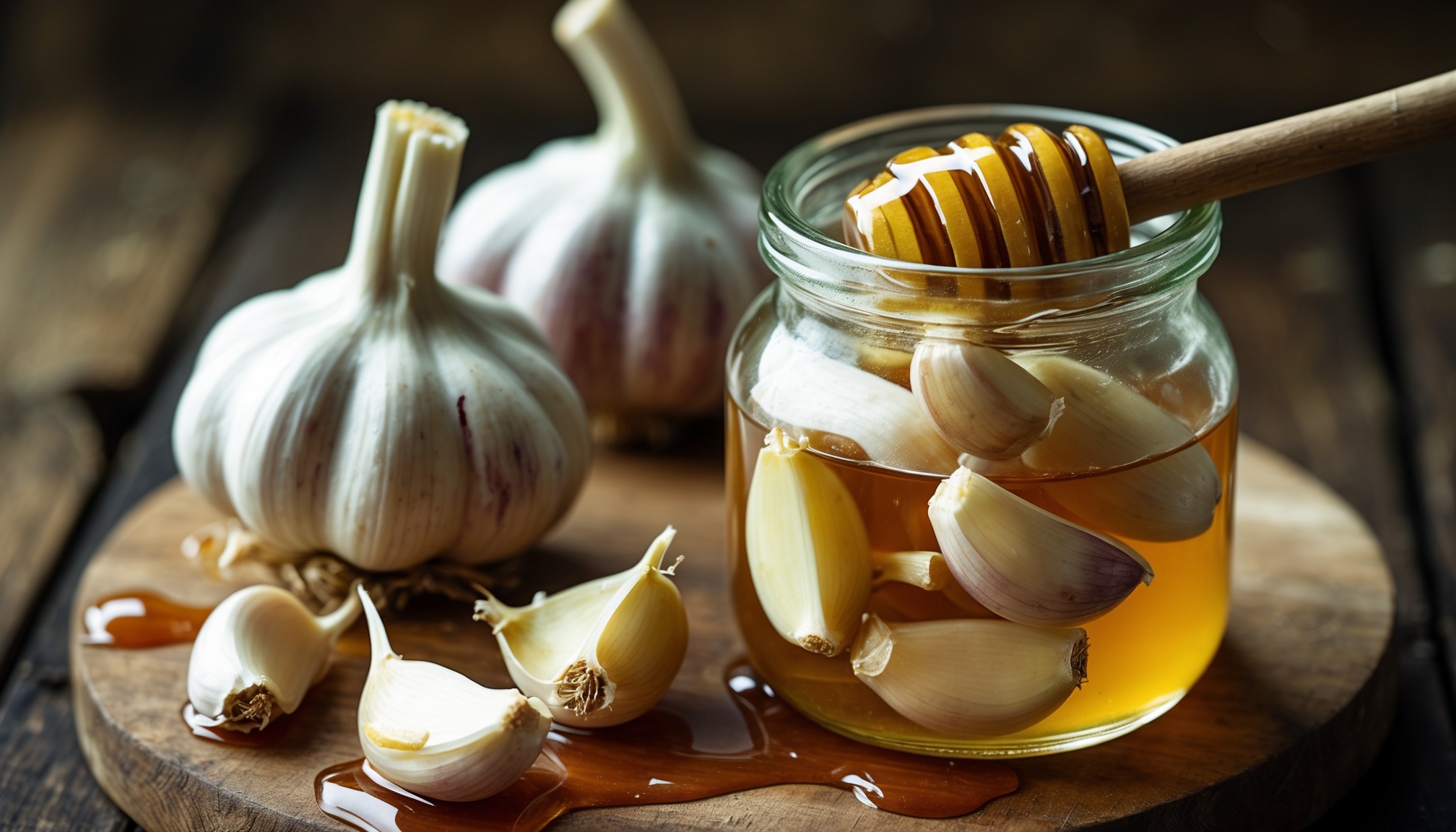
Blue or green fermented garlic is a pigment reaction, not mold. Cutting or crushing a clove releases the enzyme alliinase onto a sulfur compound called isoalliin, producing 1-propenyl thiosulfinates that then react with garlic’s own free amino acids to build pyrrole pigments. Young garlic and cold-stored bulbs carry more of the precursor, so they color more readily.
What Is Actually Happening Inside the Clove?
Garlic keeps its color chemistry in two compartments until something breaks the cells. The enzyme alliinase sits in the vacuole; its substrates, the S-alk(en)ylcysteine sulfoxides, sit in the cytosol. Slice, crush or press a clove and the two meet.
Alliinase is a pyridoxal-5’-phosphate-dependent C–S lyase. It cleaves the carbon–sulfur bond of its substrate, releasing a sulfenic acid, pyruvic acid and ammonia. The sulfenic acids condense into thiosulfinates — and which one you get depends on which sulfoxide went in.
- Alliin is the abundant precursor. It produces allicin, the compound behind the sharp smell of fresh-cut garlic. Allicin is about flavor, not color.
- Isoalliin is the minor one. It produces 1-propenyl thiosulfinates, which the food chemistry literature calls the “color developers.”
Those 1-propenyl thiosulfinates react with free amino acids in the clove — alanine, glutamine, glutamic acid, asparagine, aspartic acid, arginine and lysine among them — to form N-substituted 3,4-dimethylpyrroles. Those pyrroles are not yet colored; they react in turn with carbonyl compounds, and the products of that step are the pigments. As the International Journal of Food Studies review of garlic greening sets out, green is not one pigment but a mixture of yellow and blue ones. Shift the ratio and you get blue cloves in one jar and green ones in the next.
One consequence contradicts the explanation repeated most often online: nothing in that sequence requires copper, iron or any other trace metal from your tap water. Every reactant is already inside the clove.
Why Does Cold Storage Make It More Likely?
Because the enzyme that builds the precursor works best in the cold. γ-Glutamyl transpeptidase (GGT) converts stored γ-glutamyl peptides into the sulfoxides, and it reaches maximum activity at 4°C (39°F) — refrigerator temperature. Bulbs held cold accumulate more isoalliin before you ever open them.
The mirror image holds too: holding garlic at 35°C (95°F) sharply reduces GGT activity and, with it, the greening. That is why the effect looks random from the cook’s side. Two heads of one variety, one from a cold display case and one from a warm pantry, can behave differently in the same brine.
| Factor | Effect on color | Mechanism |
|---|---|---|
| Bulbs stored near 4°C (39°F) | More blue-green | GGT activity peaks, building more precursor |
| Bulbs stored near 35°C (95°F) | Much less | GGT activity drops sharply |
| Young, uncured garlic | More likely | UC ANR: more likely with immature garlic |
| Vinegar or acidic brine | More likely | Acetic acid raises tonoplast permeability |
| pH below 3 | Suppressed | Alliinase is inhibited below pH 3 |
| Whole, uncut cloves | Slower | Enzyme and substrate stay separated |
Why Does Acid Trigger It If Acid Also Stops the Enzyme?
Garlic sits naturally around pH 4.5–5.5, and alliinase is inhibited below pH 3. A vinegar brine should therefore switch the reaction off — yet pickles are where people see blue garlic most.
The answer is sequence. Monocarboxylic acids such as acetic acid increase permeability of the tonoplast, the membrane around the vacuole. The enzyme escapes and meets its substrate before the acid has penetrated deeply enough to drop the internal pH below the inhibition threshold. The acid opens the door faster than it shuts the enzyme down.
Blue-Green Garlic vs. Actual Spoilage
The two look nothing alike once you know what separates them. Pigment color sits inside the flesh of the clove, the texture stays firm and the smell stays garlicky and sour. Spoilage organisms grow on surfaces: fuzzy or hairy patches on the cloves or the brine, sliminess, ropy liquid, a putrid or solvent-like smell.
The University of California’s Garlic: Safe Methods to Store, Preserve, and Enjoy treats the blue or purple color that appears in an acidic brine as a natural color change rather than a sign of spoilage, and notes it is more likely with immature garlic. That describes the reaction in general, not any particular jar. If yours also shows fuzzy growth or an off smell, use our spoilage checklist instead.
How Do You Reduce the Chance of It Happening?
You are managing the precursor, not the recipe.
- Skip refrigerated bulbs. Whole garlic held near 4°C (39°F) sits at the GGT optimum. UC ANR gives 60°F (16°C), dry and dark, as the storage target for whole bulbs.
- Let freshly harvested garlic cure. Immature garlic is the case UC ANR flags as most likely to discolor.
- Bruise less. Whole peeled cloves break fewer cells than crushed ones, so less enzyme meets less substrate.
None of these is a switch. Our simple jar method and the fermented honey garlic recipe both behave this way, and the honey version, starting far from acidic, gives the enzyme the longest window of all.
Nothing here is an assessment of your particular jar. We can describe what the research says about a color reaction in general; we cannot see what is in front of you. If a batch smells wrong, looks wrong, or you are simply unsure, discard it.
FAQ
Why did only some of my cloves turn blue?
Precursor levels vary from clove to clove. UC ANR notes the tendency to discolor “can differ among cloves from a single head of garlic,” so a partly blue jar is the expected outcome rather than a strange one.
Does the color change the taste?
The pigments form from minor sulfur compounds present in small quantities, while garlic’s dominant flavor compounds come from the separate alliin-to-allicin route. Most people describe no difference between a blue clove and a white one from one jar.
Will the blue color fade or spread over time?
Both happen. The reaction runs over hours to days after the cells are broken, so a jar can deepen in color across its first week. Because the pigment sits in the clove flesh rather than the brine, it tends to stay put.
Can filtered water stop it?
The pathway described in the food chemistry literature runs on compounds already inside the clove and does not depend on minerals from the water. Filtered water is a reasonable default for fermenting, but it is not the lever that controls this.
Sources: International Journal of Food Studies — Garlic greening: pigments’ biosynthesis and control strategies · UC Agriculture and Natural Resources — Garlic: Safe Methods to Store, Preserve, and Enjoy · Food Chemistry — Cysteine reacts to form blue–green pigments with thiosulfinates from garlic
Related: Fermented Garlic: Simple Jar Method · Fermented Honey Garlic · How to Tell If Your Ferment Has Gone Bad · Black Garlic