
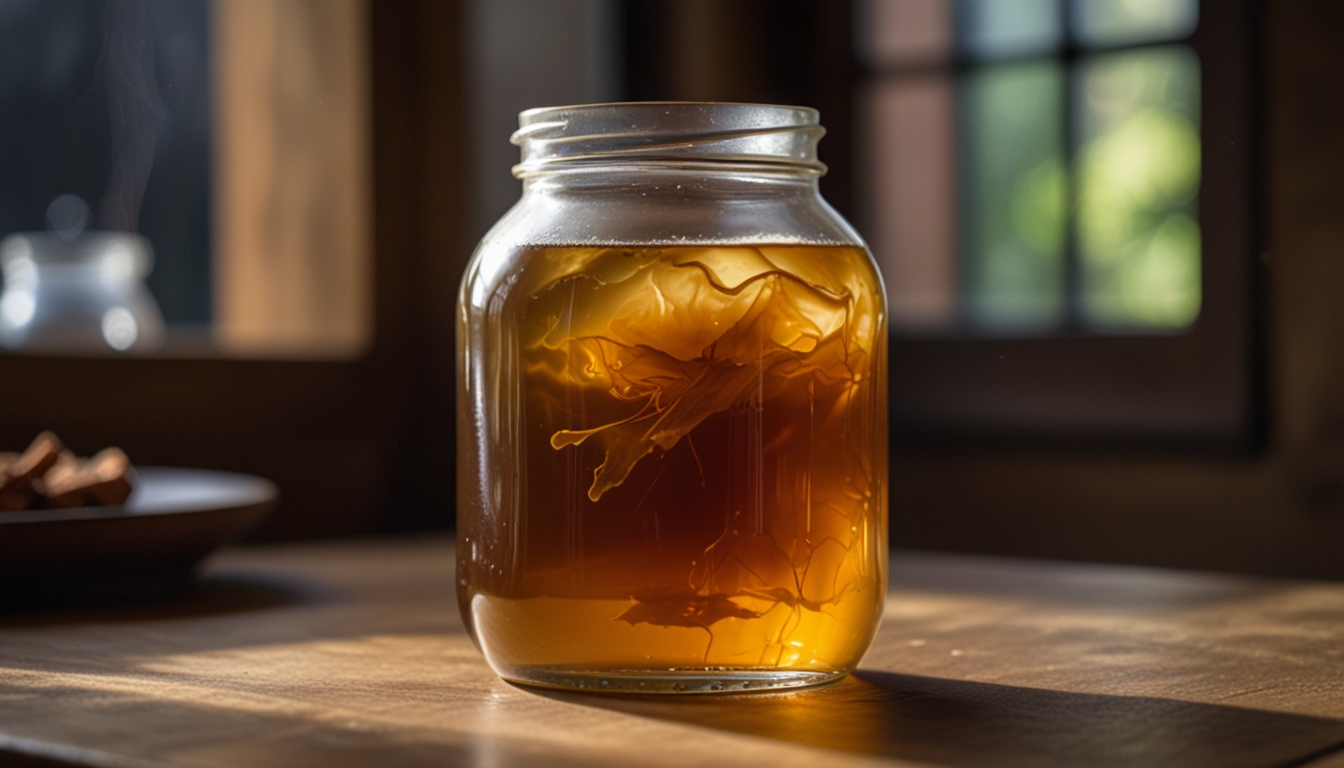
Keep a SCOBY in enough finished kombucha to cover it, loosely lidded, at the same temperature you brew at — the optimal band is 20–22°C (68–72°F). Between batches it can sit for weeks. The useful test of whether it is still working is not how it looks but whether the liquid around it measures pH 4.0 or lower.
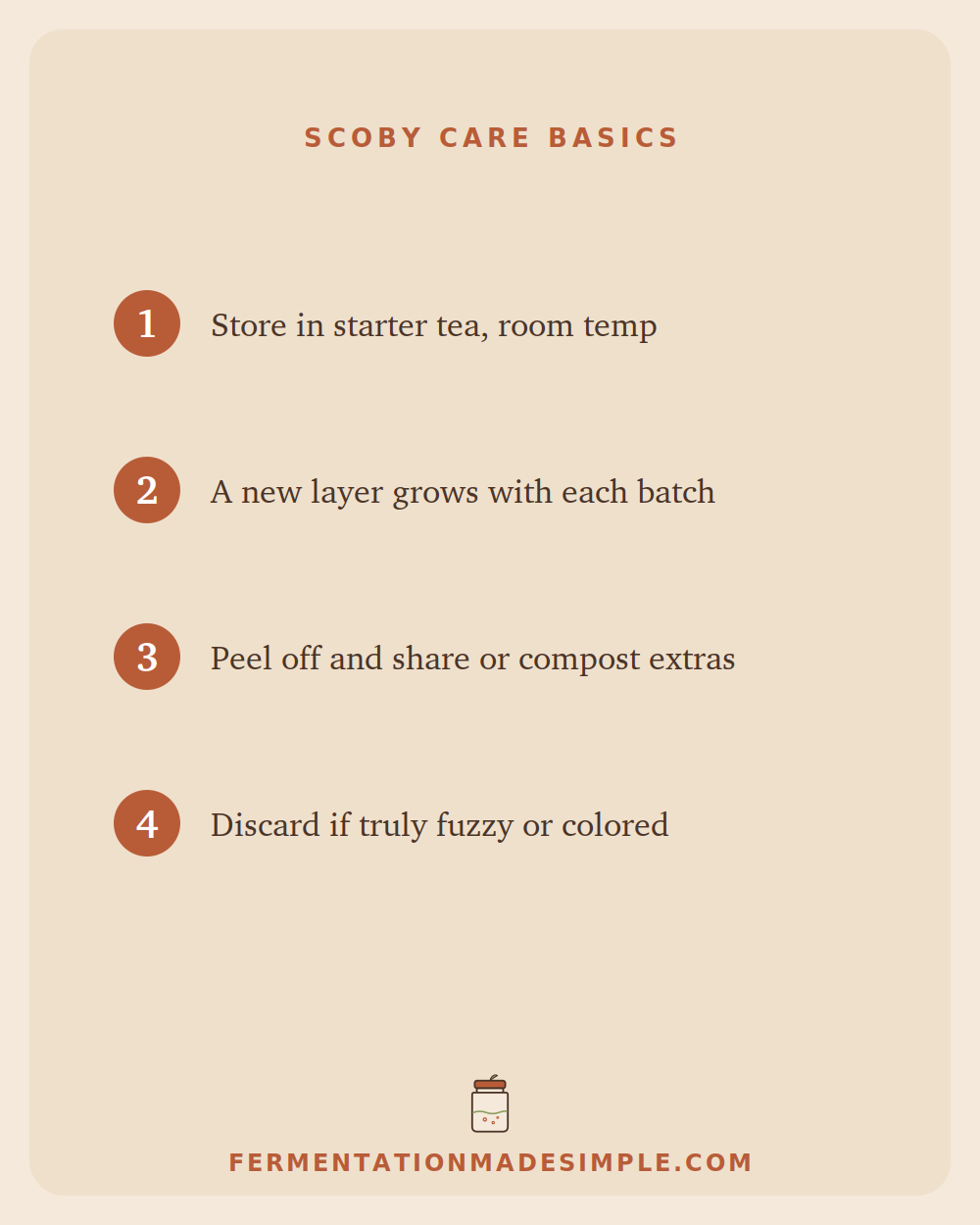
What Is a SCOBY, Exactly?
The disc is not the culture — it is a mat the culture builds. Its proper name is a pellicle, a white mat of culture that floats on top of the fermentation, formed by the same organisms that are also swimming in the tea underneath it.
The residents are named in the published guidance: acetic acid bacteria including Komagataeibacter, Gluconobacter and Acetobacter; lactic acid bacteria including Lactobacillus and Lactococcus; and a long yeast list running from Brettanomyces and Saccharomyces to Zygosaccharomyces. That matters for everything below: the starter tea you save carries the culture just as surely as the disc does.
Still working out the brew itself? Start with our kombucha beginner’s guide.
How Do You Store a SCOBY Between Batches?
In a jar, submerged in finished kombucha, covered with cloth rather than sealed. Spare growth can be peeled and shared with others, or stored for several weeks in a similar cloth covered vessel, covered by kombucha. That jar is what people call a SCOBY hotel.
| Situation | What to do | Reference point |
|---|---|---|
| Brewing again within days | Leave it in the finished batch | — |
| Pausing for weeks | Cloth-covered jar, covered by kombucha | Several weeks |
| Holding room temperature | Same band as brewing | 10–26°C, optimal 20–22°C |
| Restarting after a pause | Check starter tea pH first | Proceed at pH 4.0 or less |
Two things people get wrong. A tight lid, when the acetic acid bacteria in that list need air. And the fridge, which drops the culture below the published 10°C (50°F) floor and slows it to a crawl rather than preserving it.
Why Does It Grow a New Layer Every Batch?
Because building the pellicle is what the acetic acid bacteria do at the surface, batch after batch. The sequence runs from a light haze that gradually turns whitish, then opaque and thicker as time progresses.
Leave the stack fused or peel it apart — neither affects the brew much, because the culture is distributed through the liquid. A thick stack does displace tea, which is the practical reason to thin it.
Is My SCOBY Still Healthy?
Most of what alarms beginners is ordinary. The exception is fuzzy, raised growth on the surface.
| What you see | Reading |
|---|---|
| Cream, beige or brown patches | Ordinary colour variation |
| Brown stringy strands hanging below | Yeast, ordinary |
| Holes, bumps, uneven thickness | Ordinary |
| A new layer growing at an angle | Ordinary; it follows the liquid surface |
| Fuzzy blue, green, grey, brown or black patches sitting proud of the surface | Published guidance says to discard |
BCCDC’s wording is direct: discard if there are “fuzzy patches of blue, green, grey, brown or black on SCOBY.” The distinguishing feature is texture, not colour — mould is dry and raised, while the pellicle is wet and flat against the liquid. Our comparison of mould versus normal SCOBY growth goes through it in pictures.
What Does an Exhausted Culture Look Like?
Rarely dramatic. A run-down culture does not die visibly; it stops keeping to the timetable. The signs worth watching:
- Batches run long. Kombucha fermentation runs 7 to 21 days, typically 10, and the standard home recipe runs 7 to 10 days at 68–77°F (20–25°C). A batch still tasting like sweet tea well past that window, at a temperature in range, points at the culture rather than the recipe.
- No new layer forms. A brew that finishes without laying down any fresh pellicle is unusual.
- Starter tea will not come down to pH 4.0. This is the measurable version of the first two, and the published go/no-go threshold.
- The hotel has been diluted. Repeated top-ups with sweet tea rather than finished kombucha leave weak starter liquid — the usual cause behind all of the above.
The fix for most of these is the same: brew with a larger proportion of strong starter tea. The published figure is 100 to 200 mL per litre — a tenth to a fifth of the batch. If nothing brings it back, a bought live culture is a faster reset than growing one from a bottle of shop kombucha.
Keeping the Hotel Itself in Shape
- Top up with finished kombucha, not sweet tea. Acidity is what the hotel is for.
- Keep everything under the liquid. A disc sitting half out of the tea is a dry surface, and dry surfaces are where fuzzy growth starts.
- Thin the stack from the bottom, pulling the oldest, darkest layers rather than the fresh top one.
- Hold it in the brewing range. 10–26°C (50–79°F) is the outer band; 20–22°C (68–72°F) is where it runs best.
This article summarises published guidance on kombucha culture care. It is not an assessment of any particular jar or culture. If a SCOBY or a batch looks, smells or tastes wrong to you, discard it and start again from a fresh culture.
FAQ
How long can a SCOBY sit in a hotel before I use it again?
Spare growth stored in a cloth-covered jar and covered by kombucha keeps for several weeks. Before brewing again, NCHFP’s instruction is to check the starter liquid and proceed only if it measures pH 4.0 or lower.
Can I keep my SCOBY in the refrigerator?
A domestic fridge sits below the 10°C (50°F) floor of the published 10–26°C range for kombucha fermentation, so the culture becomes very slow. A cloth-covered jar at room temperature is the storage method the guidance describes.
Do brown stringy bits mean something is wrong?
No — those strands are yeast, and they are part of the symbiotic mix, alongside the acetic and lactic acid bacteria. The growth that warrants discarding is fuzzy and raised above the surface in blue, green, grey, brown or black.
How much starter tea should I keep back for the next batch?
The published starter culture proportion is 100 to 200 mL per litre of batch. The practical version for a gallon brew is to retain at least 1 to 2 cups of finished kombucha.
Sources: BC Centre for Disease Control, Fermented Foods Guideline 3.11: Kombucha and Jun · Colorado State University Extension, Understanding and Making Kombucha · National Center for Home Food Preservation, Kombucha Tea
Related: How to Make Kombucha at Home · Kombucha Mould vs SCOBY · Buying a SCOBY Instead of Growing One · Second Fermentation Guide