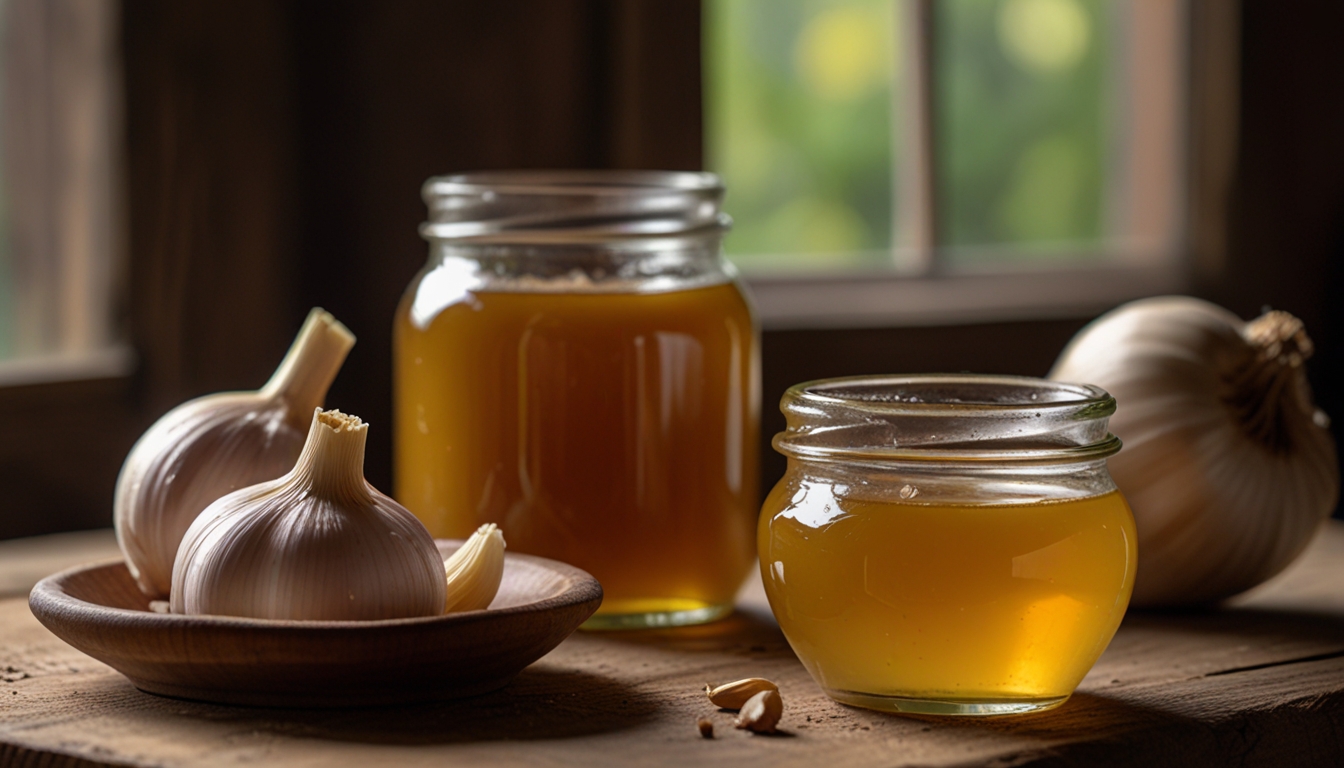
Fermented honey garlic is peeled garlic cloves submerged in raw honey and left at room temperature. It is a two-ingredient preparation with an unusual profile: honey has a very low water activity while garlic has a very high one, and extension food scientists have written specifically about that combination. Read the source section below before you start.
What Do Extension Food Scientists Say About Garlic in Honey?
This preparation sits outside the tested home-preservation recipes, and two extension sources have addressed it directly. Here is what they say, quoted rather than summarised into a verdict.
In a March 2023 Ask Extension answer, Joy Waite-Cusic (Oregon State University) responded to a reader who had fermented garlic in raw honey for a month under an airlock and measured pH between 3.6 and 4.1. The response states that “garlic is a low acid plant food (pH ~5.8), and honey varies from low to high acidity (pH 3.4 – 6.1)”, that honey “commonly has C. botulinum spores in it”, and that “honey has a very low water activity, but garlic has a very high water activity”. It notes that pH strips are not an accurate measure, that any acid drop would ideally occur in under 24 hours, and concludes: “There are no research-based recipes to prove that fermenting garlic in raw honey is a safe practice or how to do it safely.”
K-State Research and Extension makes the same water-activity point and adds the open question: the water activity of honey is low because of its sugar content, but “when the two are combined, what is the final water activity? It depends on the ratio” and other factors. It also notes that honey can be a source of infant botulism in children under one year old.
| Figure | Value as published |
|---|---|
| Garlic pH | ~5.8 (low-acid food) |
| Honey pH | 3.4 to 6.1 |
| Honey water activity | Very low (high sugar) |
| Garlic water activity | Very high |
| Growth limit for C. botulinum | Cannot grow below pH 4.6 |
| Garlic in oil at room temperature | At risk for development of botulism |
For the last two rows: USDA FSIS describes Clostridium botulinum as anaerobic and states it cannot grow below a pH of 4.6. NCHFP writes that mixtures of garlic in oil stored at room temperature are at risk for the development of botulism, and directs that garlic-in-oil be made fresh and refrigerated at 40°F (4°C) or lower for no more than 4 days, or frozen for several months. That guidance covers oil, not honey; both extension answers reference it as the closest tested comparison.
What You’ll Need
- 1 cup peeled garlic cloves (whole)
- 1 cup raw honey (paid link)(raw honey carries more wild yeast and ferments better)
- A small clean glass jar (paid link)with a lid
Step-by-Step
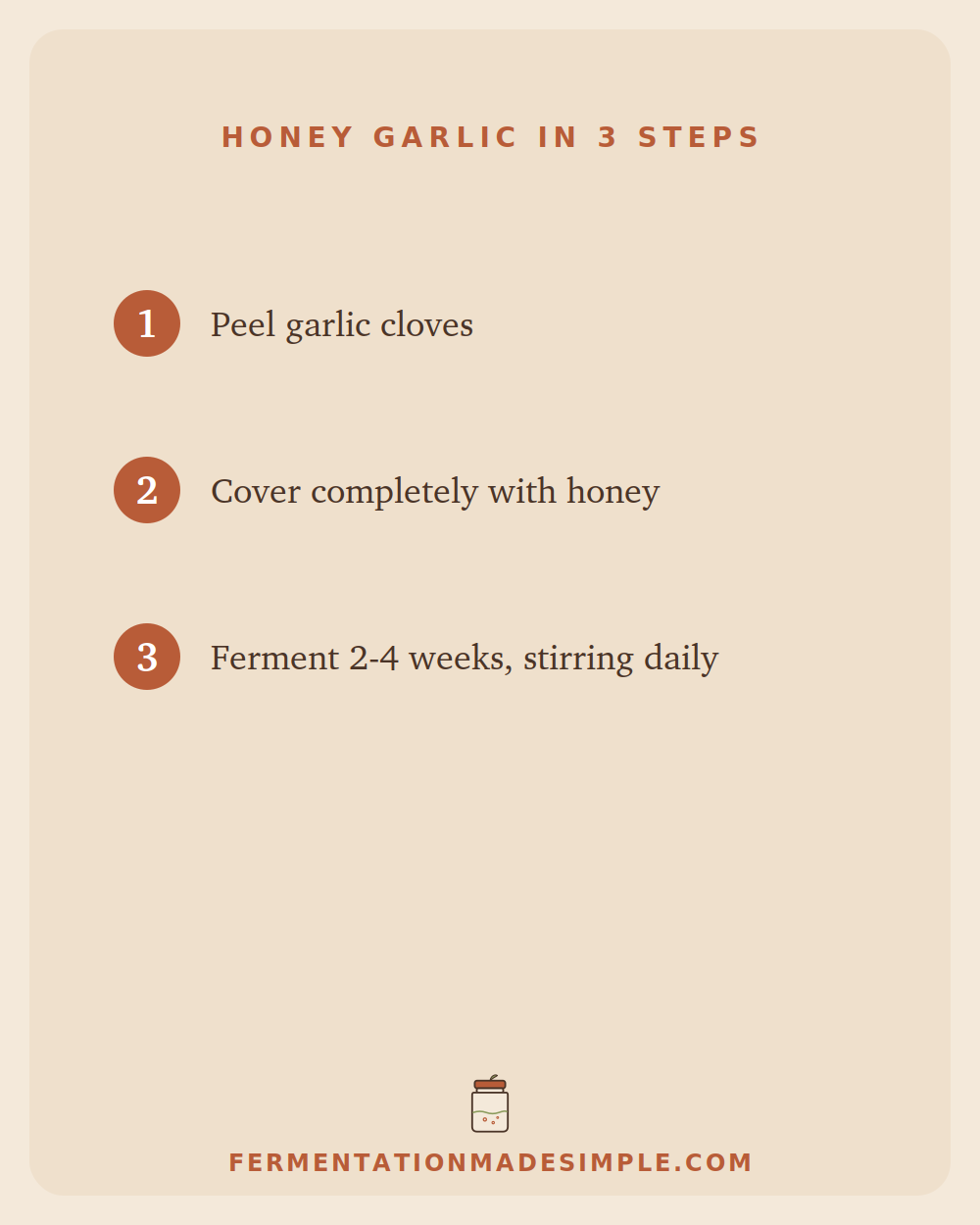
- Peel the garlic. Whole cloves work best — no need to chop.
- Pack the jar. Add the garlic cloves to the jar.
- Cover with honey. Pour honey over the garlic until every clove is fully covered.
- Burp daily. Loosen the lid once a day for the first couple of weeks to release gas, then reseal.
- Wait. Let it ferment 2-4 weeks, stirring or flipping occasionally so all the garlic stays coated.
How Long Does It Take?
We are not publishing a number, because no tested time window has been published for garlic in honey the way 3 to 4 weeks at 70–75°F (21–24°C) is published for cucumbers and cabbage. What you observe is qualitative: bubbles collecting around the cloves and along the glass, the honey visibly thinning, and the cloves sinking as they lose buoyancy.
The thinning is the part worth understanding. Honey is hygroscopic and the cloves hold a lot of water, so moisture migrates out of the garlic into the honey. That is the shift both sources point at when they ask what the final water activity is: the jar does not stay as dry as the honey you poured in.
Why Do the Cloves Change Colour?
Garlic turning blue, green or teal in an acidic medium is a pigment reaction involving sulphur compounds released when cloves are cut or bruised, reported across pickled and fermented garlic preparations rather than honey specifically. It is a colour change, not a growth, and says nothing about the rest of the jar either way. Our note on garlic turning blue-green covers the chemistry.
How Should It Be Stored?
There is no tested storage recommendation for this preparation, which is itself the answer. The nearest published guidance is NCHFP’s for garlic in oil: refrigerate at 40°F (4°C) or lower and use within 4 days, or freeze.
K-State’s note that honey can be a source of infant botulism in children under one year applies to honey in any form, fermented or not.
This article reports what the published extension and federal food-safety guidance says about garlic, honey and botulism. It is not an assessment of any particular jar, and nothing above is a clearance for a batch you have made. If a ferment looks, smells or tastes wrong to you, or you are unsure, discard it.
FAQ
Is there a tested recipe for fermented honey garlic?
Not that we could find. The Ask Extension answer states there are no research-based recipes proving that fermenting garlic in raw honey is a safe practice or showing how to do it safely. Tested recipes exist for fermented cucumbers, sauerkraut and kombucha, not for this.
Why do the sources focus on water activity?
Because the two ingredients sit at opposite ends of it. Honey’s water activity is low because of its sugar content, garlic’s is very high, and both published answers ask what the combined value ends up being — which depends on the ratio and other factors.
What pH figures do the sources give?
Garlic sits at around pH 5.8 and honey from 3.4 to 6.1, and pH strips are described as not an accurate measure. USDA FSIS states that C. botulinum cannot grow below pH 4.6.
What does NCHFP say about garlic in oil?
That mixtures of garlic in oil stored at room temperature are at risk for the development of botulism, and that garlic-in-oil should be made fresh and refrigerated at 40°F (4°C) or lower for no more than 4 days, or frozen for up to several months. That covers oil, not honey; both extension answers refer to it.
Sources: Ask Extension, Fermentation of Garlic (Oregon State) · K-State Research and Extension, Honey Fermented Garlic May Be Risky · NCHFP, Garlic-in-Oil · USDA FSIS, Clostridium botulinum
Related: Fermented Garlic, Simple Jar Method · Garlic Turning Blue-Green · Black Garlic · How to Tell If a Ferment Has Gone Bad