
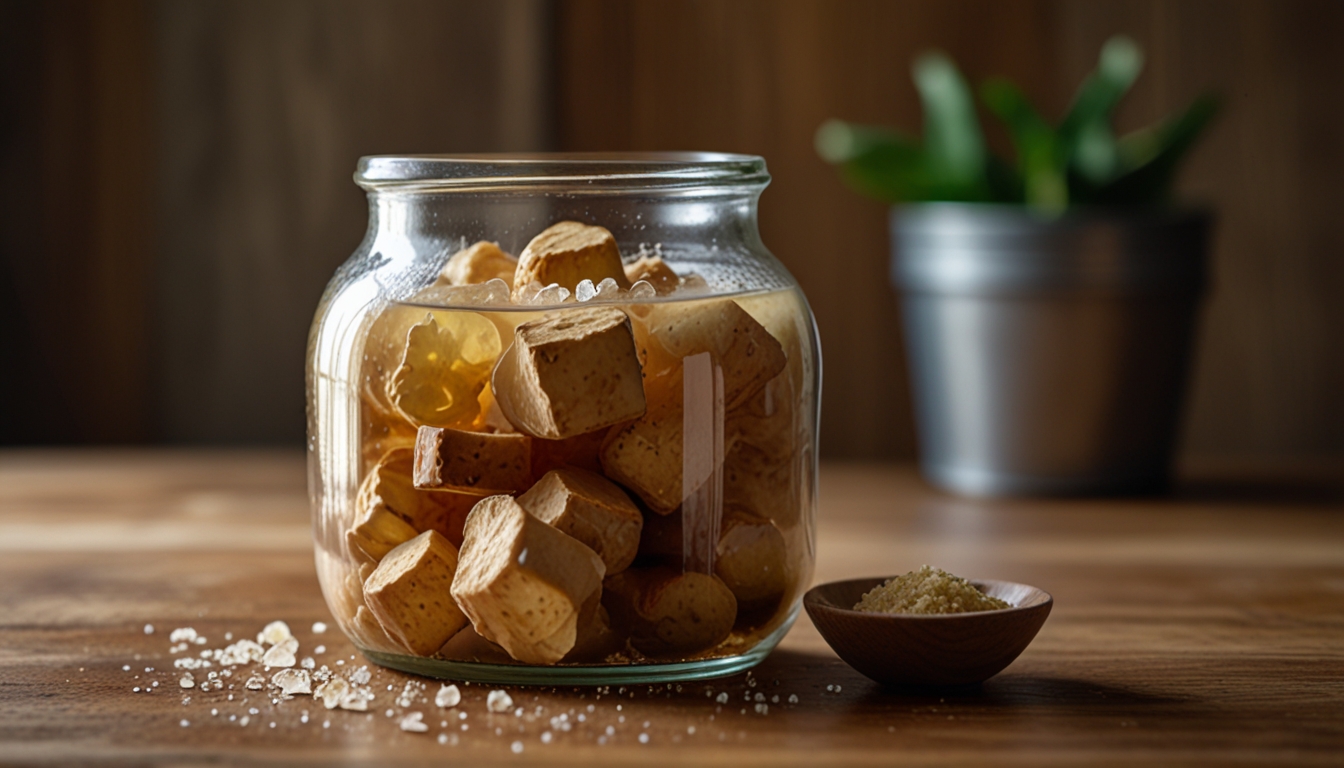
A ginger bug is a jar of grated ginger, sugar and unchlorinated water that you feed daily until the wild yeasts and lactic acid bacteria riding on the ginger skin take hold and start producing gas. Once it bubbles on its own, a few tablespoons of the liquid become the starter that carbonates homemade soda.
What Is a Ginger Bug Actually Doing?
It is a spontaneous fermentation that you then keep going by backslopping. Spontaneous means the fermentation is driven by microbes already present on the food substrate, or on the equipment and utensils; backslopping means using a previous ferment to start the next. A ginger bug is both: it starts spontaneously, then every feeding is a small backslop.
The microbes arrive on the ingredients themselves — yeast can be found on all sorts of places like grapes or ginger — and the same CO2 that raises bread is what makes a drink bubbly. Alongside the yeasts, lactic acid bacteria do the acidifying work, producing lactic acid as their major end product and driving a finished ferment’s pH below 4.6. That is why a mature bug smells sharp rather than simply sweet.
Ingredients & Equipment
- Fresh ginger root (unpeeled, organic if possible — the wild yeast lives on the skin)
- White or raw cane sugar
- Non-chlorinated water (filtered or left out uncovered overnight)
- A clean wide-mouth glass jar (paid link)
- A kitchen scale (paid link) (optional, but makes measuring consistent)
Step-by-Step
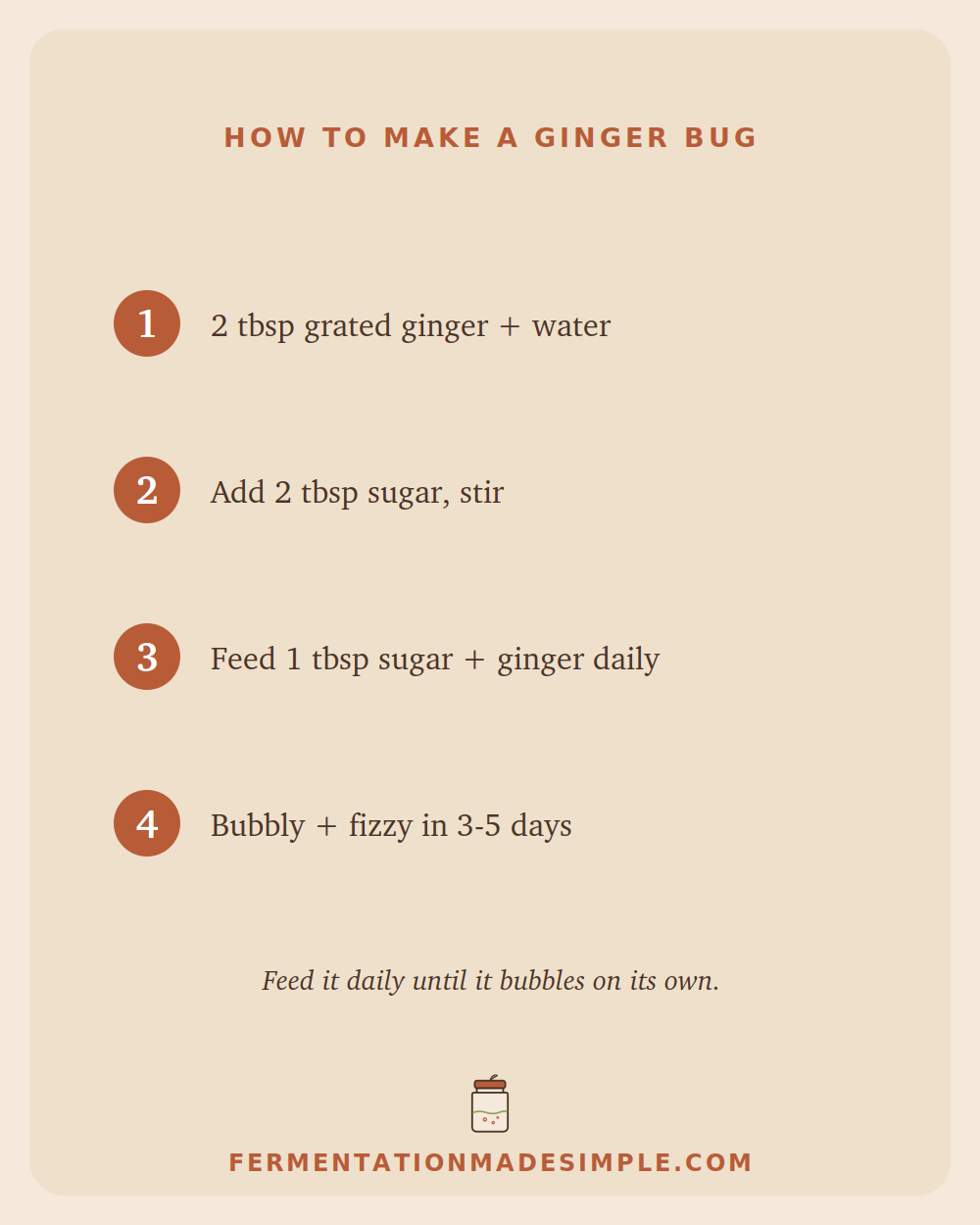
- Start the jar. Add 2 tablespoons grated or finely chopped ginger and 1 cup water to the jar.
- Add sugar. Stir in 2 tablespoons sugar until mostly dissolved.
- Cover loosely with a cloth or coffee filter and secure with a rubber band.
- Feed it daily. Every day, stir in 1 more tablespoon each of grated ginger and sugar.
- Watch for bubbles. After 3-5 days of daily feeding, it should start bubbling on its own — that’s when it’s ready to use.
What Temperature Does a Ginger Bug Want?
No temperature spec is published for ginger bugs specifically, but the sugar-water and sweet-tea ferments that are documented cluster in a recognizable band that brackets the range a ginger bug lives in.
| Reference ferment | Published range |
|---|---|
| Yeast-driven carbonation, optimum for yeast activity | 80–100°F (27–38°C) |
| Water kefir, standard schedule | 21–25°C (70–77°F) for 48–96 hours |
| Water kefir, shortened schedule | 25–30°C (77–86°F) for 20–24 hours |
| Kombucha, full working range | 10–26°C (50–79°F), optimal 20–22°C (68–72°F) |
| Kombucha, second published figure | 64–79°F (18–26°C) |
Two things fall out of that table. The warm end, 80–100°F, is the optimum for yeast activity in a sealed carbonating bottle, not a target for the open starter jar. And a kitchen at the cool end of the kombucha range, around 64°F (18°C), is still inside every published band — it simply moves slowly. A bug that has not bubbled after four days in a cold kitchen is usually cold, not dead.
How Do You Turn It Into Soda?
Strain a few tablespoons of the active liquid into sweetened juice or cooled herbal tea, bottle it, leave it sealed at room temperature for a short window, then refrigerate. The bottling stage is where the published guidance gets specific, because that is where a sugar-fed yeast population is working inside a closed vessel.
- Bottle choice. UF/IFAS states that "appropriately pressure-rated bottles must be used to achieve high carbonation levels." The same guide puts the absolute maximum recommended carbonation at 8 volumes of CO2, and notes people can first detect fizz at roughly 0.6 volumes — a wide span, and the top of it is not a home-kitchen target.
- Headspace. Leave about one inch of space at the top of each bottle before sealing airtight.
- Time sealed. Colorado State Extension directs bottlers to cap tightly and leave the bottles at room temperature 1–3 days for potential carbonation, or refrigerate immediately, and warns that longer periods capped at room temperature "could result in carbon dioxide accumulation and even explosion."
- Stopping point. Refrigeration is the brake: chilling slows fermentation and holds carbonation where it is. WSU states the failure mode bluntly — if a drink over-ferments in a closed container, "the pressure can build up to the point where the bottle EXPLODES."
In practice: bottles built to hold gas, a consistent headspace, a short sealed window, and the first bottle opened over a sink. If you brew kombucha too, the same bottling logic applies there.
How Do You Keep It Alive?
A ginger bug is a continuous culture, so maintenance is really a feeding question. At room temperature it gets fed daily; refrigerated between uses it slows enough that a weekly feeding keeps it going. Each time you draw liquid off for a soda you remove part of the population, and the fresh ginger and sugar you stir in replace both the food and the microbes clinging to the new shavings.
A healthy bug fizzes within a few hours of feeding and smells sharp and bready. One that has gone quiet, turned flat and solvent-smelling, or grown fuzzy colored patches is a culture to start over rather than rescue.
Nothing here is an assessment of any particular jar in front of you. These are the ranges and procedures the cited agencies publish; they cannot tell you what happened in your kitchen. If a batch looks, smells or behaves wrong — visible mold, an off odor, a bottle that seems oddly pressurized — discard it rather than taste it.
FAQ
Why isn’t my ginger bug bubbling?
The two usual causes are chlorinated tap water and a cool kitchen. Published water kefir schedules run 21–25°C (70–77°F), and the kombucha range bottoms out at 10°C (50°F) with an optimum of 20–22°C (68–72°F). Below that optimum everything takes longer, so keep feeding daily and move the jar somewhere warmer before concluding it has failed.
Do I really need unpeeled ginger?
The logic follows directly from how a spontaneous fermentation starts: it is driven by microbes already on the substrate, and ginger skin is one of the surfaces where that wild yeast is found. Peeling removes the part of the root carrying that population, which is why the usual instruction is to scrub rather than peel.
Can I feed it honey instead of sugar?
Honey ferments — jun, a honey-fed relative of kombucha, takes 250 mL of honey into a 2 L solution. But the published schedules for sugar-water cultures specify sucrose: 5–10% w/v sucrose for water kefir, and 10–15% for reactivating dormant grains. Cane sugar is the variable those numbers were written around.
How is a ginger bug different from water kefir grains or a kombucha SCOBY?
A ginger bug has no physical culture body you strain out and reuse — the microbes live loose in the liquid and on the ginger shavings. Water kefir grains, by contrast, are translucent granules 5–20 mm across, and a kombucha SCOBY is a floating cellulose mat. All three are separate cultures and none substitutes for another. Our water kefir guide covers that culture in detail.
Sources: BC Centre for Disease Control — Introduction to Fermented Food Safety · BCCDC — Kefir Guidance (3.12) · UF/IFAS — A Guide to Carbonating Beverages at Small Scale · Washington State University — Naturally Carbonated Soda
Related: Fermentation for Beginners · Kombucha Recipe · Water Kefir: A Beginner’s Guide