
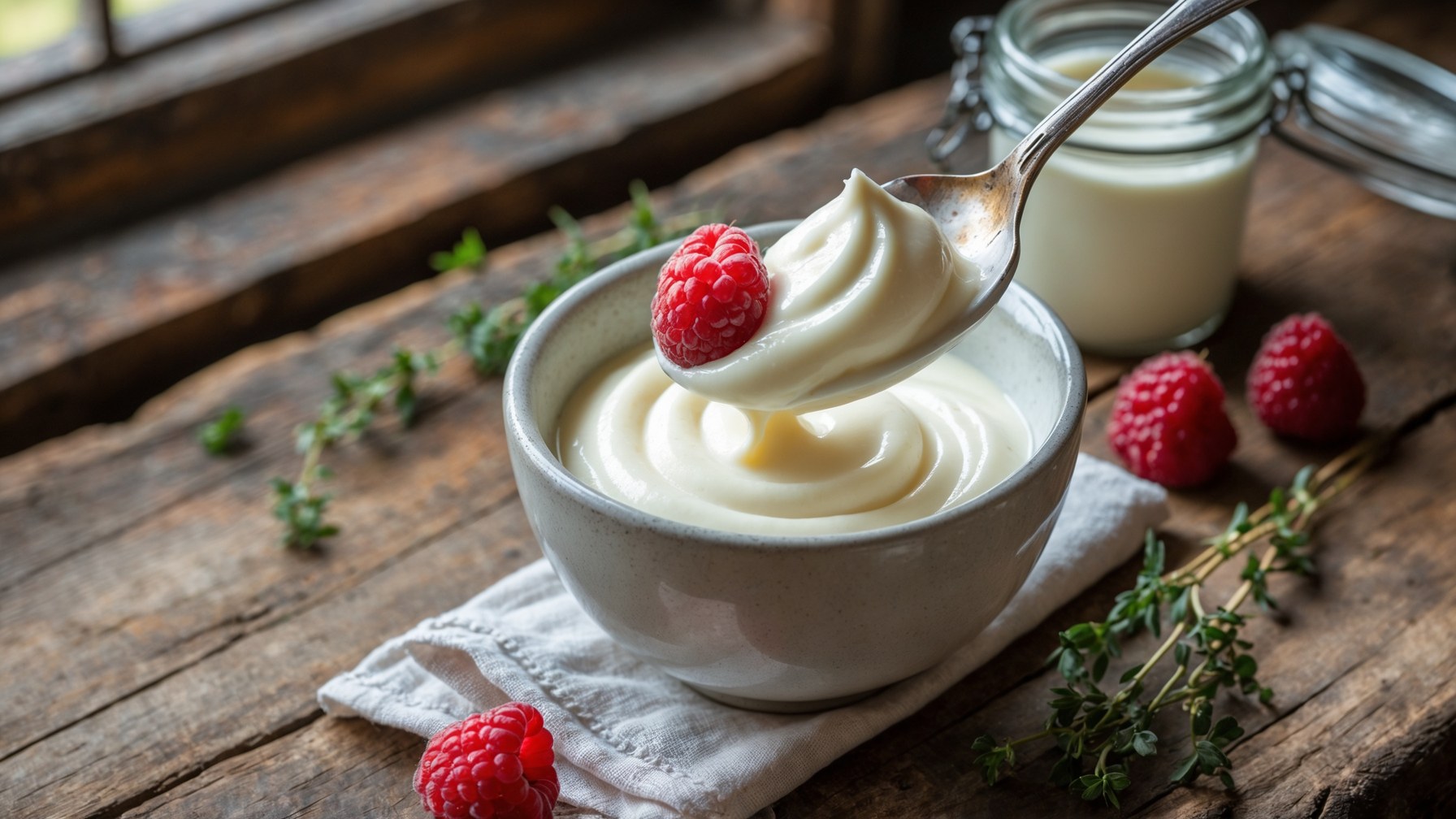
Crème fraîche is cream thickened with a little buttermilk until it turns rich, tangy, and spoonable. Stir 2 tablespoons of buttermilk into 1 cup of heavy cream, cover the jar, and leave it at room temperature for 8 to 24 hours.
Homemade crème fraîche takes two ingredients: heavy cream that is not ultra-pasteurized and a spoonful of cultured buttermilk. The common method uses 2 tablespoons of buttermilk per cup of cream and 8 to 24 hours at 65–75°F, then refrigeration, where it thickens further and keeps up to about 10 days. Utah State University Extension describes a heated, pH-checked method that finishes at pH 4.6 or below. Crème fraîche stays stable in hot sauces, where sour cream curdles.
Ingredients
- 1 cup heavy cream, not ultra-pasteurized
- 2 tablespoons buttermilk with live cultures (or ½ cup sour cream per 2 cups of cream)
- Equipment: a clean wide-mouth glass jar (paid link) and a spoon
Step-by-Step
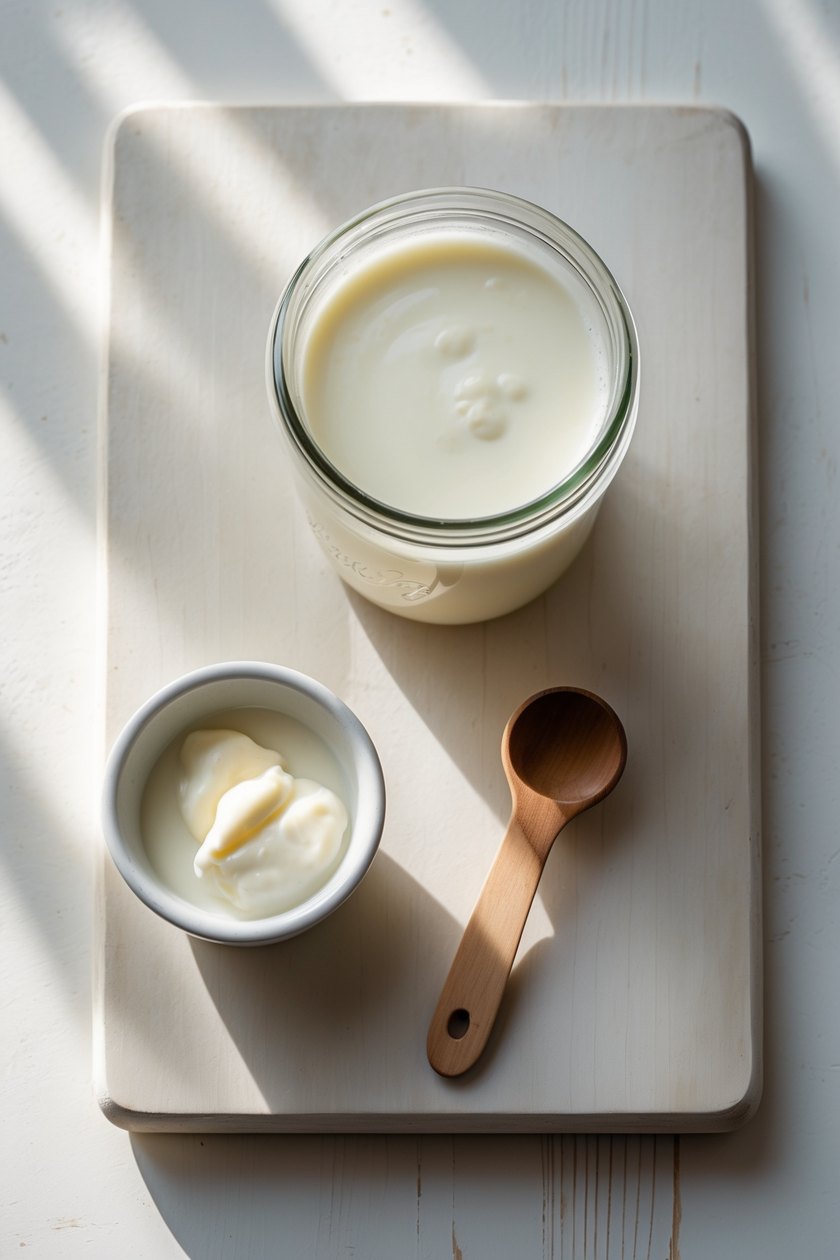
- Pour the cream into a clean glass jar.
- Stir in the buttermilk until fully combined.
- Cover the jar loosely and leave it at room temperature, ideally 65–75°F, for 8 to 24 hours.
- Check it from hour 8. It is ready when it is very thick and tangy.
- Stir once, cover tightly, and refrigerate. It thickens a little more as it chills.
How Long Does Crème Fraîche Take to Thicken?
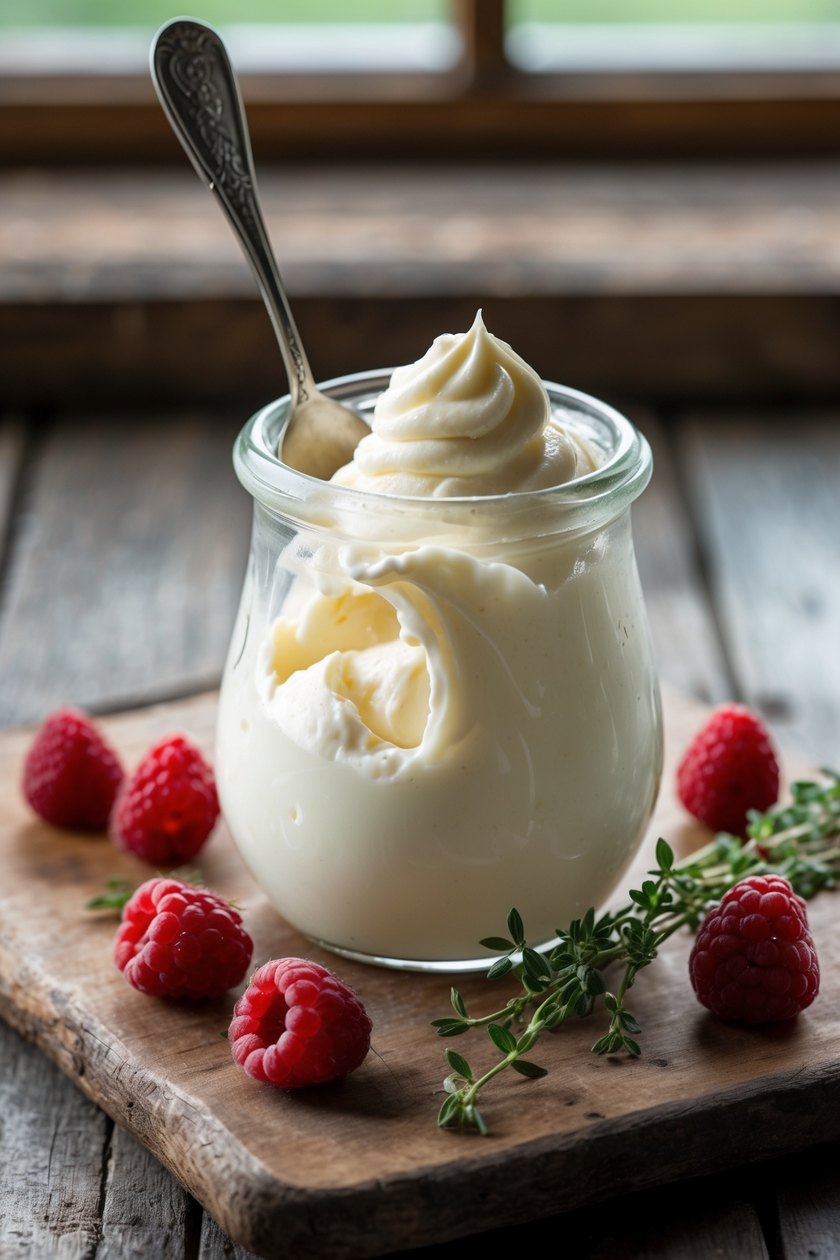
Crème fraîche takes 8 to 24 hours to thicken at room temperature. A warmer room finishes near 8 hours, and a cool room takes closer to 24. The finished cream is very thick, holds a spoon, and tastes mildly tangy rather than sharply sour.
The culture amount differs from recipe to recipe, which is why timing varies. One popular recipe uses 2 tablespoons of buttermilk per cup of cream, another uses roughly 1 tablespoon per cup, and the Utah State method uses 1 cup of culture for 4 cups of cream, which works out to 4 tablespoons per cup.
Treat the clock as a window and the texture as the timer. Across the sources, the culture share runs from about 1 to 4 tablespoons per cup of cream, so the same 8-to-24-hour range covers very different batches. A batch with more culture reaches the same thickness sooner. Start checking at hour 8, and stop when the cream holds a spoon, not when a number on the clock says so.
Is It Safe to Leave Cream Out for Crème Fraîche?
The common home method leaves cream at room temperature for up to 24 hours, which is standard practice for cultured dairy but is not the only method. Utah State University Extension describes a heated version: bring the cream to 185–200°F, hold it for 2 to 5 minutes, cool it, culture it, and keep it warm until it reaches pH 4.6 or below.
| Step | Room-temperature method | Extension method |
|---|---|---|
| Cream to culture | 1 cup heavy cream : 2 tbsp buttermilk | 4 cups whipping cream : 1 cup buttermilk, acidophilus milk, or yogurt |
| Heat step | None | Heat to 185–200°F, hold 2–5 minutes, stir constantly |
| Culturing temperature | Room temperature, ideally 65–75°F | Cool to 104–113°F, then hold at about 108°F (42.3°C) |
| Finish line | Very thick, after 8–24 hours | pH of 4.6 or below |
| Equipment | Covered glass jar | Clean, sanitized jars and pH strips |
Use fresh cream, a clean jar, and a covered container, and refrigerate the crème fraîche as soon as it is thick. The extension page we read describes only the heated, pH-checked method, so the no-heat version is common home practice rather than extension-tested guidance. If the cream smells sharply off, looks pink or slimy, or shows mold, throw it out. This is general food-safety guidance, not medical advice. When in doubt, throw it out.
What Is the Difference Between Crème Fraîche and Sour Cream?
Crème fraîche is made from richer cream than sour cream and stays stable when heated. Crème fraîche sits at around 30 percent butterfat, while US sour cream must contain at least 18 percent. Crème fraîche tastes milder and nuttier, and sour cream is tangier and more liquid.
That fat difference matters in the pan. Sour cream curdles when heated, and crème fraîche can go into hot soups and sauces without fear of curdling.
Which Cream and Starter Work Best?
Heavy cream that is not ultra-pasteurized works best. Popular recipes recommend avoiding ultra-pasteurized cream, and they use buttermilk as the standard starter. Utah State University Extension also lists acidophilus milk, yogurt, and crème fraîche starter packets as options.
Check that the buttermilk lists live cultures. If you already make Homemade Yogurt, a spoonful of your own plain yogurt is a documented alternative starter.
How Do You Use Crème Fraîche?
Use it wherever you would use a rich, tangy cream. Spoon it onto soup, stir it into a pan sauce at the end, dollop it over fresh fruit, or serve it next to homemade labneh on a mezze-style plate. Because it holds up to heat, it is the better choice for sauces that simmer.
How Long Does Crème Fraîche Keep?
Homemade crème fraîche keeps up to about 10 days in the refrigerator. One popular recipe gives 10 days, and another says 1 to 2 weeks, so plan on the shorter figure. Keep it covered and cold, and use a clean spoon each time.
💬 My Take
The usual pitch for homemade crème fraîche is that it is two ingredients and zero effort, and that is mostly true. What the Extension page adds is the part recipes skip: a defined finish line. Instead of a clock, it uses a pH of 4.6 or below. Most home cooks will never measure that, so the practical stand-in is texture, smell, and fresh cream. I would use the simple method for everyday cooking and treat the heated method as the careful option when the batch is for guests.
- Mix 2 tablespoons of buttermilk into 1 cup of heavy cream that is not ultra-pasteurized
- Leave it covered at 65–75°F for 8 to 24 hours, and check the texture from hour 8
- The Extension method heats the cream to 185–200°F and finishes at pH 4.6 or below
- Crème fraîche (around 30 percent butterfat) stays stable in hot sauces, where sour cream (18 percent minimum) curdles
- Refrigerate once thick and plan on about 10 days
- Fresh cream, a clean jar, and your nose are the safety checks that matter
Frequently Asked Questions About Crème Fraîche
Can I use sour cream or yogurt as the starter?
Yes. Utah State University Extension lists buttermilk, acidophilus milk, yogurt, or a crème fraîche starter packet as the culture, and one popular recipe uses ½ cup of sour cream per 2 cups of heavy cream. Buttermilk is the most common choice.
Why didn’t my crème fraîche thicken?
Most often the room was too cool. At 65–75°F the cream needs 8 to 24 hours, and a cool kitchen pushes it toward the full 24. Check again before you give up. Ultra-pasteurized cream is also best avoided, since recipes recommend a cream that is not ultra-pasteurized.
Is crème fraîche the same as sour cream?
No. Sour cream must contain at least 18 percent butterfat in the US, while crème fraîche starts from richer cream at around 30 percent. The higher fat also makes crème fraîche stable in hot soups and sauces, where sour cream curdles.
Can I cook with crème fraîche without it curdling?
Yes. Crème fraîche can go into hot soups and sauces without fear of curdling, unlike sour cream, which curdles when heated.
How long does homemade crème fraîche keep?
Up to about 10 days in the refrigerator, according to one popular recipe. Another says 1 to 2 weeks. Plan on 10 days, and note that it keeps thickening slightly as it chills.
Is crème fraîche a fermented food?
Yes. It is cultured cream: bacteria convert the lactose in the cream into lactic acid, which thickens it and adds tang. That is the same basic process behind yogurt and buttermilk.
Sources: Utah State University Extension, Cultured Cream · The Daily Meal, Crème Fraîche · MasterClass, Crème Fraîche vs. Sour Cream
Related: How to Make Labneh · Homemade Yogurt · Milk Kefir: A Beginner’s Guide