
Homemade yogurt comes down to four numbers: heat the milk to 185°F and hold it, cool to 112–115°F, stir in the starter, then hold at 110°F for 4 to 7 hours. Cooperative Extension guidance puts a quarter cup of live-culture starter per quart of milk, and the finished yogurt keeps 10 to 21 days at 40°F or below.
Ingredients
- 4 cups whole milk (or 2%; skim works but yields a thinner yogurt)
- A yogurt starter culture (paid link), or 2-3 tablespoons plain yogurt with live cultures from a previous batch
Step-by-Step
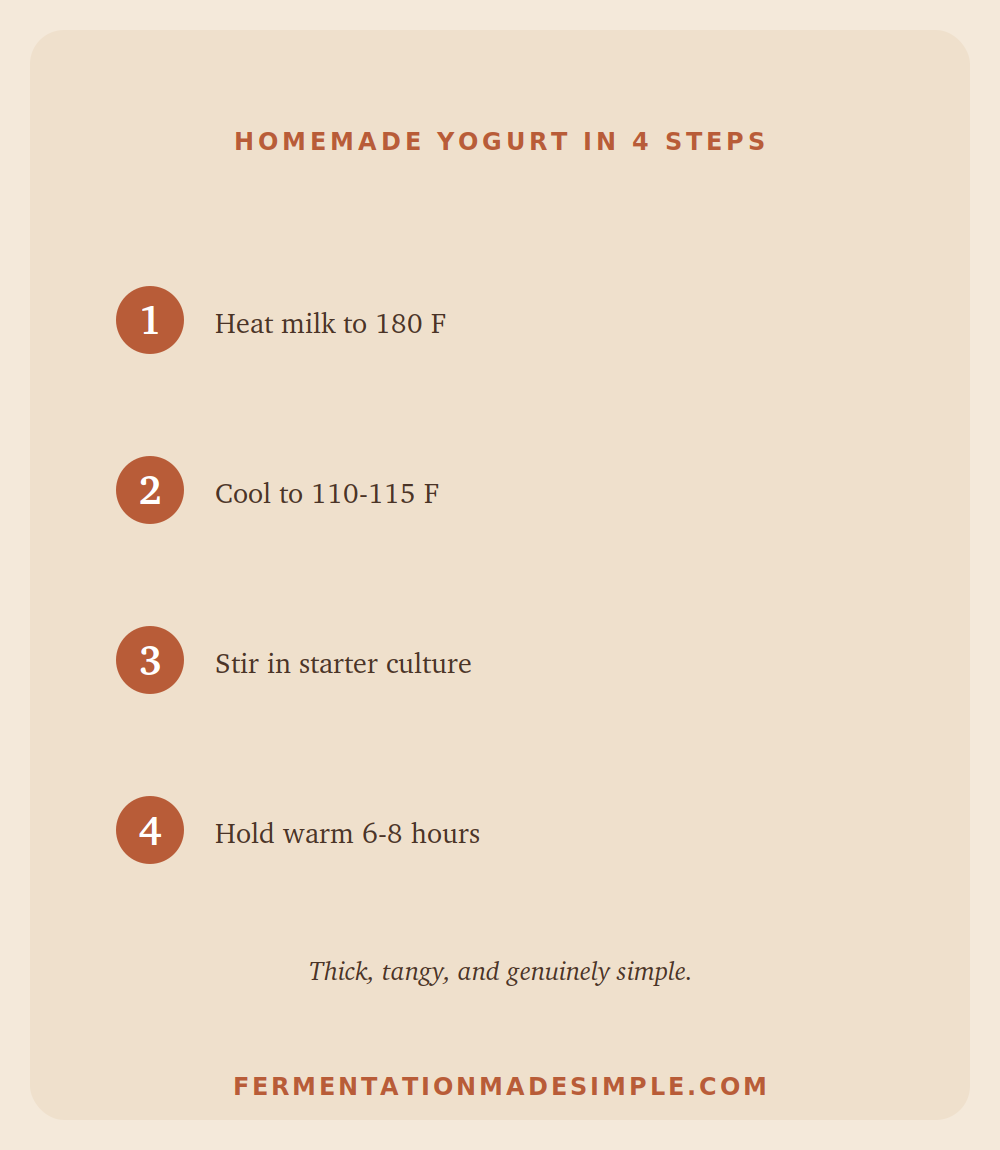
- Heat milk to 180°F (82°C), stirring occasionally, then remove from heat.
- Let the milk cool to 110-115°F (43-46°C) — this step matters, since hotter temperatures kill the culture.
- Stir in the starter culture until fully combined.
- Pour into a jar, cover, and hold at 100-110°F for 6-8 hours — a turned-off oven with the light on, or a yogurt maker, both work well.
- Refrigerate once set; it will thicken further as it chills.
The Four Temperatures That Decide Everything
Yogurt is unusually unforgiving about temperature and unusually forgiving about everything else. University of Alaska Fairbanks Cooperative Extension publishes the full set:
| Stage | Target | Why it matters |
|---|---|---|
| Heating the milk | 185°F, up to 200°F for firmer yogurt | Denatures the whey proteins so they set into a gel rather than staying liquid |
| Hold time at that heat | 10 minutes thinner, up to 20 minutes thicker | The single easiest lever on final texture |
| Cooling before the starter | 112–115°F | Above this the culture is damaged; the milk must come down first |
| Incubation | 110°F, plus or minus 5°F, for 4–7 hours | The band where the culture works steadily |
Note the hold-time row in particular. Most home recipes skip it entirely, which is why so many batches come out thin despite everything else being right. Holding at 185°F for twenty minutes instead of bringing the milk up and immediately pulling it off the heat changes the texture more than any straining trick.
Getting a Thicker Yogurt
- Hold the milk longer at 185–200°F. Extension guidance puts 20 minutes at the thick end against 10 at the thin end. Free, and the biggest single factor.
- Use whole milk. Skim sets, but thinner. Fat carries body.
- Strain it. A few hours in a cloth-lined sieve in the fridge turns ordinary yogurt into Greek-style. What drains off is whey, and it is worth keeping for baking.
- Add dry milk powder. A third of a cup per quart before heating raises the solids and firms the set.
- Incubate toward the longer end. Seven hours gives a firmer, tangier result than four.
Holding 110°F Without a Yogurt Maker
The equipment question is really a heat-retention question. Anything that holds a jar near 110°F for several hours works:
- Oven with the light on. Most ovens sit in the right band with just the bulb. Check yours with a thermometer before committing a batch.
- Cooler with warm water. Jars in a picnic cooler surrounded by 115°F water, lid closed. Very stable.
- Instant Pot yogurt setting. Purpose-built for exactly this range.
- Wrapped in towels on a heating pad set low. Works, but verify the temperature rather than trusting the dial.
Whatever you use, resist stirring or moving the container during incubation. The gel sets as an intact structure and breaking it mid-set gives a grainy, separated result.
Storage and Re-Culturing
Extension guidance puts finished yogurt at 10 to 21 days refrigerated at 40°F or lower. Save a quarter cup from each batch as the starter for the next one. After several generations the culture tends to weaken and the set gets looser, at which point a fresh commercial starter resets it.
Some separation of clear liquid on top is whey, not a fault. Pour it off or stir it back in.
This article summarises published Cooperative Extension guidance on home yogurt making. It is not an assessment of any particular batch. If a batch looks, smells, or tastes wrong to you, discard it.
FAQ
Can I use store-bought yogurt to start a batch?
Yes, as long as it says live or active cultures and has no added thickeners or flavouring. Extension guidance puts a quarter cup of plain live-culture yogurt per quart of milk.
Why didn’t my yogurt set?
Almost always one of three things: the milk was still too hot when the starter went in (it needs to be down to 112–115°F), the incubation drifted outside 110°F plus or minus 5, or the starter was old. Ultra-pasteurized milk also sets less reliably.
How long does homemade yogurt keep?
Extension guidance says about 10 to 21 days held at 40°F or lower. It turns progressively tangier over that window as the culture stays slowly active.
Can I incubate longer than 7 hours?
You can, and the result is firmer and noticeably more sour. Past roughly 12 hours the whey tends to separate out and the texture suffers.
Source: University of Alaska Fairbanks Cooperative Extension, Making Yogurt at Home
Related: Milk Kefir Guide · Fermentation for Beginners · Water Kefir Guide