
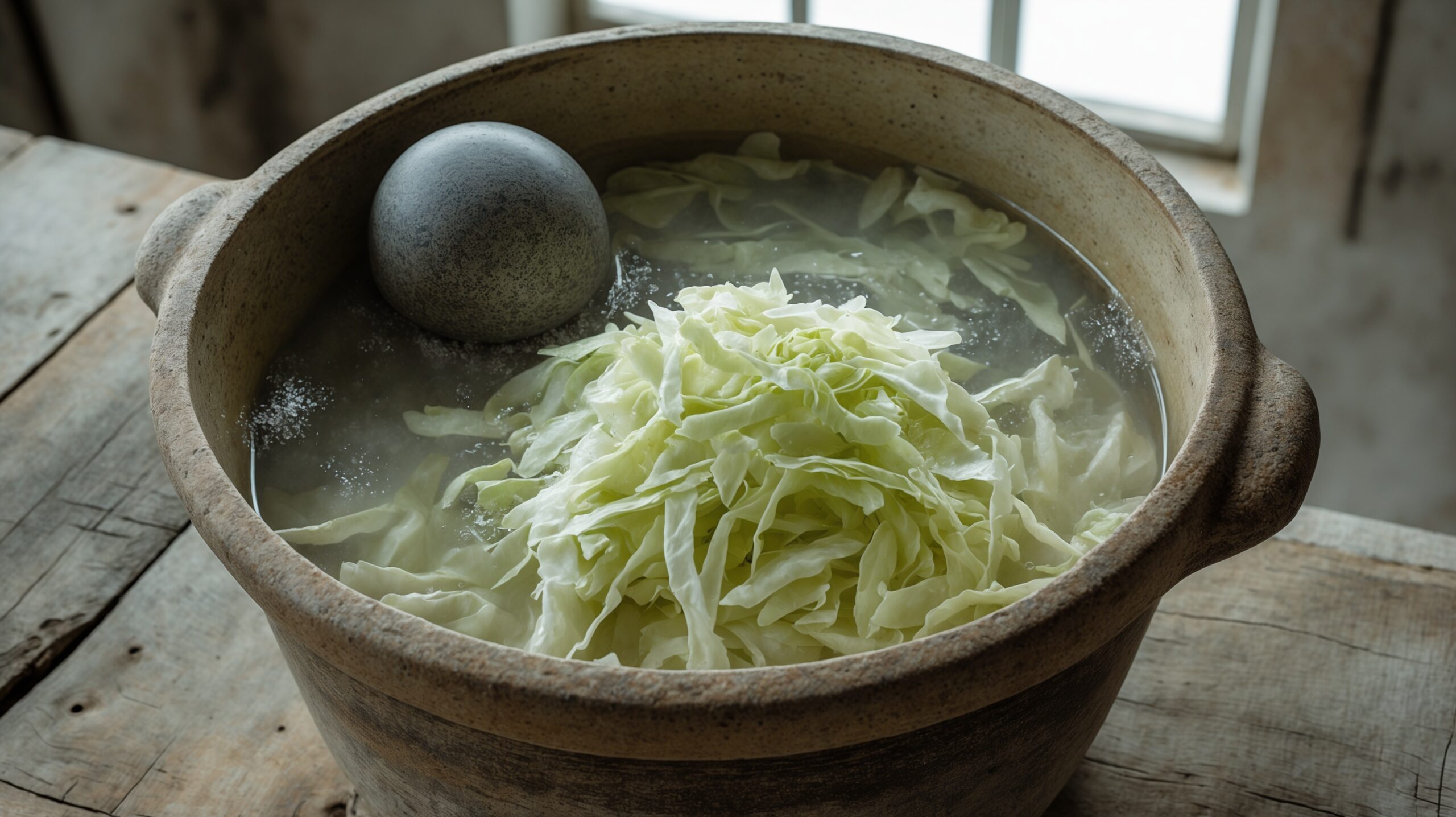
Making sauerkraut in a crock means scaling the standard 2% salt-to-cabbage ratio up to 5–25 pounds of cabbage, packing it under a weight, and fermenting at 70–75°F for 3–4 weeks in a container with 4–5 inches of headspace above the kraut.
A crock scales sauerkraut past what a single mason jar can hold. Use 3 tablespoons of pickling salt per 5 pounds of shredded cabbage (about 2% by weight), and leave the crock’s rim 4–5 inches above the packed cabbage so rising foam has room. Ferment at 70–75°F for 3–4 weeks, or 60–65°F for 5–6 weeks. Water-sealed crocks need no checking until done; open crocks with a plate and weighted jars should be checked 2–3 times a week and skimmed if white scum forms.
Ingredients
- 5 lb (2.3 kg) green cabbage per batch — scale in 5 lb increments for larger crocks (25 lb fills a 5-gallon crock to a workable fermenting depth)
- 3 tablespoons (about 54 g) non-iodized pickling or canning salt per 5 lb cabbage (roughly 2% of the cabbage’s weight — matches our Sauerkraut Salt Calculator for any batch size)
- Backup brine, if needed: 1½ tablespoons pickling salt per quart of water, boiled and cooled
Equipment
- A food-grade fermentation crock, such as the Humble House 1/2 Gallon Sauerkrock (paid link) — its water-channel lid acts as a built-in airlock and comes with ceramic weights included
- A large mixing bowl for salting and massaging each 5 lb batch before it goes into the crock
- A clean kitchen towel, if your crock doesn’t have a water-seal lid
Step-by-Step
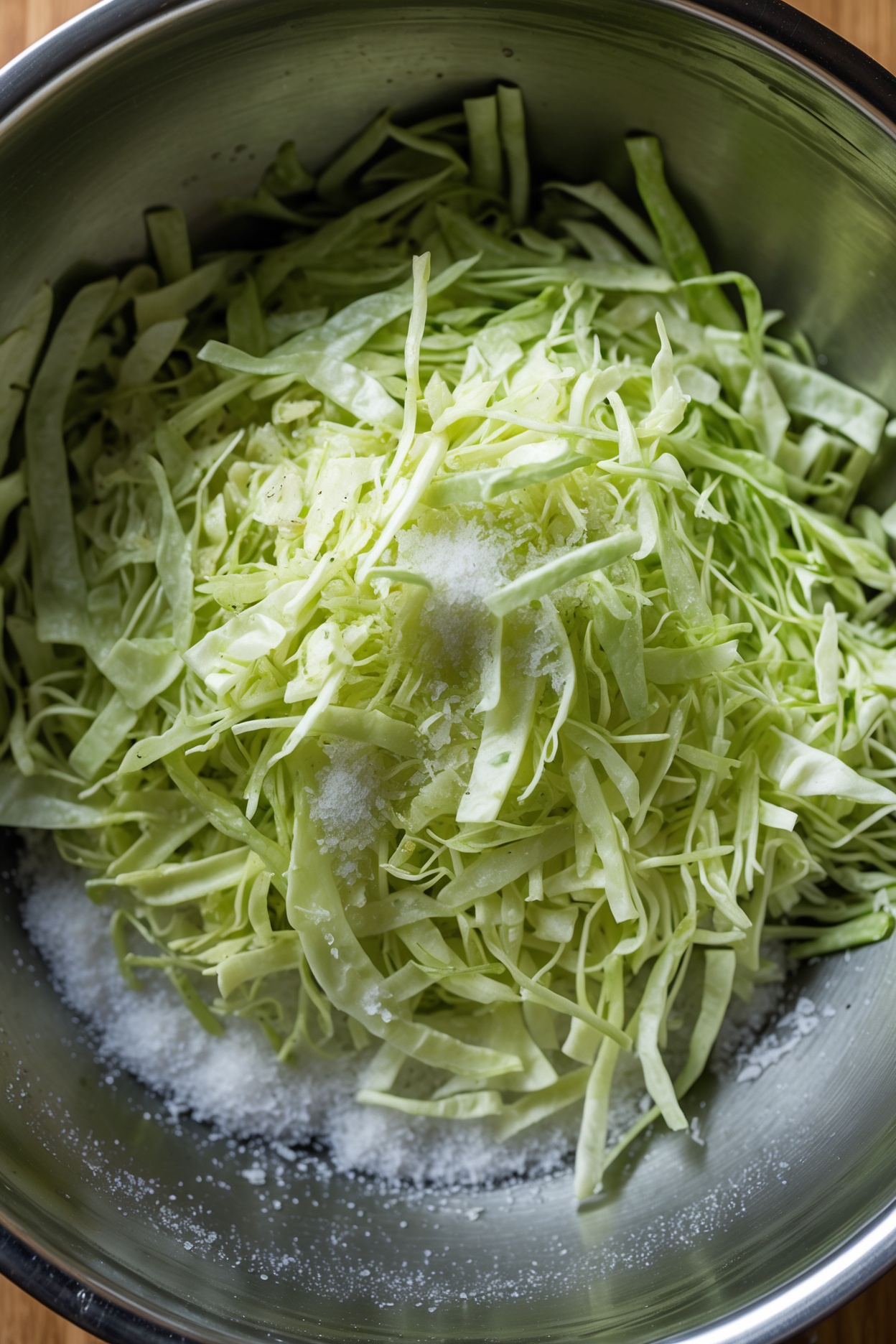
- Weigh the cabbage in 5 lb batches. Remove the outer leaves and set 2–3 aside. Quarter, core, and shred the rest thinly.
- Salt each batch. Sprinkle 3 tablespoons of pickling salt over every 5 lb of shredded cabbage.
- Massage until brine pools. Work the salt into the cabbage with clean hands for 5–10 minutes, until it softens and releases liquid.
- Pack the crock in layers. Press each batch firmly into the crock, pushing out air pockets, before adding the next.
- Cover and weight it down. Lay the reserved outer leaves on top, then add ceramic crock weights (most crock kits include them) or a plate weighted with two brine-filled quart jars. The cabbage must stay fully under the brine.
- Check headspace. The crock’s rim should sit 4–5 inches above the packed cabbage — fermentation produces foam and gas that need somewhere to go.
- Seal or cover. Fill the water channel if your crock has a water-seal lid. For an open crock, cover it with a clean kitchen towel instead.
- Ferment at room temperature. Hold it at 70–75°F for 3–4 weeks, or 60–65°F for 5–6 weeks, out of direct sunlight. Start tasting after day 7–10.
Why Use a Crock Instead of a Jar for Sauerkraut?
A crock holds 5–25+ pounds of cabbage in one batch, while a mason jar handles 2–3 pounds at most, making a crock the practical choice once you’re fermenting sauerkraut for a household rather than a single jar at a time.
Our jar method for sauerkraut covers the same 2% salt ratio on a 2-pound, single-jar scale — it’s the right starting point for a first batch. A crock becomes worth the investment once you’re restocking every few weeks rather than making a one-off jar. Traditional stoneware crocks also add a practical feature jars don’t have: a built-in water-seal lid that vents fermentation gas automatically, so the batch doesn’t need daily burping. If you haven’t picked a crock yet, our crock buying guide compares a half-gallon starter kit against a 3-gallon option for bigger households.
How Much Headspace Does a Sauerkraut Crock Need?
A sauerkraut crock needs its rim to sit 4–5 inches above the level of the packed, weighted cabbage, according to North Carolina State University Extension’s home food preservation guidance — this gap catches the foam and bubbling that fermentation produces over the first 1–2 weeks.
This is one of the clearest differences between jar and crock fermentation. A quart jar only has an inch or two of headspace to spare, so it needs loosening or burping to release gas. A properly sized crock has enough vertical room that gas escapes past the weight and up through the brine without the batch overflowing. Skipping this margin is the single most common reason a first-time crock ferment bubbles over onto the counter. If a crock is packed too close to the rim, split the batch into a second, smaller container rather than forcing everything into one vessel.
Only ferment in food-grade containers — a glazed stoneware crock, food-grade plastic pail, or glass. Washington State University Extension specifically warns against garbage cans or plastic “scrub” buckets, which aren’t rated for food contact and can leach into the brine or produce off-flavors.
What Temperature Keeps a Crock Fermenting Safely?
Sauerkraut ferments fully in 3–4 weeks at 70–75°F, in 5–6 weeks at 60–65°F, and effectively stops below 60°F, while temperatures above 75°F can soften the texture of the finished kraut, per extension guidance from Washington State University and NC State University.
A crock’s larger thermal mass makes it more forgiving of small temperature swings than a jar, but it still needs a stable spot — a kitchen corner away from a stove, heater vent, or window that gets direct afternoon sun. A cool basement in the 60–65°F range isn’t a problem; it just means a longer wait and, many fermenters find, a more complex sour flavor.
If your kitchen runs cool in winter, don’t move the crock somewhere warm to speed things up — a spot above 75°F is exactly the range extension guidance flags for softer, mushier kraut. Wrapping the crock in a towel to even out drafts works better than chasing a warmer room.
Is White Scum on Crock Sauerkraut Normal?
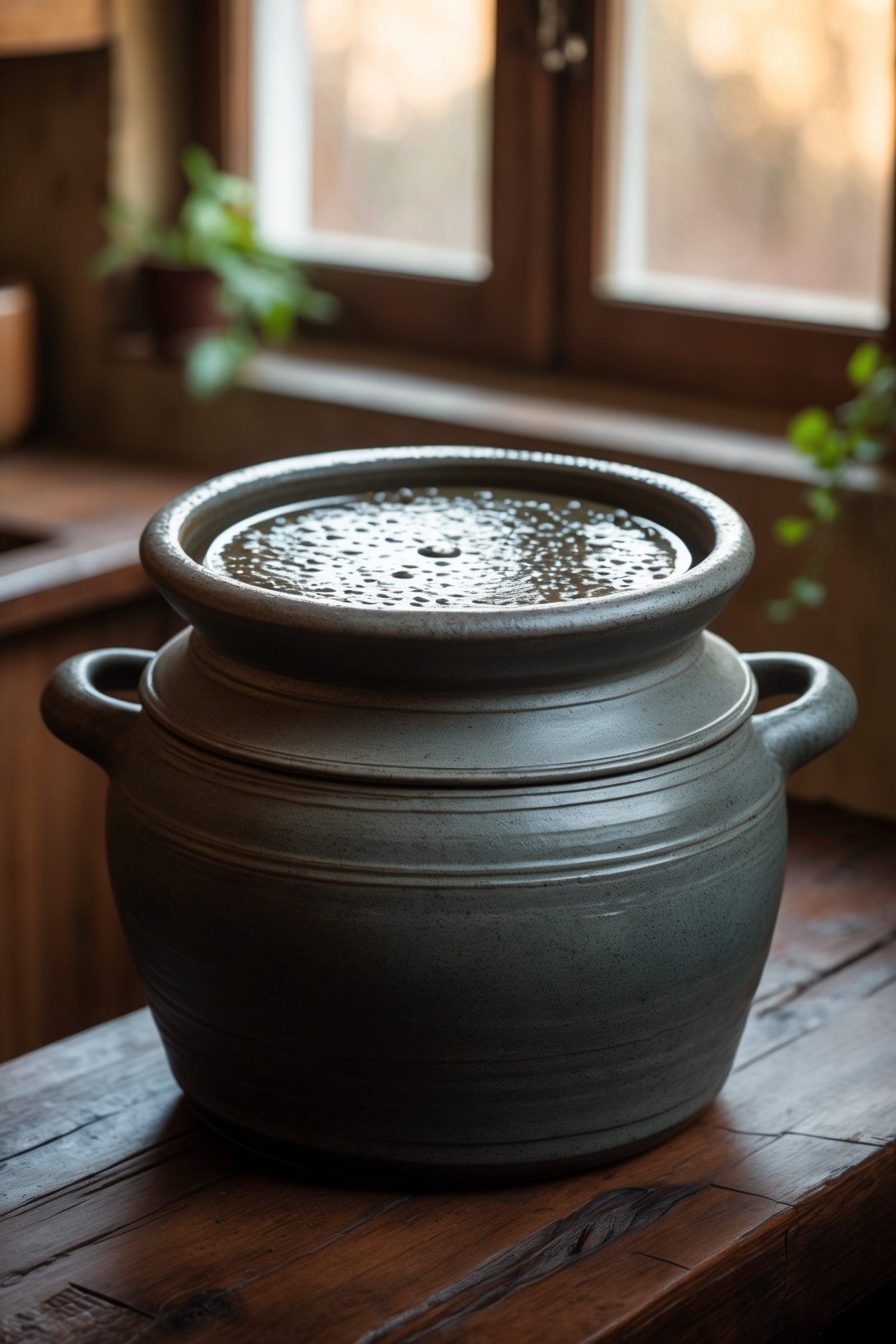
A thin white film on crock sauerkraut is kahm yeast, and Washington State University Extension lists it as common and not a reason to discard a batch — skim it off during routine checks and keep fermenting. A pink, orange, or fuzzy growth is different and should be discarded.
If you’re using the plate-and-weighted-jars method, check the crock 2–3 times a week and skim off any white scum you see; it reforms harmlessly as long as the cabbage stays submerged. A double-bagged brine weight seals against the container’s edges and mostly avoids this step, since little air reaches the surface. Either way, a sulfurous smell in the first week is also normal and fades within a few days as fermentation gets going.
This is general information, not medical advice. Discard the batch if you see pink or orange discoloration, fuzzy mold, or sliminess, or if it smells rotten rather than sharply sour — extension guidance links pink growth to excess or uneven salting or cabbage that slipped above the brine. See our fermented food safety guide for a full checklist before tasting a questionable batch.
How Do You Know When Crock Sauerkraut Is Ready?
Crock sauerkraut is ready once it tastes pleasantly sour with a clean crunch and the vigorous bubbling of the first 1–2 weeks has settled down, which typically lines up with the 3–4 week mark at 70–75°F or 5–6 weeks at 60–65°F.
Start tasting around day 7–10 and check every few days after that. A longer ferment trades some crunch for a stronger, tangier flavor — there’s no single correct stopping point, only personal preference within the safe window. Once it tastes right, move the crock to a refrigerator (it keeps several months cold) or pack it into jars.
💬 My Take
I switched my big batches from the plate-and-jars method to a water-sealed crock a few years back, and the real win wasn’t less mess — it was fewer decisions. With a plate and weighted jars, I was checking the crock every other day out of habit, skimming scum that wasn’t actually a problem. A water-seal lid removes that temptation entirely: you pack it, fill the channel, and leave it alone until the calendar says it’s time to taste. For a first crock batch, that’s one less thing to second-guess.
- Use 3 tablespoons pickling salt per 5 lb cabbage (~2% by weight), scaled up for bigger crocks
- Leave 4–5 inches of headspace between the crock’s rim and the packed cabbage
- Ferment at 70–75°F for 3–4 weeks, or 60–65°F for 5–6 weeks
- White scum is normal and gets skimmed off; pink, orange, or fuzzy growth means discard the batch
- Check open crocks (plate + weighted jars) 2–3 times a week; water-sealed crocks can be left undisturbed
Frequently Asked Questions About Making Sauerkraut in a Crock
Can I use a plastic container instead of a stoneware crock?
Yes, as long as it’s explicitly food-grade plastic, such as a food-grade plastic pail — extension guidance warns against repurposing garbage cans or plastic buckets that aren’t rated for food contact.
How many pounds of cabbage fit in a typical crock size?
A half-gallon crock comfortably holds a single 5 lb batch, while a 3-gallon crock suits 15–25 lb of cabbage across multiple salted batches, leaving the required 4–5 inches of headspace at the top.
Do I need to check the crock every day?
No. Checking 2–3 times a week is enough if you’re using the plate-and-weighted-jars method; a water-sealed crock or a double-bagged brine weight can be left completely undisturbed until the fermentation time is up.
Can I ferment kimchi or pickles in the same crock?
Yes — the same crock works for kimchi, whole cucumbers, or other vegetables; only the salt ratio and fermentation time change per recipe. It’s a less practical choice for liquid ferments like kombucha, where a jar is easier to manage.
Sources and Further Reading
- Washington State University Extension (Lewis County) — Sauerkraut Making directions: salt ratios, weighting methods, temperature and scum guidance
- NC State University Cooperative Extension (Henderson County) — Fall Food Preservation: Sauerkraut, citing USDA home-canning guidance on headspace and fermentation temperature
- fermentationmadesimple.com — Is Fermented Food Safe? A Beginner’s Safety Guide (internal safety reference)
- fermentationmadesimple.com — Sauerkraut Salt Calculator (internal salt-ratio cross-check)