
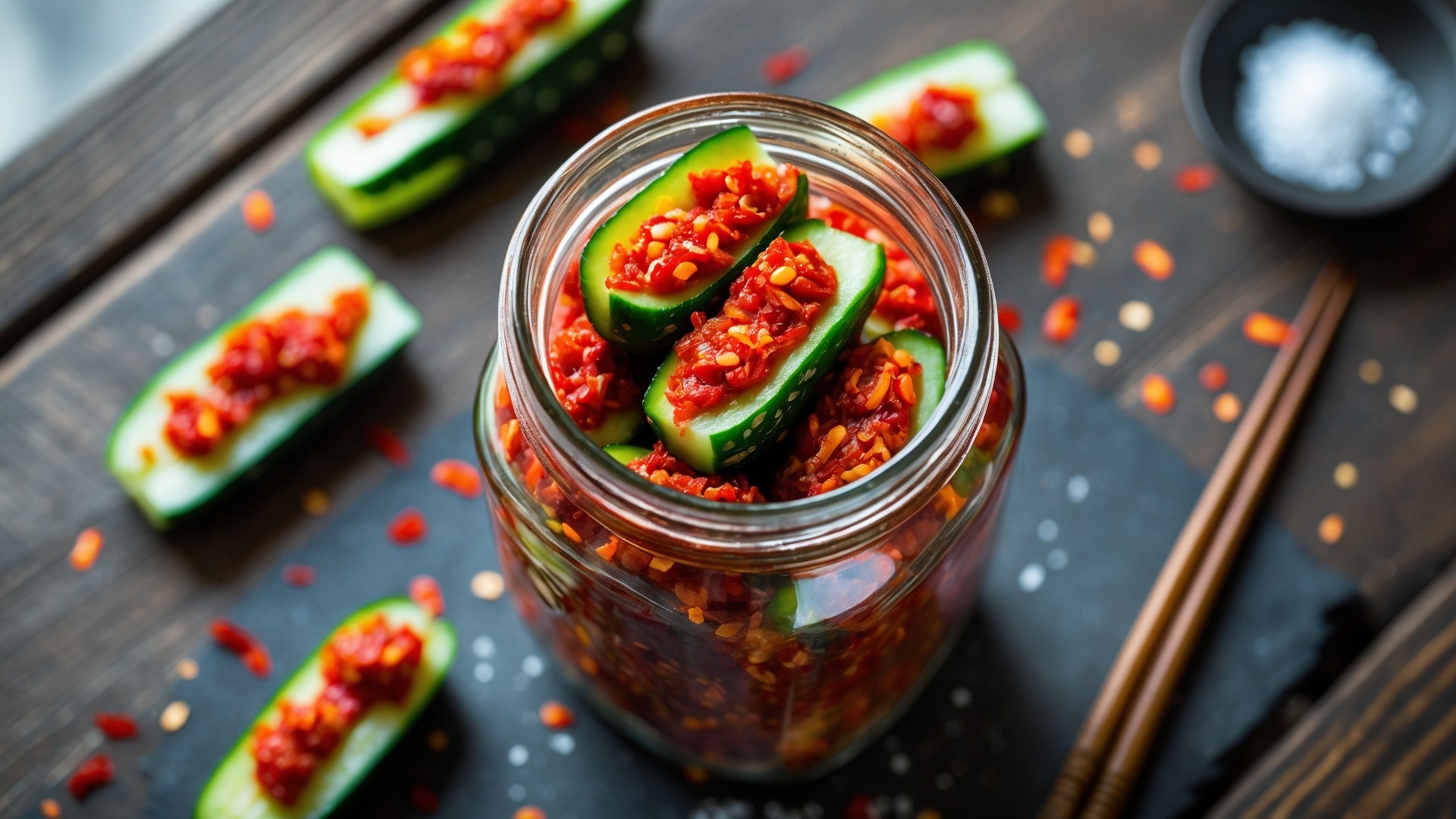
Cucumber kimchi, known as oi sobagi, stuffs small pickling cucumbers with a gochugaru-garlic filling and ferments them for 12 to 24 hours at room temperature before refrigeration. Unlike napa cabbage kimchi, oi sobagi stays crisp, develops flavor fast, and is best eaten within about two weeks.
Oi sobagi uses small Korean, Persian, or kirby cucumbers stuffed with a gochugaru, garlic, ginger, and fish sauce filling. A hot brine of about 100 grams (½ cup) of coarse salt per liter of water, poured over the cucumbers for 30 minutes to 2 hours, keeps them crunchy instead of soggy. Fermentation runs 12 to 24 hours at room temperature, then the kimchi moves to the fridge, where flavor peaks around day 3 to 5 and the batch stays good for roughly two weeks.
Ingredients
- 6 to 8 small Korean, Persian, or kirby cucumbers (about 2.5 lbs / 1.1 kg) — not large English or slicing cucumbers
- ½ cup (100 g) coarse sea salt, for the brine
- 4 cups (1 L) water, for the brine
- 5 tablespoons gochugaru (Korean red pepper flakes (paid link))
- 2 tablespoons minced garlic
- 1 teaspoon minced ginger
- 2 tablespoons fish sauce or salted shrimp (saeujeot)
- 1 tablespoon sugar or rice syrup
- ½ cup chopped Korean chives (buchu) or scallions
- ¼ cup julienned or grated carrot (optional)
Step-by-Step
- Trim the ends off each cucumber, then cut each one crosswise into 2 to 3 pieces, about 2 to 3 inches (5–7 cm) long.
- Stand each piece on one cut end. Slice two perpendicular cuts lengthwise through the piece, stopping about three-quarters of the way down so the quarters stay attached at the base, forming an X-shaped pocket.
- Bring the water to a boil and stir in the salt until it dissolves. Let the brine cool for 2 to 3 minutes, then pour it — still hot — over the cucumber pieces. Using it hot, not cold, is what keeps the texture crunchy instead of soft.
- Soak the cucumbers in the brine for 30 minutes to 2 hours, flipping once halfway, until a piece bends without snapping. Thicker cucumbers need the longer end of that range.
- Drain the cucumbers well for about 10 minutes and pat them dry. Most recipes skip rinsing, since the surface salt is part of what keeps the texture firm.
- Mix the gochugaru, garlic, ginger, fish sauce, and sugar into a thick paste. Fold in the chives and carrot.
- Stuff each cucumber pocket with the filling, pressing it gently into the slits without squeezing the cucumber itself out of shape.
- Pack the stuffed cucumbers into a clean jar or container, cut-side up, and cover loosely.
- Leave the jar at room temperature for 12 to 24 hours, until you see small bubbles and smell a light tang, then move it to the refrigerator.
- Chill for at least a few hours before eating. Flavor peaks around day 3 to 5 in the fridge.
Why Does the Brine Need to Be Hot Instead of Cold?
A hot brine shocks the cucumber’s cell walls before they have time to soften, which locks in crunch. Cold or room-temperature brine draws water out more slowly and leaves the cucumbers limp by the time fermentation finishes.
Cucumbers are mostly water held inside cell walls built from pectin. Salt pulls that water out through osmosis no matter what temperature the brine starts at, but a near-boiling brine also briefly firms the pectin on contact, similar to blanching. That combination — fast salt penetration plus a quick heat-set — is why recipes built around whole or large-cut cucumber pieces, like oi sobagi, call for pouring the brine on hot rather than letting the cucumbers sit in room-temperature salt water.
This matters more for oi sobagi than for sliced, loose-style cucumber kimchi, where cucumbers are cut small and mixed directly with seasoning. Smaller pieces release water fast regardless of brine temperature and are meant to be eaten within a day or two, so some quick recipes skip the hot-brine step entirely. Stuffed oi sobagi pieces are larger and meant to hold their shape through a longer fridge life, so the hot-brine step carries more weight here.
Persian cucumbers, sold in 1-pound bags at most US grocery stores, work as a near-identical substitute for Korean cucumbers in this recipe — thin skin, small seed cavity, and the same hot-brine timing applies. Kirby cucumbers (the small bumpy ones sold for pickling) work too, but their skin is slightly thicker, so give them the longer end of the 30-minute-to-2-hour soak.
How Long Does Cucumber Kimchi Need to Ferment?
Cucumber kimchi ferments for 12 to 24 hours at room temperature, then continues more slowly in the refrigerator, where flavor typically peaks around day 3 to 5. That is far shorter than the weeks or months napa cabbage kimchi takes to fully develop.
Room temperature (around 68–72°F / 20–22°C) is warm enough for the lactic acid bacteria on the cucumber surface to get going without racing ahead of food-safety guidelines. Some recipes use an even shorter room-temperature window — as little as 2 to 3 hours — to “jump-start” fermentation before the jar goes straight into the fridge, trading a faster timeline for a milder, less tangy result. Either approach works; the difference is how sour the kimchi tastes on day one.
Because cucumbers hold more water than cabbage or radish, the fermentation window for oi sobagi is also narrower on the other end. Left at room temperature much past 24 hours, the texture starts softening faster than the flavor improves, which is the main reason this kimchi moves to the fridge sooner than most other kimchi varieties on this site.
Which Cucumbers Work Best for Oi Sobagi?
Small Korean cucumbers, Persian cucumbers, or kirby (pickling) cucumbers work best for oi sobagi. Their thin skin and small seed cavity hold up through brining and stuffing, while large English or standard slicing cucumbers turn watery and dilute the filling.
Standard grocery-store slicing cucumbers carry a thicker, often waxed skin and a wider band of soft seeds at the center. Once salted, that seed core breaks down fastest and releases the most liquid, which waters down the gochugaru filling and leaves the finished kimchi runny instead of clinging to the cucumber. Smaller, thinner-skinned varieties have proportionally less of that soft center, so they hold the stuffing better and stay firmer through a week or two in the fridge.
How Long Does Cucumber Kimchi Keep, and When Should You Throw It Out?
Cucumber kimchi keeps for about two weeks in the refrigerator, with the best texture in the first 3 to 5 days. A strong, vinegary smell as it ages is normal over-fermentation, not spoilage — the kimchi is safe to eat, just more sour.
The BC Centre for Disease Control sets a safety target of pH 4.6 or lower for fermented vegetables, reached within a few days at room temperature or refrigerated. Oi sobagi’s quick brine and short ferment generally gets there fast, but texture is the real tell for this watery vegetable: a sour smell or tangy taste alone is normal, while a soft, slimy texture or visible mold means the batch should be thrown out, not eaten. This is general food-safety guidance, not medical advice — when in doubt, discard the batch.
Because cucumbers carry more water than cabbage, radish, or garlic, oi sobagi turns soft sooner than those other ferments even when it is perfectly safe. If a batch tastes fine but has gone limp past the two-week mark, texture rather than safety is usually the reason to stop eating it. For a full walkthrough of sight, smell, and texture checks that apply across ferments generally, see How to Tell If Your Ferment Has Gone Bad.
How Is Oi Sobagi Different From Regular Napa Cabbage Kimchi?
Oi sobagi skips the hours-long salting and draining step that napa cabbage kimchi requires, ferments in 12 to 24 hours instead of weeks, and is meant to be eaten within about two weeks rather than stored for months. The two share a filling style but very little else in method or shelf life.
Napa cabbage for kimchi is typically salted and left to drain for 1 to 2 hours or longer before rinsing, which pulls out enough water that the cabbage can hold a stronger seasoning paste and still ferment slowly over weeks. Our Easy Kimchi Recipe for Beginners and Kimchi Salt Calculator both target a retained salt level of roughly 2 to 3% after that draining step — a number that does not carry over to oi sobagi, where the cucumbers are briefly brined rather than salted and drained, and most of that salt stays on the surface rather than fully absorbed.
Other kimchi variants on this site show the same family resemblance with different methods: Kkakdugi (Cubed Radish Kimchi) uses a dry-salt method similar to cabbage, while Baek Kimchi (White Kimchi, No Chili) and Mul Kimchi (Water Kimchi) both ferment in a thin brine closer to oi sobagi’s timeline than to cabbage kimchi’s.
💬 My Take
Most people’s first batch of oi sobagi disappoints them for the wrong reason — they wait for it to taste like a jar of aged napa kimchi, and it never will. Cucumbers don’t hold up to a long ferment the way cabbage does, so the whole recipe is built around a short, fast window instead of a slow one. Once I stopped treating it like “kimchi that happens to use cucumber” and started treating it like a quick pickle with kimchi seasoning, the timing made a lot more sense: brine it hot, stuff it, give it one day on the counter, then eat it over the next week or two while it’s still crisp. Trying to stretch it further just trades crunch for sourness without much upside.
- Use small Korean, Persian, or kirby cucumbers — large slicing cucumbers turn watery and dilute the filling
- Pour the brine (about 100 g salt per liter of water) on hot, not cold, to keep the texture crunchy
- Ferments in just 12 to 24 hours at room temperature, versus weeks for napa cabbage kimchi
- Flavor peaks around day 3 to 5 in the fridge; best eaten within about two weeks
- Soft, slimy texture or visible mold means discard — a sour smell or tangy taste alone is normal
Frequently Asked Questions About Cucumber Kimchi
Can I use regular slicing cucumbers instead of Korean cucumbers?
You can, but the result will be softer and wetter. Standard slicing or English cucumbers carry a larger, wetter seed core that breaks down fast once salted, diluting the filling. If that is all you have, scoop out the seed core before stuffing to reduce the extra liquid.
Do I need to rinse the cucumbers after brining?
No. Most recipes drain the cucumbers well and pat them dry without rinsing, since the surface salt that remains is part of what keeps the texture firm through fermentation and storage.
Can I make a quick, unstuffed version instead?
Yes. A loose-style version — cucumbers cut into half-moons, salted briefly, and tossed directly with the seasoning paste instead of stuffed — ferments on the same general timeline and is a faster option when you are short on time or small cucumbers.
Is cucumber kimchi vegan?
Not by default. Traditional recipes use fish sauce or salted shrimp (saeujeot) for depth of flavor. Swap in soy sauce or a vegan fish sauce alternative and the recipe ferments the same way, though the flavor will be milder.
Why did my cucumber kimchi turn soft after a few days?
Soft texture after several days in the fridge is usually just age catching up with a naturally watery vegetable, not spoilage — cucumbers hold up for about two weeks, shorter than cabbage or radish kimchi. If the softness comes with a slimy coating or off smell rather than just a tangy one, treat that as spoilage and discard the batch.
Sources and Further Reading
- BC Centre for Disease Control — Fermented Foods Guideline for kimchi: brine concentration ranges (5–15%), pH ≤4.6 safety target, and fermentation time/temperature guidance.
- Oregon State University Extension — Guidance on distinguishing normal over-fermentation (sour smell, vinegary taste) from spoilage (soft, slimy texture) in kimchi.
- Crazy Korean Cooking — Practical brine ratio, soak time, and “bends without snapping” doneness test for stuffed cucumber kimchi.
- Future Dish — Hot-brine technique for keeping cucumbers crisp, and quick room-temperature fermentation timing for oi sobagi.