
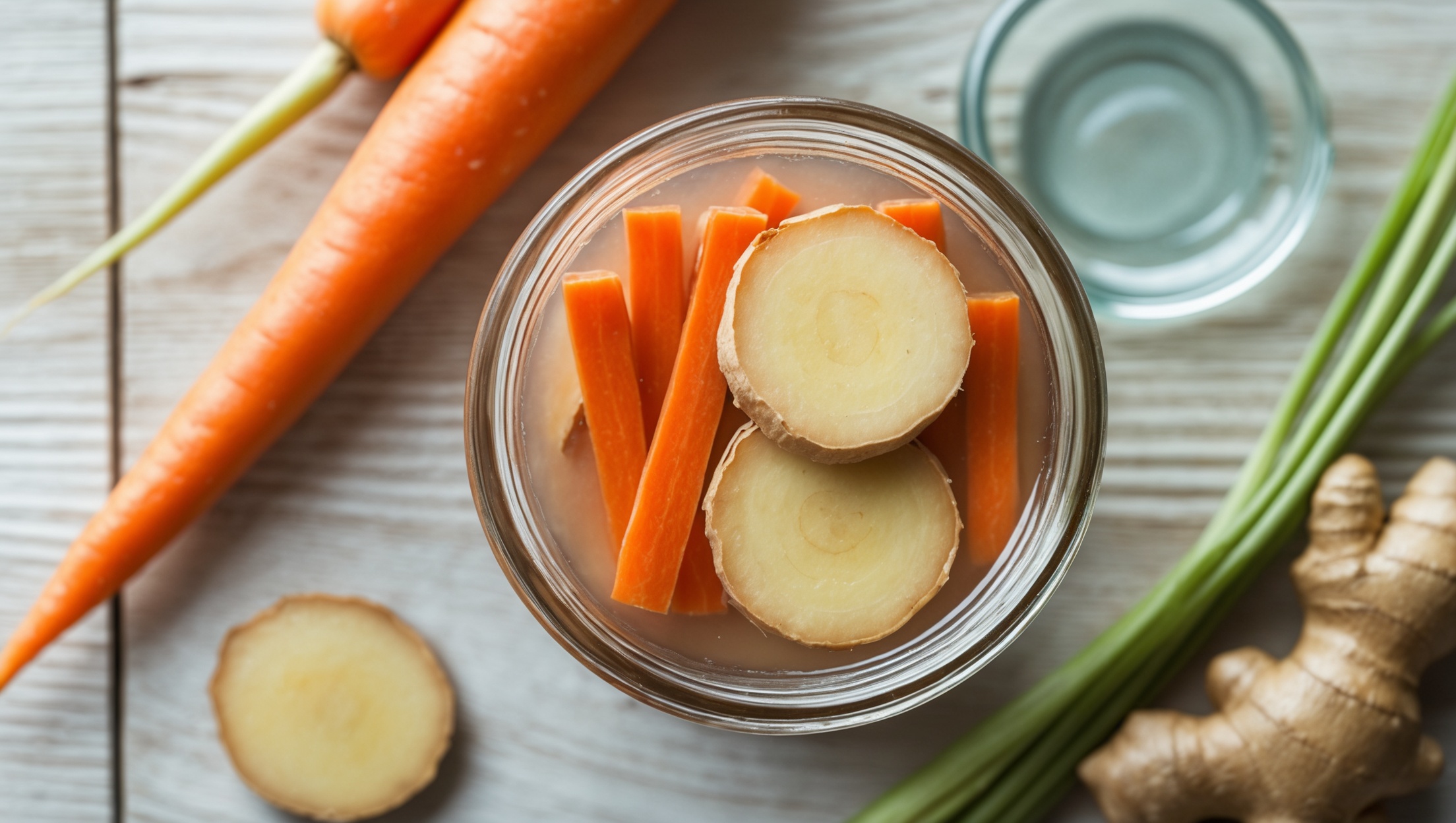
Fermented carrots with ginger use a 5% salt brine — 50 grams of salt per liter of water — and turn tangy within 5 to 10 days at room temperature. Cut into sticks or coins, carrots ferment faster than whole cucumbers or shredded cabbage because more surface area touches the brine.
Fermented carrots with ginger need a 5% brine (50g salt per liter of water), 5 to 10 days at 68–72°F to finish, and a weight to keep them fully submerged. Sliced carrots ferment roughly twice as fast as whole cucumbers because the cut surface exposes more of the vegetable to the brine. Kept submerged and refrigerated, they hold for several months — the acidity, not the cold, is what preserves them.
Ingredients
- 1 lb carrots, peeled and cut into sticks or ¼-inch coins
- 1 to 2 inches fresh ginger, peeled and thinly sliced
- 2 garlic cloves, smashed (optional)
- Water + fine sea salt, 5% brine — see our Salt & Brine Calculator
- ½ teaspoon whole coriander or mustard seeds (optional)
- A fermentation glass weight (paid link) to keep everything under the brine
Step-by-Step
- Cut the carrots into sticks or coins no thicker than ¼ inch — thinner cuts ferment faster and more evenly.
- Mix the brine: dissolve 50g of fine sea salt into 1 liter of water, stirring until fully clear.
- Pack the carrots, ginger, garlic, and optional spices tightly into a clean jar.
- Pour the brine over the vegetables until fully covered, leaving 1 inch of headspace.
- Weigh everything down so no carrot sticks float above the liquid, then cover loosely.
- Ferment at 68–72°F for 5 to 10 days, checking daily that the carrots stay submerged.
- Taste starting on day 5. Once the sourness and crunch match what you want, refrigerate.
What Salt Ratio Works Best for Fermented Carrots?
A 5% brine — 50 grams of salt per liter of water — is the working ratio for fermented carrot sticks or coins. That figure comes from the BC Centre for Disease Control’s table of lacto-fermentation salt concentrations by vegetable, which lists carrots separately from shredded cabbage.
Carrots sit at a different point on the salt scale than sauerkraut. Shredded cabbage uses 2% of the vegetable’s own weight because it releases enough liquid on its own to form a brine. Carrot sticks don’t release liquid the same way when just salted and left — they need an external brine poured over them, measured as a percentage of the water instead of the vegetable. At 5%, carrots stay firm through the full ferment without turning mushy, and the salt load is high enough to suppress spoilage organisms while lactic acid bacteria take over.
Weigh the salt rather than measuring by the spoon. The National Center for Home Food Preservation notes that flake salt varies too much in density for tablespoon measurements to stay consistent — a digital kitchen scale removes that variable entirely. Our Salt & Brine Calculator converts any jar size into the exact gram count.
Don’t reuse a 2% cabbage ratio for carrots just because it’s the number most beginners learn first. The two ferments work on different mechanics — cabbage self-brines from its own cell water, carrots don’t release enough liquid to do that, so an under-salted carrot brine dilutes fast and risks softening before the lactic acid bacteria establish themselves.
Why Add Ginger to Fermented Carrots?
Ginger adds sharp, peppery aromatics to fermented carrots through gingerol, the compound responsible for raw ginger’s bite. It does not change the salt ratio or fermentation time — its role here is flavor, not preservation.
Gingerol is the pungent oil found in fresh ginger root; it mellows slightly during fermentation into a rounder, less sharp heat than raw ginger has straight off the knife. A couple of thin slices are usually enough for a pint-sized batch — more turns the brine assertively spicy within the first few days. Garlic and whole coriander or mustard seed are common additions alongside it, each contributing its own aromatic layer without altering the core 5% brine.
How Long Do Fermented Carrots Take to Ferment?
Fermented carrot sticks or coins typically finish in 5 to 10 days at 68–72°F (20–22°C). That is roughly half the time whole cucumber pickles need, because the cut surface lets brine reach the center of each piece almost immediately.
The timeline moves with temperature. A kitchen sitting near 72°F often finishes on the faster end, around day 5 to 6, while a cooler spot closer to 65°F can take the full 10 days or slightly longer. Thicker coins ferment a little slower than thin matchstick cuts, since the center of a thick piece takes longer to acidify than a thin one.
Readiness is a taste call, not a hard deadline. The brine typically turns faintly cloudy by day 3 to 4 as fermentation gets underway, and the carrots taste tangy through to the center once they’re done — not just on the surface. Carrots fermented past 10 days keep developing sourness and will soften gradually; that is a flavor preference, not a sign of spoilage on its own.
How Can You Tell If Fermented Carrots Have Gone Bad?
Fermented carrots have gone bad if they turn soft and mushy, develop slimy texture, or smell disagreeable rather than sharply sour. A thin white film on the brine surface is usually harmless kahm yeast, not the fuzzy, raised mold that signals the batch should be discarded.
Kahm yeast forms a flat, often slightly wrinkled white film across the surface of the brine. It’s cosmetic — skim it off, and the carrots underneath are typically fine. Mold looks different: raised, fuzzy, and often colored blue, green, gray, or black, growing in distinct spots rather than a flat sheet. Virginia Tech Cooperative Extension’s fermentation guidance is direct on this point — if the vegetables themselves turn soft, slimy, or develop a disagreeable odor, discard them.
This article is not medical advice. If you see fuzzy, raised mold of any color, or the carrots themselves turn slimy or smell off, discard the entire batch rather than trying to scoop around the affected spot. When in doubt, throw it out and start a fresh jar.
How Long Do Fermented Carrots Last in the Fridge?
Refrigerated fermented carrots kept fully submerged in their brine hold for several months. The BC Centre for Disease Control treats pH 4.6 as the critical safety threshold for fermented vegetables, and a properly finished carrot ferment sits well under that line.
The acid does the preserving, not the cold. Cold storage simply slows the bacteria down so the carrots stop souring as quickly; it isn’t what keeps them safe. Carrots that are exposed above the brine line in the fridge dry out and discolor faster than submerged ones, so top off the liquid or push everything back under before sealing the jar for storage.
💬 My Take
Most beginner guides treat carrots as a drop-in replacement for cucumbers or cabbage, with the same 2 to 3% salt figure copied across every vegetable. Carrots are the one common ferment where that shortcut actually produces a worse result — too little salt and the cut surfaces soften before the lactic acid bacteria get ahead of everything else in the jar. The 5% figure isn’t a stricter rule for its own sake; it matches how little liquid carrots release compared to cabbage, so the brine has to do more of the work on its own.
- Brine ratio: 5% salt by water weight — 50g salt per liter of water
- Ferment time: 5 to 10 days at 68–72°F (20–22°C)
- Cut thinner for faster, more even fermentation — sticks or ¼-inch coins
- Harmless: a flat white kahm yeast film on the brine surface
- Discard the batch: fuzzy raised mold, sliminess, or a disagreeable odor
- Fridge life: several months, submerged and below pH 4.6, per BC Centre for Disease Control guidance
Frequently Asked Questions About Fermented Carrots
These questions come up most often once the basic brine and timing are settled.
Can I use baby carrots instead of regular carrots?
Yes, though whole baby carrots ferment slower than cut regular carrots since they have less exposed surface area. Halving them lengthwise speeds things up to match the 5 to 10 day window.
Do I need a starter culture to ferment carrots?
No. Raw carrots carry enough naturally occurring lactic acid bacteria on their skin to ferment in a plain salt brine, the same way cabbage, cucumbers, and most raw vegetables do.
Can I make fermented carrots without ginger?
Yes. Ginger is a flavor addition, not a requirement for fermentation to work. The 5% brine and 5 to 10 day timeline stay the same with or without it.
Why did my fermented carrots turn soft instead of staying crunchy?
Under-salted brine, warm room temperatures above 75°F, or carrots left fermenting well past 10 days are the most common causes. Using the full 5% ratio and checking for doneness starting on day 5 usually fixes it.
Can I reuse the brine from a finished batch of fermented carrots?
A small splash can jump-start a new batch, but it isn’t a substitute for making a fresh, properly measured 5% brine — reused brine dilutes unpredictably and loses salt concentration with each reuse.
Sources and Further Reading
The following sources informed the ratios, timing, and safety guidance in this article.
- BC Centre for Disease Control · bccdc.ca · Fermented Foods Guidance 3.1, including Table 3 salt/brine concentrations by vegetable and the pH 4.6 safety threshold for fermented vegetables.
- National Center for Home Food Preservation, University of Georgia · nchfp.uga.edu · General guidance on salt types and weighing versus volume measurement for fermenting and pickling.
- Virginia Tech Cooperative Extension · pubs.ext.vt.edu · Vegetable fermentation guidance (FST-328) on temperature ranges and spoilage signs for home vegetable ferments.
Save this recipe on Pinterest for your next batch.
Related: Salt & Brine Calculator · How Long to Ferment Vegetables · Fermented Okra · Fermented Cauliflower · Which Vegetables Can You Ferment?