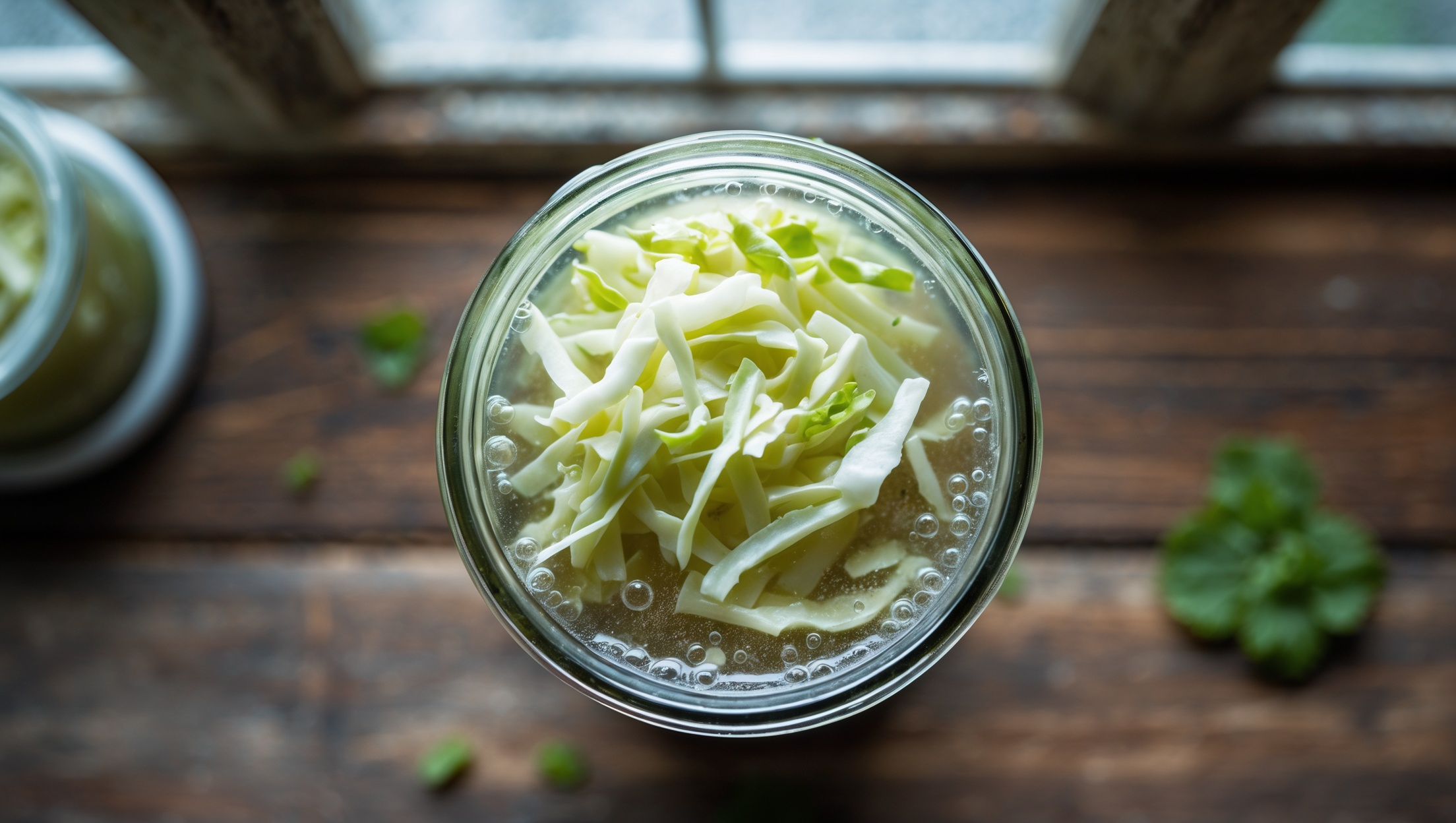
Lacto-fermentation is a preservation process where salt creates conditions that favor lactic acid bacteria already living on vegetables, letting them convert natural sugars into lactic acid. That acid is what makes sauerkraut sour, kimchi tangy, and keeps both safe to eat without refrigeration or vinegar.
New to fermenting? Our Fermentation for Beginners: The Complete Guide covers everything you need for your first jar. This post focuses on the science behind why the process actually works.
How Does Salt Turn Vegetables Into a Lacto-Ferment?
Salt draws water out of vegetables through osmosis, creating a brine that suppresses many spoilage-causing bacteria while lactic acid bacteria tolerate the salty, low-oxygen environment. Once competing microbes are held back, lactic acid bacteria multiply and convert the vegetables’ natural sugars into lactic acid.
Most vegetable ferments use around 2% salt by weight as a starting point — the same ratio behind this site’s Fermentation Salt & Brine Calculator. At that concentration, salt pulls enough moisture out of shredded cabbage to submerge it in its own brine within hours, while staying low enough that lactic acid bacteria can multiply within a day or two.
Lactic acid bacteria (LAB) are a group of bacteria, including Leuconostoc and Lactobacillus species, that produce lactic acid as their main byproduct when they consume sugar. They already live on the surface of raw cabbage, cucumbers, and most other vegetables, so fermenting doesn’t add bacteria — it changes which bacteria already present get to dominate.
Different vegetables need different salt concentrations. Shredded cabbage for sauerkraut typically uses 2-3% salt by weight, whole cucumbers for pickles often need a stronger 3-5% brine because their skin blocks moisture loss, and dense root vegetables like carrots can go up to 5%. The Salt & Brine Calculator handles this math for whichever vegetable is going into the jar.
The 2% number gets repeated everywhere, but it’s a starting point, not a fixed law. In my own kitchen, weighing salt as a percentage of vegetable weight, not water weight, is what actually keeps results consistent across cabbage, carrots, and cucumbers, since each vegetable holds a different amount of natural moisture. I think of it as the 2 Percent Rule: weigh the vegetables first, then calculate the salt from that number, every time.
Which Bacteria Actually Ferment the Vegetables?
Lacto-fermentation happens in stages, driven by different lactic acid bacteria species as acidity rises. Leuconostoc mesenteroides starts the process, Lactobacillus plantarum takes over as conditions turn more acidic, and fermentation typically finishes with a total acidity between 2% and 2.5%, measured as lactic acid.
Leuconostoc mesenteroides is a lactic acid bacterium that dominates the first few days of fermentation, producing carbon dioxide and mild acid that lowers the pH just enough to push out less acid-tolerant microbes. According to food science research published by NC State Extension, this initial stage typically raises total acidity to about 0.25-0.3%, calculated as lactic acid.
Lactobacillus plantarum is a more acid-tolerant lactic acid bacterium that becomes dominant once Leuconostoc mesenteroides has done its work. It pushes acidity up to roughly 1.5-2%, which is what gives sauerkraut and similar ferments their characteristic sour flavor. A final stage, carried out by acid-loving species such as Lactobacillus pentoaceticus, can bring total acidity to 2-2.5% in a fully finished batch.
Temperature controls how fast this succession moves. NC State Extension lists 65-72°F (18-22°C) as the ideal fermentation range, with a full ferment typically taking one to four weeks depending on room temperature — faster in a warm kitchen, slower in a cool one.
Is Lacto-Fermentation the Same as Pickling With Vinegar?
Lacto-fermentation and vinegar pickling are two different preservation methods that both produce sour, tangy vegetables. Lacto-fermentation relies on bacteria producing acid over days or weeks, while vinegar pickling adds acid directly and can be ready in hours, without any live bacteria doing the work.
Vinegar pickling submerges vegetables in a premade acidic solution, usually around 5% acetic acid, so no live bacteria are involved — the vinegar itself does the preserving, often within a few hours. Lacto-fermentation starts with plain salt water and lets bacteria generate acid gradually over days or weeks, which produces a more complex, evolving flavor and a naturally carbonated brine as fermentation continues.
A fermented pickle spear and a vinegar-pickled spear can look nearly identical on a plate, but only the fermented version contains live lactic acid bacteria and was never boiled in a vinegar solution. See How to Make Fermented Pickles (Crunchy Every Time) for the salt-brine version of this process.
Which Foods Are Made With Lacto-Fermentation?
Lacto-fermentation produces a wide range of foods across different cuisines, from vegetables like sauerkraut, kimchi, and fermented pickles to dairy ferments like yogurt and kefir. Each relies on the same underlying mechanism: salt or an existing culture creates conditions where lactic acid bacteria can multiply and produce acid.
Vegetable ferments make up the most common category on this site. Sauerkraut is made from cabbage, kimchi from napa cabbage and a chile paste, and fermented pickles from cucumbers — all three start with the same salt-brine process at different concentrations. See How to Make Sauerkraut for Beginners or Easy Kimchi Recipe for Beginners to see the process in practice.
Dairy ferments follow a related but distinct path. Milk Kefir: A Beginner’s Guide uses lactic acid bacteria too, but a starter culture or kefir grains replace salt as the selection method, since dairy doesn’t need salt’s moisture-drawing effect to work.
Is Lacto-Fermentation Safe to Do at Home?
Lacto-fermentation is one of the safest home food preservation methods, because the salt and quickly developing acidity create conditions that harmful bacteria can’t tolerate. A properly fermenting jar smells pleasantly sour, not putrid, and finished ferments typically reach a pH between 3.2 and 3.6, well under the 4.6 threshold food safety guidance uses to control Clostridium botulinum.
Lacto-fermentation’s safety record depends on following a few basics: keep vegetables fully submerged under the brine, use non-iodized salt, and start with clean equipment. If a batch ever grows fuzzy, colored mold, or smells rotten instead of sour, throw it out rather than trying to save it.
For the full breakdown of what’s normal versus what isn’t, see Is Fermented Food Safe? A Beginner’s Safety Guide.
Frequently Asked Questions About Lacto-Fermentation
Is lacto-fermentation the same as regular fermentation?
Lacto-fermentation is one type of fermentation, defined by lactic acid bacteria producing lactic acid. Other fermentation types, like the alcoholic fermentation in kombucha’s first stage or the acetic fermentation that makes vinegar, rely on different microorganisms producing different byproducts entirely.
Why is it called “lacto” if there’s no dairy involved?
The name comes from lactic acid, the compound these bacteria produce, not from lactose or dairy. Vegetable ferments like sauerkraut and kimchi are lacto-fermented even though they contain no milk products at all.
Do I need a starter culture for lacto-fermentation?
No. Vegetable lacto-fermentation relies on lactic acid bacteria already present on the produce itself, so salt and time are the only inputs needed. Starter cultures are more common in dairy ferments like yogurt, where the raw material doesn’t carry its own bacteria.
Can lacto-fermentation happen without salt?
Yes, in dairy and grain ferments where a starter culture or an established microbial community takes over that role. In vegetable fermentation, salt is what suppresses competing bacteria long enough for lactic acid bacteria to establish themselves, which is why most vegetable ferments still use it.
Save this guide on Pinterest to have the science handy before your next batch.
Related: Fermentation for Beginners · Is Fermented Food Safe? · Fermentation Salt & Brine Calculator
Sources and Further Reading
- Lactic Acid Fermentation · content.ces.ncsu.edu (NC State Extension) · Food science publication on the salt concentrations, temperature ranges, and bacterial succession stages behind vegetable fermentation.
- Introduction to Fermented Food Safety · bccdc.ca (BC Centre for Disease Control) · Food safety guidance for commercially and home-fermented vegetables, including pH thresholds for pathogen control.
- The Science Behind Lactic Acid Fermentation · thejapanesefoodlab.com · Explains the homofermentative and heterofermentative pathways lactic acid bacteria use to produce acid from sugar.
- Wild Fermentation by Sandor Ellix Katz · sandorkatz.com · Widely cited modern reference on the history and home practice of lacto-fermentation.