
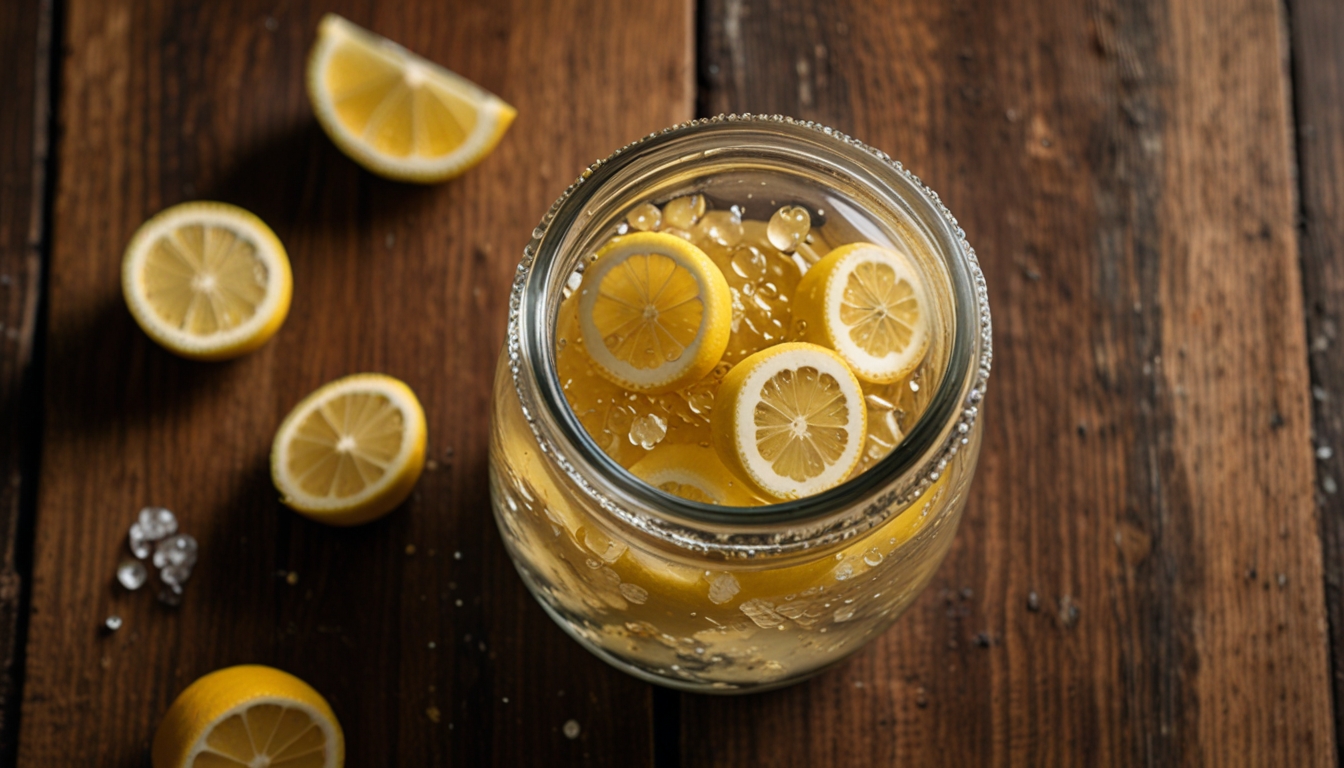
Water kefir is sugar water fermented with water kefir grains — translucent granules 5 to 20 mm across. The working schedule is 21–25°C (70–77°F) for 48 to 96 hours, using roughly 5 to 10% w/v grains in a 5 to 10% sucrose solution. It is not the same culture as milk kefir.
How Is Water Kefir Different from Milk Kefir and Kombucha?
Three separate cultures, three separate substrates, none interchangeable. The clearest way to see it is side by side, using the published physical descriptions and schedules for kefir and for kombucha.
| Water kefir | Milk kefir | Kombucha | |
|---|---|---|---|
| Culture looks like | Translucent, irregular crystal granules, 5–20 mm | Small cauliflower florets, white to yellow, 0.3–4 cm | A floating cellulose mat (SCOBY) |
| Feeds on | 5–10% sucrose solution | Milk | Sweet tea, 50–150 g/L sugar |
| Temperature | 21–25°C (70–77°F) | 20–25°C (68–77°F) | 10–26°C (50–79°F), optimal 20–22°C (68–72°F) |
| Time | 48–96 hours | 18–24 hours | 7–21 days (typically 10) |
| Culture-to-substrate | 5–10% w/v grains | 2–10% w/v grains, average 5% | 100–200 mL starter liquid per litre |
| Result | Light, mildly sweet, fizzy | Thick, tangy, drinkable-yogurt texture | Sour, tea-based, more acidic |
The grains themselves are the dividing line. Water kefir grains will not ferment milk in any sustainable way, and milk kefir grains will not live on sugar water. If you have seen both called simply "kefir grains" on a supplier page, that is the ambiguity to resolve before you buy — our milk kefir guide covers the dairy side.
Ingredients & Equipment
- 1/4 cup active water kefir grains
- 1/4 cup sugar (cane sugar works best — grains need real sugar, not honey or artificial sweeteners)
- 4 cups non-chlorinated water
- A clean wide-mouth glass jar (paid link)
- A plastic or wooden strainer (avoid reactive metal touching the grains)
Step-by-Step
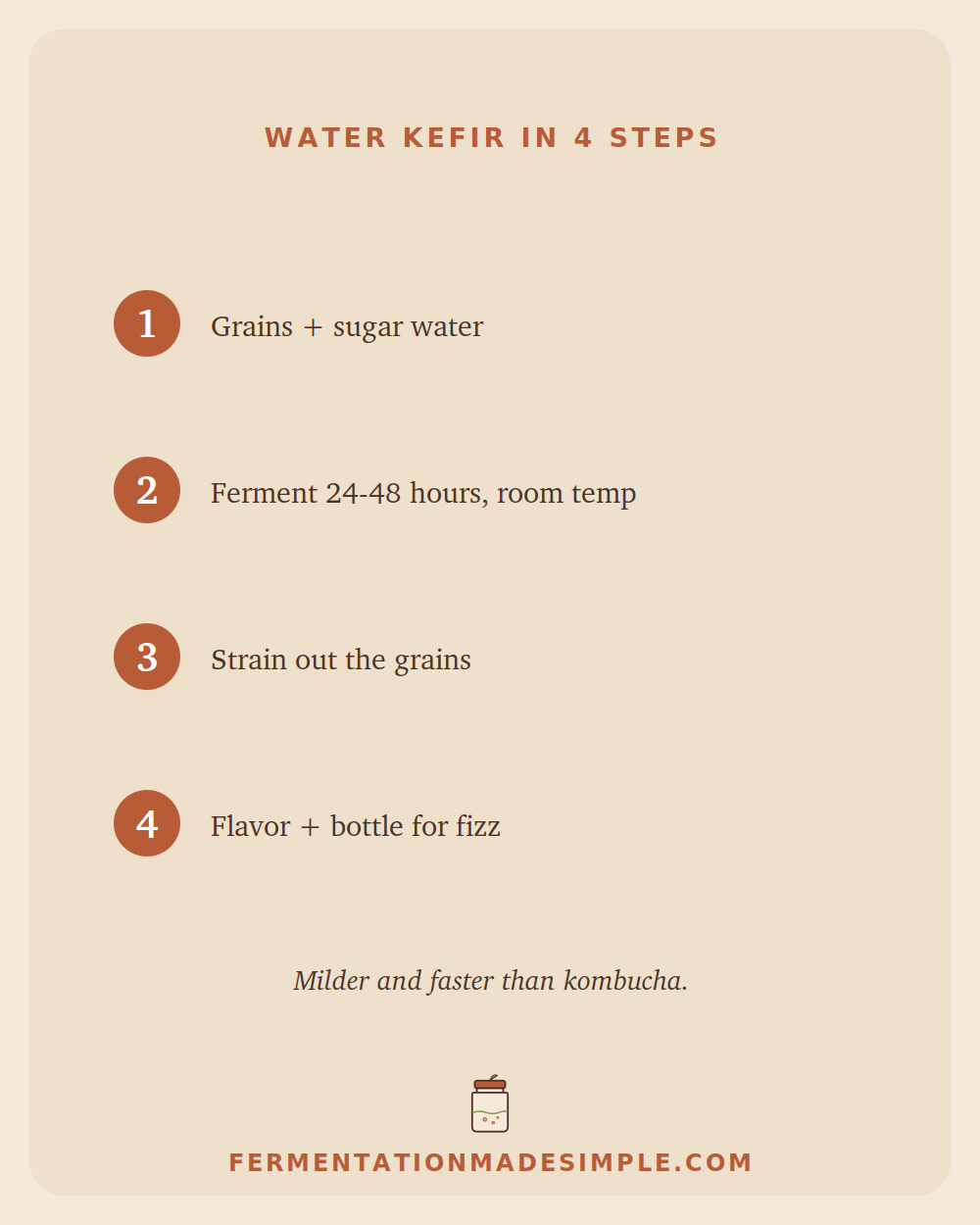
- Dissolve the sugar in the water, then let it cool to room temperature.
- Add the grains to the sugar water in your jar.
- Cover loosely with a cloth and let it sit at room temperature for 24-48 hours.
- Strain out the grains with a plastic strainer — they go into your next batch.
- Optional second ferment: add fruit or juice to the strained liquid, seal in a bottle, and leave 1-2 days for natural carbonation.
How Long and How Warm Should the First Ferment Run?
BCCDC gives two schedules rather than one. The standard is 21–25°C (70–77°F) for 48 to 96 hours. The shortened alternative runs warmer and much faster: 25–30°C (77–86°F) for 20 to 24 hours. Both target the same endpoint, a pH of 4.6 or less, with a stated lower limit of pH 2.5.
Most microbial metabolic activity happens within the first 72 hours, which explains why a four-day batch is not four times as sour as a one-day batch. Two further figures are worth having: grains are used at about 5% w/v in the fermenting mixture, and dormant grains are reactivated in a stronger 10–15% sugar solution before going back into a normal batch.
Once strained, refrigerate at 4°C (39°F) immediately, or within four hours.
Keeping Your Grains Healthy
Grains are maintained by running batches, not by storing them. Feed fresh sugar water on the schedule above and the population stays in the state the published figures describe. Healthy grains also multiply, so the volume in your strainer climbs over months and the excess gets shared or discarded.
A short break in the fridge in fresh sugar water is the standard pause, and the 10–15% reactivation solution is what brings sluggish grains back up to speed afterward. The first batch after a rest usually runs slower and tastes sweeter than normal, which is expected rather than a fault.
What About the Second Ferment?
The second ferment is where flavor and fizz come from: strain the grains out, add fruit or juice, seal, and give it a short window at room temperature. Slices of fresh ginger and lemon make the classic bright version; berries turn it deep pink; a split vanilla bean softens it into something dessert-like.
Sealing changes the problem, because a yeast population with fresh sugar in a closed bottle generates gas. UF/IFAS gives the conversion — roughly 0.46 grams of CO2 per gram of sugar fermented — states that "appropriately pressure-rated bottles must be used to achieve high carbonation levels," and puts the absolute maximum recommended level at 8 volumes of CO2. Colorado State Extension, writing about the equivalent stage in kombucha, directs bottlers to cap tightly and leave 1 to 3 days at room temperature or refrigerate immediately, noting that a longer capped period "could result in carbon dioxide accumulation and even explosion." The procedure that follows from both: pressure-rated bottles, a short sealed window, then the fridge.
None of this is an assessment of a specific batch in your kitchen. These are the ranges and procedures published by the agencies cited, and they cannot tell you what happened in your jar. If a batch smells wrong, shows fuzzy colored growth, or a bottle behaves strangely on opening, discard it rather than taste it.
FAQ
Can I use milk kefir grains to make water kefir?
No. They are physically different cultures — milk kefir grains as cauliflower-like clumps 0.3 to 4 cm across, water kefir grains as translucent granules 5 to 20 mm across — fermented on entirely different substrates. Each has its own published schedule, and swapping the substrate does not convert one into the other.
Where do water kefir grains come from?
Fermentation supply shops sell them, and home brewers pass on their surplus, since healthy grains multiply across batches. Whichever route you take, confirm you are getting water kefir grains specifically rather than milk kefir grains, and ask whether they are active or dehydrated — dehydrated grains need the 10–15% sugar solution for reactivation before they perform normally.
Does water kefir contain alcohol?
Some, because yeast fermentation produces ethanol alongside CO2. The relationship is about 0.48 grams of ethanol per gram of sugar fermented, rising in step with carbonation. A longer or warmer second ferment therefore moves both numbers up together.
Can I ferment juice instead of sugar water?
Not for the first ferment. The first-ferment schedules specify a sucrose solution at 5 to 10% w/v, which is the condition the grain-to-substrate ratios and timings were written for. Juice belongs in the second ferment, after the grains have been strained out, where it flavors the liquid without changing what the culture lives in.
Sources: BC Centre for Disease Control — Kefir Guidance (3.12) · BCCDC — Kombucha and Jun Guidance (3.11) · UF/IFAS — A Guide to Carbonating Beverages at Small Scale · Stadie et al., Food Microbiology — Interactions in water kefir
Related: Milk Kefir: A Beginner’s Guide · Kombucha Recipe · Ginger Bug Guide · Fermentation for Beginners