
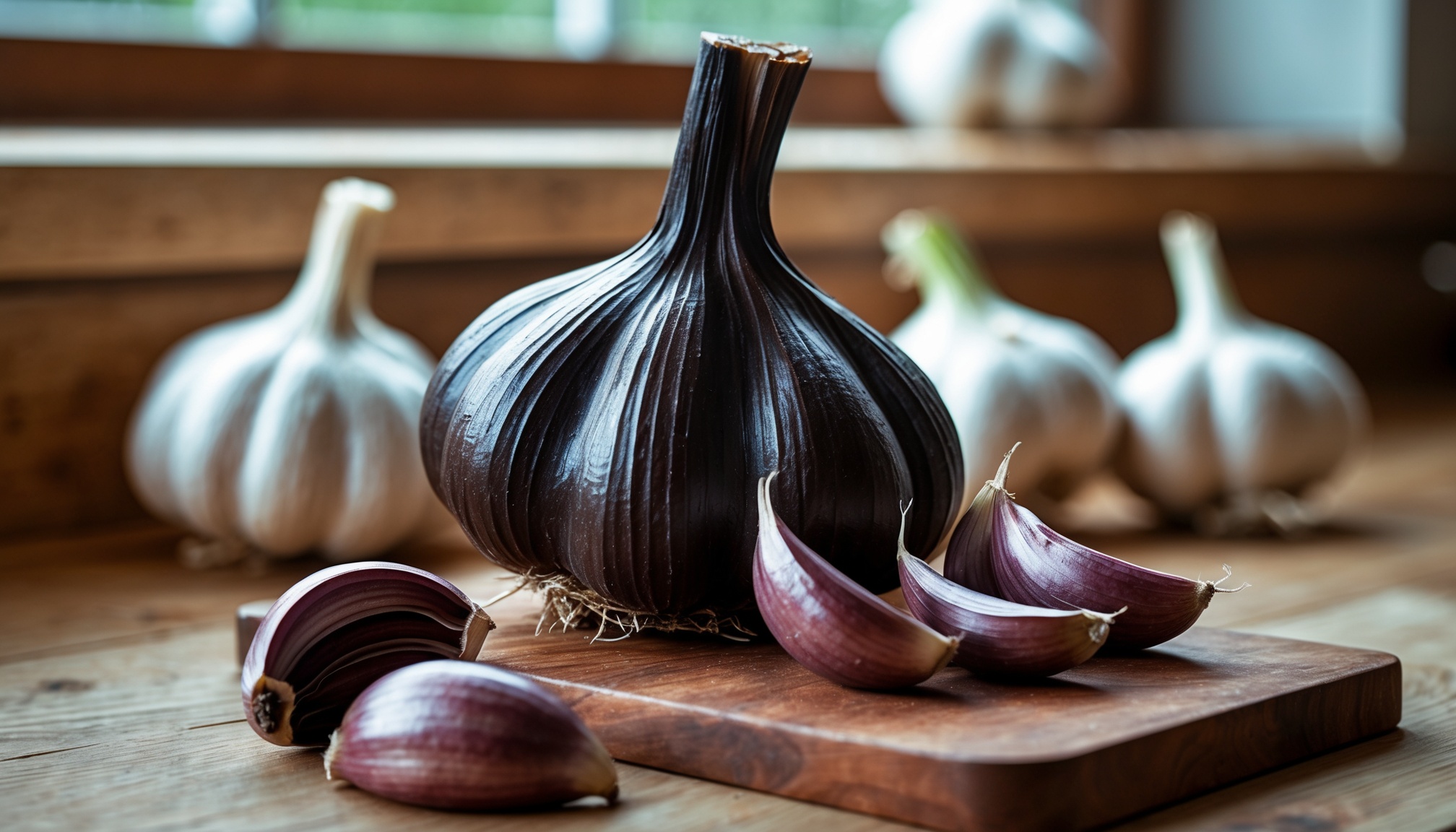
Black garlic is made by holding whole bulbs at high temperature and high humidity for weeks — 60–90°C (140–194°F) at 70–90 percent relative humidity. No salt, no brine, no starter culture. Despite the name it is not a fermentation at all: no active cultures are involved in its production.
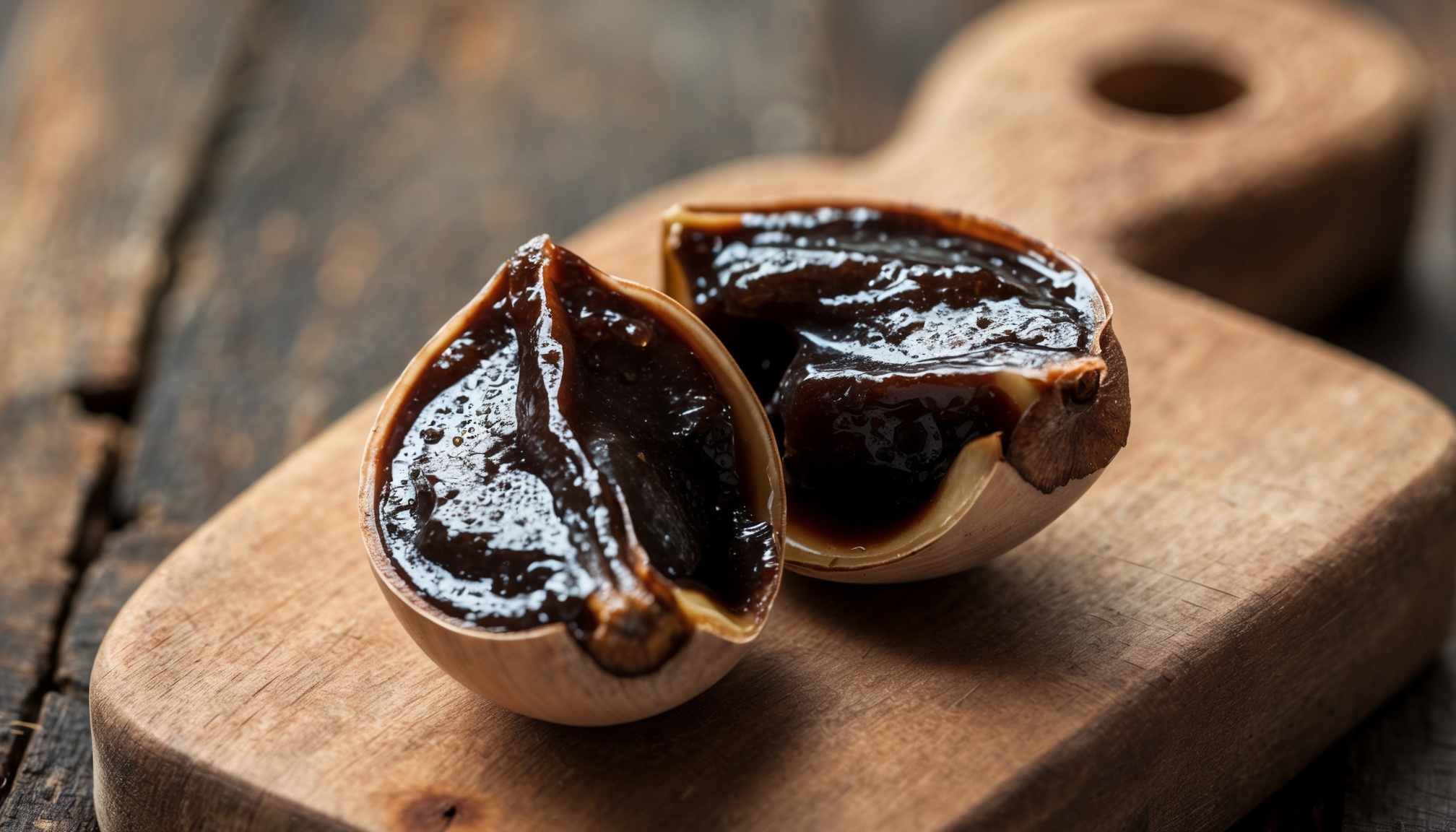
Is Black Garlic Actually Fermented?
No, and the distinction is worth getting right because it changes everything about how you make it. The National Collaborating Centre for Environmental Health puts it directly: “While some refer to black garlic as fermented garlic, it is not a true fermented product as no active cultures are involved in its production. Rather, it is an oxidation and crystallization process.”
Every other garlic recipe on this site works by keeping bacteria alive and giving them the conditions to dominate. Brined garlic in a jar depends on lactic acid bacteria; honey garlic depends on the water the cloves release. Black garlic runs at temperatures that would end any of that on the first day. The colour and sweetness come from chemistry, not microbiology.
What Temperature, and for How Long?
The general envelope is high-temperature (60–90°C) and high-humidity (70–90%) conditions for several weeks, with a range of published protocols inside it. They trade off against each other in the obvious direction — hotter runs finish sooner.
| Temperature | Duration |
|---|---|
| 70°C / 158°F | 21 days |
| 72°C / 162°F | 33 days |
| 75°C / 167°F | 21 days |
| 78°C / 172°F | 14 days |
| 70–75°C / 158–167°F at 80–90% RH | Mature at 8 days; study ran to 12 |
Two things follow. This is a hold, not a bake — 70°C sits far below roasting temperature, which is why the cloves turn jammy rather than dry out. And nothing in a normal kitchen holds that for three weeks: domestic ovens neither go low enough nor hold humidity, which is why dedicated equipment exists.
What You’ll Need
- Whole, unpeeled garlic bulbs (any variety)
- A way to hold steady heat (140-170°F) and humidity (60-90%) for weeks — a dedicated black garlic fermenter (paid link) does this automatically, since a home oven can’t safely hold a low enough temperature for that long
Step-by-Step
- Leave the garlic bulbs whole and unpeeled — don’t separate the cloves.
- Place the bulbs in the fermenter, following its specific temperature and humidity settings.
- Let it run for 3-4 weeks, checking occasionally — the bulbs will darken gradually from the inside out.
- Once cloves are fully black and soft throughout, they’re done — peel and use right away, or store at room temperature in a sealed container.
What Is Happening Inside the Clove?
Two overlapping processes, in sequence. The first stage is enzymatic hydrolysis of fructans and oligosaccharides, together with endophytic bacterial action; the second is non-enzymatic browning, the Maillard reaction.
In plain terms: garlic stores its carbohydrate as fructans, which are not especially sweet and not especially reactive. Sustained heat breaks them down into simple reducing sugars — measured fructose runs at around 20 percent by weight at day 8. Those sugars then react with amino acids in the Maillard reaction, the same non-enzymatic browning that darkens a seared steak or a loaf crust, only stretched across weeks instead of minutes. It is the reason black garlic takes on its characteristic dark brown or black colour.
The acidity climbs steadily as it runs. The published pH series for garlic held at 70°C and 90 percent relative humidity looks like this:
| Day | pH |
|---|---|
| 0 | 6.33 |
| 7 | 5.49 |
| 14 | 4.41 |
| 21 | 4.22 |
| 28 | 4.07 |
| 35 | 3.74 |
A faster schedule tracks the same curve, from pH 6.61 in fresh garlic to below 4.0 after ten days and 3.8 by day twelve. Note that this acidification happens without any lactic acid bacteria involved — it is a different route to a similar-looking number than the one in lacto-fermentation.
How Do You Know When It’s Done?
- Colour all the way through. Cloves darken from the outside in; black at the edge and tan at the centre means longer.
- Texture. Finished cloves are soft and slightly tacky, closer to a dried fruit than to roasted garlic.
- Smell. The raw pungency is gone. If you can still smell sharp garlic, it is early.
- pH, if you want a number. The series above gives you the shape of the curve for a 70°C run — 4.41 at two weeks, 4.07 at four.
What Does It Taste Like?
Nothing like raw garlic. The sharpness is gone entirely and what replaces it is sweet, savoury and faintly sour — the comparison people reach for is balsamic vinegar or tamarind, with a molasses edge. The texture is soft and sticky enough to spread with a knife.
It behaves more like a condiment than an aromatic: mash it into vinaigrettes, stir it through butter, spread it on toast. It will not do the job raw garlic does in a soffritto, so treat it as an addition rather than a substitute.
How Should You Store It?
NCCEH ties storage to the finished pH and water activity rather than to a set number of days. Its criteria: product at pH 4.2 or below is treated as shelf-stable at room temperature; product above pH 4.2 requires refrigeration, unless water activity is also below 0.85.
That last condition is worth noticing, because black garlic is not a dry product. NCCEH reports water activity of 0.93 for whole and 0.94 for peeled garlic after 14 days at 78°C and 90 percent relative humidity — well above 0.85. A shorter run that has not reached pH 4.2 therefore falls into the refrigerate category by those criteria.
This article summarises published research and public-health guidance on black garlic production. It is not an assessment of any particular batch, and the figures above describe controlled studies rather than any specific home setup. If a batch looks, smells or tastes wrong to you, discard it.
FAQ
Is black garlic fermented?
Not in the microbiological sense. NCCEH states that “no active cultures are involved in its production” and describes it as an oxidation and crystallization process, with the colour coming from the Maillard reaction — a non-enzymatic browning reaction rather than a bacterial one.
Do I need to add salt or a starter culture?
No. Black garlic takes nothing but whole bulbs, heat and humidity. Salt and starter cultures belong to lacto-fermentation, which works at room temperature and depends on live bacteria — neither of which survives a multi-week hold at 60–90°C.
Can I make black garlic in a regular oven?
Domestic ovens are not built to hold 60–90°C steadily for weeks, and they have no humidity control, which the 70–90 percent relative humidity requirement makes essential. A dedicated appliance or a rice cooker held on its keep-warm setting is the usual route.
Why does mine smell sharp and taste harsh?
Almost always an unfinished run. The published protocols range from 14 days at 78°C to 33 days at 72°C, and the pH curve at 70°C is still at 4.41 after two full weeks. Under-running is far more common than over-running.
Sources: NCCEH, Black Garlic: Food Safety Considerations During Production and Storage · Physiochemical changes and nutritional content of black garlic during fermentation, Applied Food Research
Related: Fermented Garlic: Simple Jar Method · Fermented Honey Garlic · What Is Lacto-Fermentation? · Fermentation for Beginners