
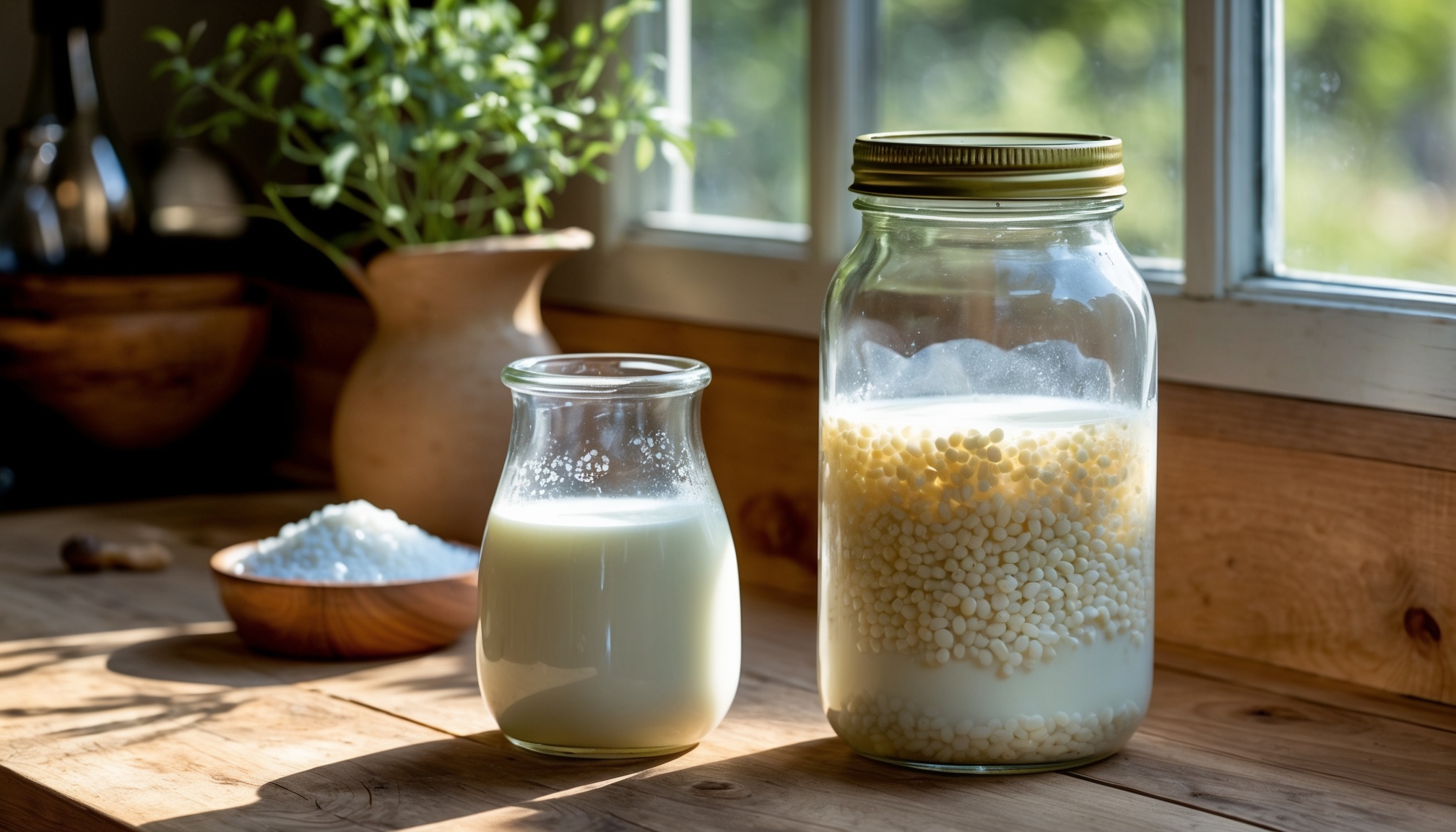
Milk kefir is dairy milk fermented with milk kefir grains — soft, cauliflower-like clumps 0.3 to 4 cm across. The schedule is 20–25°C (68–77°F) for 18 to 24 hours, using 2 to 10% grains by weight to volume, with 5% as the average — in household measure, 2 tablespoons of grains per 2 cups of milk.
How Is Milk Kefir Different from Water Kefir?
They are two separate cultures that share a name, and confusing them is the most common way a first batch goes nowhere. They are physically different and each has its own schedule.
| Milk kefir | Water kefir | |
|---|---|---|
| Grains look like | Small cauliflower florets, white to yellow, 0.3–4 cm long | Translucent irregular crystal granules, 5–20 mm across |
| Substrate | Milk | 5–10% w/v sucrose solution |
| Temperature | 20–25°C (68–77°F) | 21–25°C (70–77°F) |
| Time | 18–24 hours | 48–96 hours |
| Grain ratio | 2–10% w/v, average 5% | 5–10% w/v |
| Result | Thick, tangy, drinkable-yogurt texture | Light, mildly sweet, fizzy |
The grains are not convertible. Dropping milk kefir grains into sugar water does not turn them into water kefir grains, and the reverse fails too. If a supplier’s listing just says "kefir grains," that is the question to settle before ordering — our water kefir guide covers the other culture in detail.
What You’ll Need
- Live milk kefir grains (paid link) — a one-time purchase, since they multiply and can be reused indefinitely
- 2 cups whole milk (or 2%; avoid ultra-pasteurized milk, which ferments less reliably)
- A glass jar and a non-metal strainer
Step-by-Step
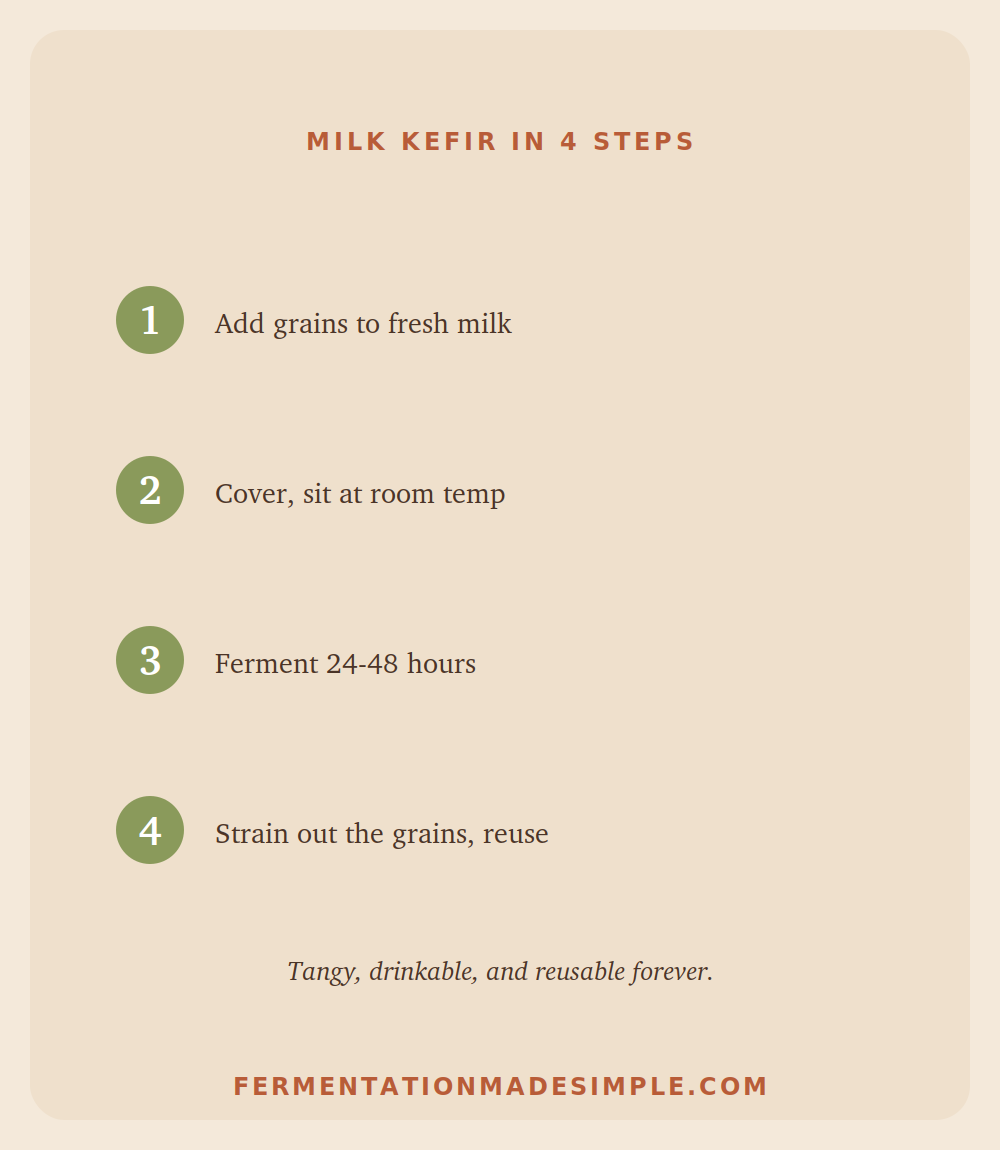
- Add the kefir grains to a jar of fresh milk, roughly 1 tablespoon of grains per 2 cups of milk.
- Cover loosely (a cloth or loose-fitting lid — don’t seal airtight) and leave at room temperature.
- Ferment for 24-48 hours, until the milk thickens slightly and tastes tangy.
- Strain out the grains with a non-metal strainer — the liquid is your finished kefir, ready to drink.
- Add the strained grains to fresh milk right away to start the next batch.
How Warm, How Long, How Many Grains?
The published figures agree closely. The working schedule is 20–25°C (68–77°F) and 18 to 24 hours, and BCCDC sets a critical limit of 36 hours to reach a pH of 4.6 or less. A slightly wider band of 65–85°F (18–29°C) is also published for the same 18 to 24 hours. Pasteurized milk is simply cooled to 20–25°C (68–77°F); no warming is required.
| Variable | Published figure |
|---|---|
| Fermentation temperature | 20–25°C (68–77°F) |
| Fermentation temperature (wider) | 65–85°F (18–29°C) |
| Fermentation time | 18–24 hours |
| Upper time limit to reach pH ≤4.6 | 36 hours |
| Grain ratio | 2–10% w/v, average 5% |
| Grain ratio, household measure | 2 Tbsp grains per 2 cups milk |
| Starting milk pH | 6.5–6.9 |
| Refrigeration | 4°C immediately or within 4 hours; ≤41°F |
| Homemade shelf life, refrigerated | 3–12 days |
On milk choice the guidance is specific: use milk that is pasteurized — heated to 161°F for 15 to 20 seconds — but not ultra-pasteurized or labeled UHT. That is the single variable most likely to make an otherwise correct batch stay thin.
Caring for Your Grains
Grains are maintained by running batches on the schedule above, not by storage. Strained grains go straight into fresh milk; the 18-to-24-hour cycle at 20–25°C is what keeps the population in the state the published ratios assume. Healthy grains also grow, so the volume in your strainer climbs over months and the surplus gets shared or discarded.
A pause in the fridge in fresh milk is the standard break. In the cold, fermentation slows sharply, and the first batch after a rest usually runs slower and tastes milder than normal — expected behavior, not a fault.
Why Did My Kefir Separate?
A yellow, watery layer at the bottom is whey, and it is an over-fermentation signal with two adjustments: shorten the fermentation time or increase the volume of milk. Both move the same lever, since a fixed quantity of grains works through less milk faster.
Room temperature is the third lever. At the top of the 65–85°F band a batch can be done well inside 18 hours; at the bottom it may need the full 24. Checking at 18 hours and then every few hours after is how you find your kitchen’s number, and the finished drink goes into the fridge at the point given in the table above.
UF/IFAS notes that kefir at pH below 4.5 suppresses many pathogens, while adding that E. coli, Listeria and Salmonella can survive it. That is a statement about the process, not about any particular jar. Nothing here is an assessment of what is on your counter — if a batch smells wrong, shows fuzzy colored growth, or looks unlike previous batches, discard it rather than taste it.
FAQ
What’s the difference between milk kefir and water kefir?
Different grains, different substrates, different schedules. Milk kefir grains are cauliflower-like clumps 0.3 to 4 cm long fermented in milk for 18 to 24 hours; water kefir grains are translucent granules 5 to 20 mm across fermented in a 5 to 10% sucrose solution for 48 to 96 hours. Neither set can be switched onto the other’s substrate.
Can I use ultra-pasteurized milk?
Published guidance advises against it, directing you to pasteurized milk — 161°F for 15 to 20 seconds — rather than milk labeled UP or UHT. The heavier heat treatment changes the milk proteins the culture works with, and it is the usual explanation for a batch that stays thin after a full 24 hours at the right temperature.
Should I avoid metal strainers?
Plastic or other non-reactive strainers are the usual recommendation, and brief contact during straining is not the concern — prolonged contact is. Since a strain takes under a minute and the grains go straight back into fresh milk, the practical rule is simply not to store grains in a metal vessel.
How long does finished milk kefir keep?
BCCDC gives 3 to 12 days for homemade milk kefir, against up to 21 days for commercial versions, and directs refrigeration at 4°C immediately or within four hours of straining. Kefir left at room temperature keeps fermenting and keeps souring, which is why the fridge step is part of the recipe rather than an afterthought.
Sources: BC Centre for Disease Control — Kefir Guidance (3.12) · Colorado State Extension — Understanding and Making Kefir · UF/IFAS — Fermented Foods: Kefir (FS457)
Related: Water Kefir: A Beginner’s Guide · Homemade Yogurt · Fermentation for Beginners