
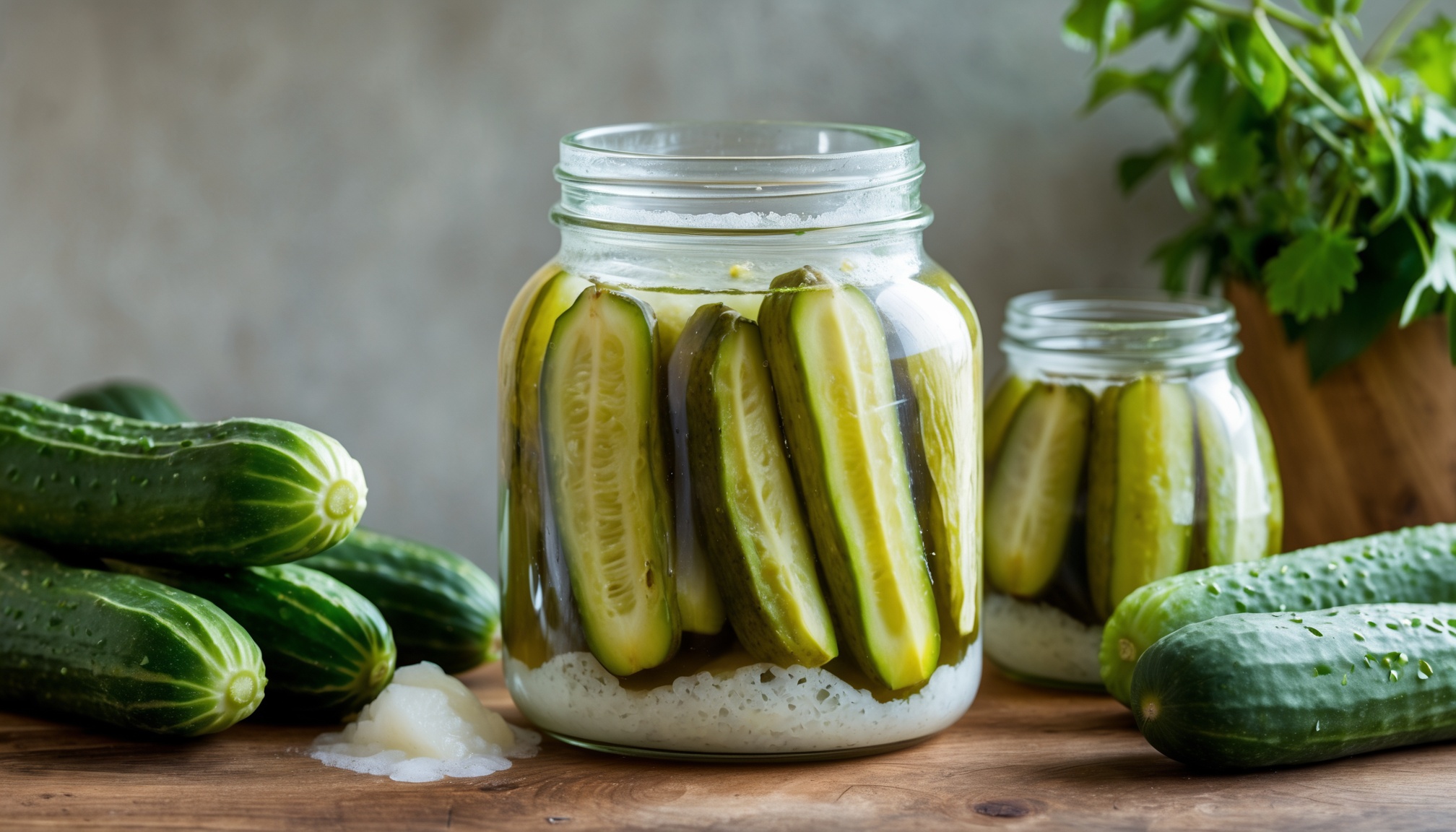
Cloudy brine is what an active vegetable fermentation looks like. The brine becomes cloudy as fermentation proceeds in week one and clears again by around week four. Two other causes are entirely non-biological: anti-caking additives in table salt, and minerals in hard water.
Why Does the Brine Go Cloudy?
Because the liquid fills with bacteria. In a sauerkraut ferment, Leuconostoc mesenteroides increases rapidly in the first 24 hours, reaching populations on the order of 108 CFU per milliliter, with bubbles visible within the same day. Homofermentative lactobacilli then take over from around week two. A cell count at that scale scatters light, and the brine that was clear on day one turns milky.
Sediment adds to it. Shredded or sliced vegetables release starch and fine particles that settle at the bottom of the jar or hang in the liquid. Neither of those is the fermentation itself, but both arrive at the same time and look like part of it.
| Cause | What it looks like |
|---|---|
| Bacterial growth | Even milky haze that develops over the first days, alongside bubbling |
| Anti-caking agents in salt | Cloudiness present from the start, before any fermentation activity |
| Hard water | Haze plus possible off-colors from iron or sulfur |
| Table or gourmet salts | Cloudiness, sometimes discoloration |
| Vegetable sediment | Fine particles settling at the bottom, clearer liquid above |
What You’ll Need to Keep the Jar Under Brine
A waterless airlock lid (paid link) also helps here — it keeps outside contaminants out while still venting gas, which can reduce excess cloudiness in some ferments.
Does Cloudy Brine Clear Up on Its Own?
That is the usual arc: cloudy through week one, clearing by week four. It fits the microbial picture — the early Leuconostoc bloom subsides, the population shifts, acid accumulates, and cells and sediment drop out of suspension.
The timing lines up with the rest of the schedule. A vegetable ferment takes roughly 3 to 4 weeks at 20–25°C (68–77°F), or up to 6 weeks at lower temperatures, and sauerkraut takes 3 to 4 weeks at 70–75°F (21–24°C). Cloudiness that persists past that window usually means the ferment is running cold and is simply behind schedule — kraut may not ferment at all below 60°F (15°C).
Cloudiness caused by salt additives or hard water will not clear, because nothing is going to consume it. That is cosmetic: cloudiness from non-iodized table salt does not harm the pickles.
When Is It Not Just Cloudiness?
Cloudy liquid is ordinary. Three other things are not. Illinois Extension identifies a white surface layer that is not fuzzy as kahm yeast, and a film that is fuzzy or appears in round patches as mold. It states that fermented foods which are slimy, or which smell spoiled or rotten, should be discarded.
- Uniform haze with bubbling and a sour smell — the ordinary week-one pattern.
- Fuzzy growth or round patches on the surface — mold, distinct from kahm yeast. Our fermentation safety guide collects what the authorities publish on surface growth.
- Slimy or ropy liquid, or a spoiled or rotten smell — the stated grounds for discarding the batch.
Submersion is the preventive step every document agrees on. Keep at least 3 cm of brine between the vegetables and the top of the vessel, covered and weighted down; gas heaving in the first 48 hours can push vegetables up into the air where surface yeasts and molds grow. The fix is to vent gas or drain some brine, not to leave the lid loose. Our fermented pickles method shows the packing order.
This page summarizes what the BC Centre for Disease Control, NCHFP, Oregon State Extension and Illinois Extension publish about brine appearance during fermentation. It is not an assessment of any particular jar. If a batch looks, smells or feels wrong to you, Illinois Extension’s rule applies: when in doubt, throw it out. Our guide to spoiled ferments has the full checklist.
FAQ
Is cloudy brine normal in fermented pickles?
The brine becomes cloudy as fermentation proceeds during week one and clears by around week four. Cloudiness from non-iodized table salt does not harm the pickles. The guidance does not treat cloudiness on its own as grounds for discarding a batch.
Why was my brine cloudy from the very first day?
Most likely the salt or the water. Non-caking material added to salts may make the brine cloudy, which is why canning or pickling salt is specified instead. Hard water is the other cause, and moderately soft water is the recommendation for brines.
Will the cloudiness go away?
The usual timeline has it clearing by around week four as the bacterial population stabilizes and sediment settles. Cloudiness from salt additives or hard water is chemical rather than microbial and will not clear on its own.
What does the guidance say separates cloudy from spoiled?
Illinois Extension names fuzzy growth or round patches as mold rather than kahm yeast, and states that fermented foods which are slimy or smell spoiled or rotten should be discarded. Cloudy liquid alone is not on that list.
Sources: BC Centre for Disease Control — Fermented Vegetables Guidance · NCHFP — General Information on Pickling · Oregon State University Extension — Pickle Fact Sheet · Illinois Extension — Fermenting FAQ
Related: How to Make Fermented Pickles · How to Tell If Your Ferment Has Gone Bad · Fermented Food Safety Guide