
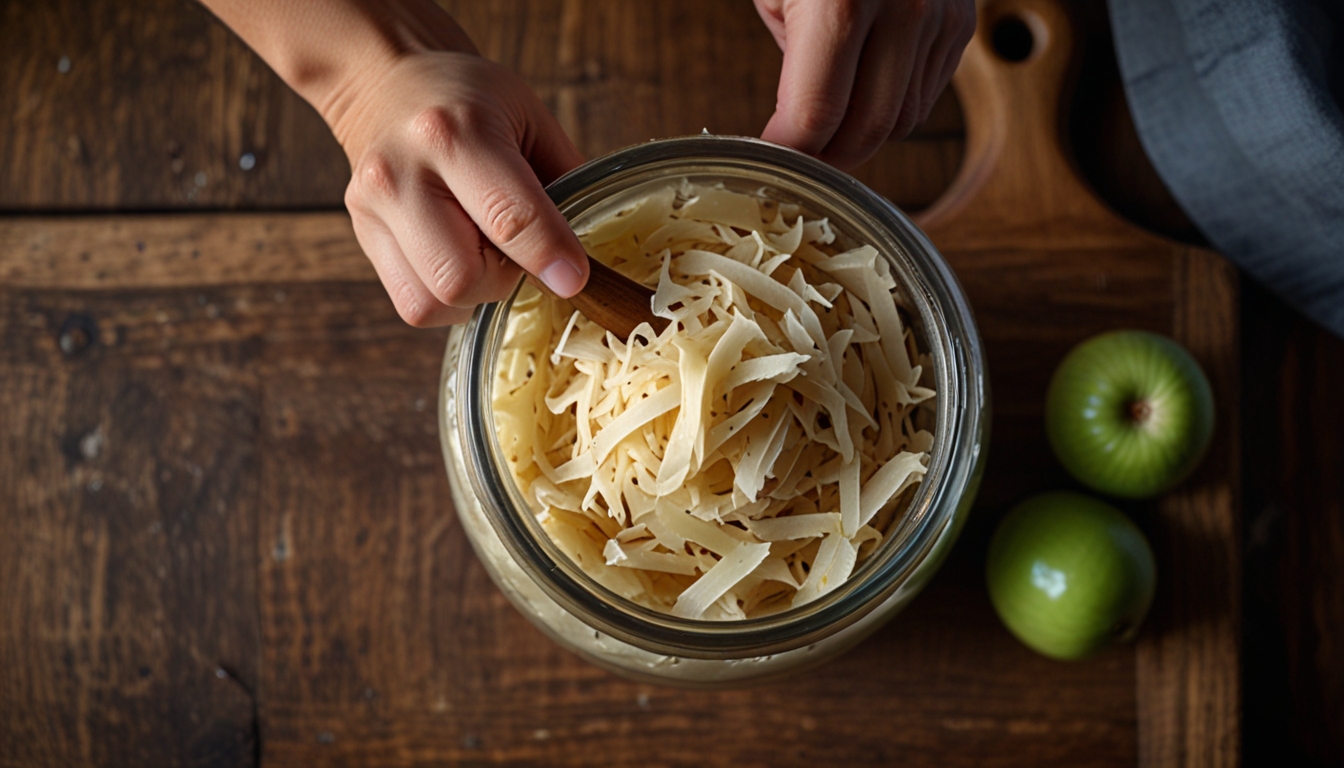
A quiet jar is usually a cold jar, a sealed jar, or a jar past its gassy phase. Bubbling is a stage marker rather than a requirement: kraut is done “when bubbling ceases”, and full fermentation takes 3 to 4 weeks at 70–75°F, stretching to 5 to 6 weeks at 60–65°F. Below 60°F, kraut may not ferment at all.
Does Sauerkraut Have to Bubble?
No — bubbling marks one phase, not the whole process. The sequence runs like this: as soon as brine forms, fermentation starts and carbon dioxide bubbles appear, driven by Leuconostoc mesenteroides, which produces gas and acid until acidity reaches roughly 0.25 to 0.3 percent. Lactobacillus plantarum (now Lactiplantibacillus plantarum) then carries acidity to about 1.5 to 2 percent, and a final stage takes it to 2 to 2.5 percent.
The visible gas belongs largely to that first stage. Most of the acid, and the flavor you actually want, develops afterward in the long quiet stretch. This is why the end of bubbling is the signal that fermentation is finished, rather than proof that it is running.
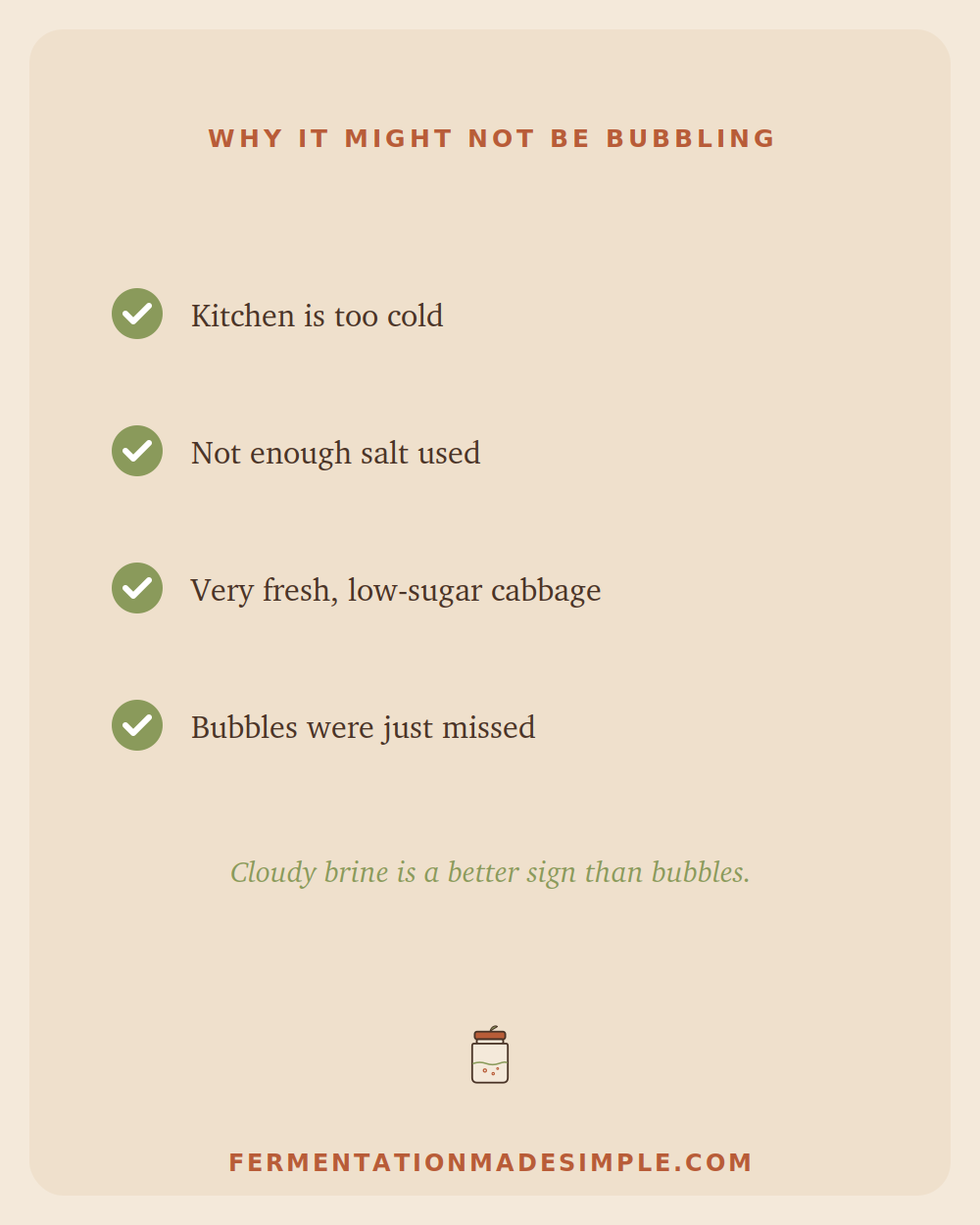
Why Isn’t Your Jar Bubbling?
Work down this list in order. The first two explain the large majority of quiet jars, and neither means anything went wrong.
| Reason | What happens | How to check |
|---|---|---|
| The kitchen is cool | Below 60°F (15°C) sauerkraut may not ferment; 60–65°F (15–18°C) takes about six weeks | Thermometer next to the jar, not on the wall |
| Gas escapes silently | Containers must allow gas to vent; an airlock releases it without visible bubbling | Look for gas pockets in the kraut, not at the lid |
| The gassy phase is over | Gas comes from the opening Leuconostoc stage | Count the days since you packed it |
| Too little brine | Cabbage should be covered by 1 to 2 inches of brine | If juice does not cover the cabbage, add boiled and cooled brine |
| Salt is off target | 1–3% for cabbage, 2.25% optimal; 2.25–2.5% favors Leuconostoc | 3 tablespoons canning or pickling salt per 5 pounds of cabbage |
| Wrong salt | Iodized salt may slow fermentation and discolor vegetables | Check the box for iodine and anti-caking agents |
What Should You Watch Instead of Bubbles?
Three signals are more informative than gas, and they run on a predictable schedule.
- The brine turns cloudy. The brine becomes cloudy as fermentation proceeds in week one, then clears by around week four. Cloudiness is the most reliable early sign that bacteria are working.
- The smell shifts. Raw cabbage gives way to something sharply sour over the first week or two. That change is the lactic acid building up.
- The volume drops and the color dulls. Shreds soften, the pack settles, and bright green fades toward pale straw.
Taste is the final arbiter: clean spoon, small sample, once a week from about day seven. If this week tastes more sour than last week, the jar is moving.
What You’ll Need to Read the Jar Properly
If this happens often, a proper waterless airlock lid (paid link) makes it much easier to see and trust that fermentation is actually happening, without needing to loosen the lid to check.
The rest is unglamorous: a weight heavy enough to hold shreds under the brine, a jar with room above the cabbage — in a crock, the rim should sit at least 4 or 5 inches above it — and a kitchen thermometer, which settles the temperature question faster than anything else.
How Much Does Temperature Change the Timeline?
| Temperature | Time to full fermentation |
|---|---|
| Below 60°F (15°C) | May not ferment |
| 60–65°F (15–18°C) | 5 to 6 weeks |
| 70–75°F (21–23°C) | 3 to 4 weeks |
| Above 75°F (24°C) | Faster, but kraut may become soft; above 80°F (26°C) it may become soft and spoil |
Ten degrees is the difference between three weeks and six. A jar on a tiled floor or against an exterior wall in winter runs cooler than the thermostat reading, which is why the thermometer belongs next to the jar.
When Is a Quiet Jar Actually a Problem?
When nothing at all has changed. If after one to two weeks at room temperature the brine is still clear, the smell is still raw cabbage, and the shreds are still crisp and bright, the fermentation has not started. Check the temperature first, then the brine level, then the salt. The remedy for a dry pack is direct: if juice does not cover the cabbage, add boiled and cooled brine, made with 1½ tablespoons of salt per quart of water.
Separately, Illinois Extension gives the standard spoilage guidance: when in doubt, throw it out — if fermented foods appear slimy or smell spoiled or rotten, discard them. Our kahm yeast vs. mold guide covers surface growth.
To rebuild the setup from scratch, the sauerkraut recipe covers packing and weighting, and the beginner’s guide covers salt ratios and submersion.
This article summarizes published guidance on fermentation timing and troubleshooting. It is not an assessment of any particular batch, and nothing here can tell you what is in your jar. If a ferment looks, smells or tastes wrong to you, discard it.
FAQ
Should I stir or shake the jar to get it bubbling?
No. With a brine-bag weight, the instruction is not to disturb the container until fermentation is complete and bubbling ceases. Opening the jar adds oxygen at the surface, which is where films and molds get their start.
Is it normal for bubbling to stop after a few days?
Yes. Gas production belongs to the opening Leuconostoc mesenteroides stage, before acidity climbs toward 1.5 to 2 percent. Bubbling ceasing is the marker that fermentation has finished, not that it has failed.
Does an airlock lid hide the bubbling?
It changes where you see it. Gas vents continuously rather than collecting under a tight lid, so there is no burst when you open the jar. Look for gas pockets rising through the packed cabbage instead of at the rim.
Can I move a cold, quiet jar somewhere warmer?
Yes, and it is the usual fix. Aim for the optimal 70–75°F (21–23°C) band, and avoid pushing past it — above 75°F kraut may become soft, and 80°F (26°C) is the point where it may soften and spoil.
Sources: NCHFP, Sauerkraut · NC State Extension, Lactic Acid Fermentation · Clemson HGIC, Making Sauerkraut · BC Centre for Disease Control, Fermented Vegetables Guidance
Related: Sauerkraut for Beginners · Kahm Yeast vs. Mold · Fermentation for Beginners