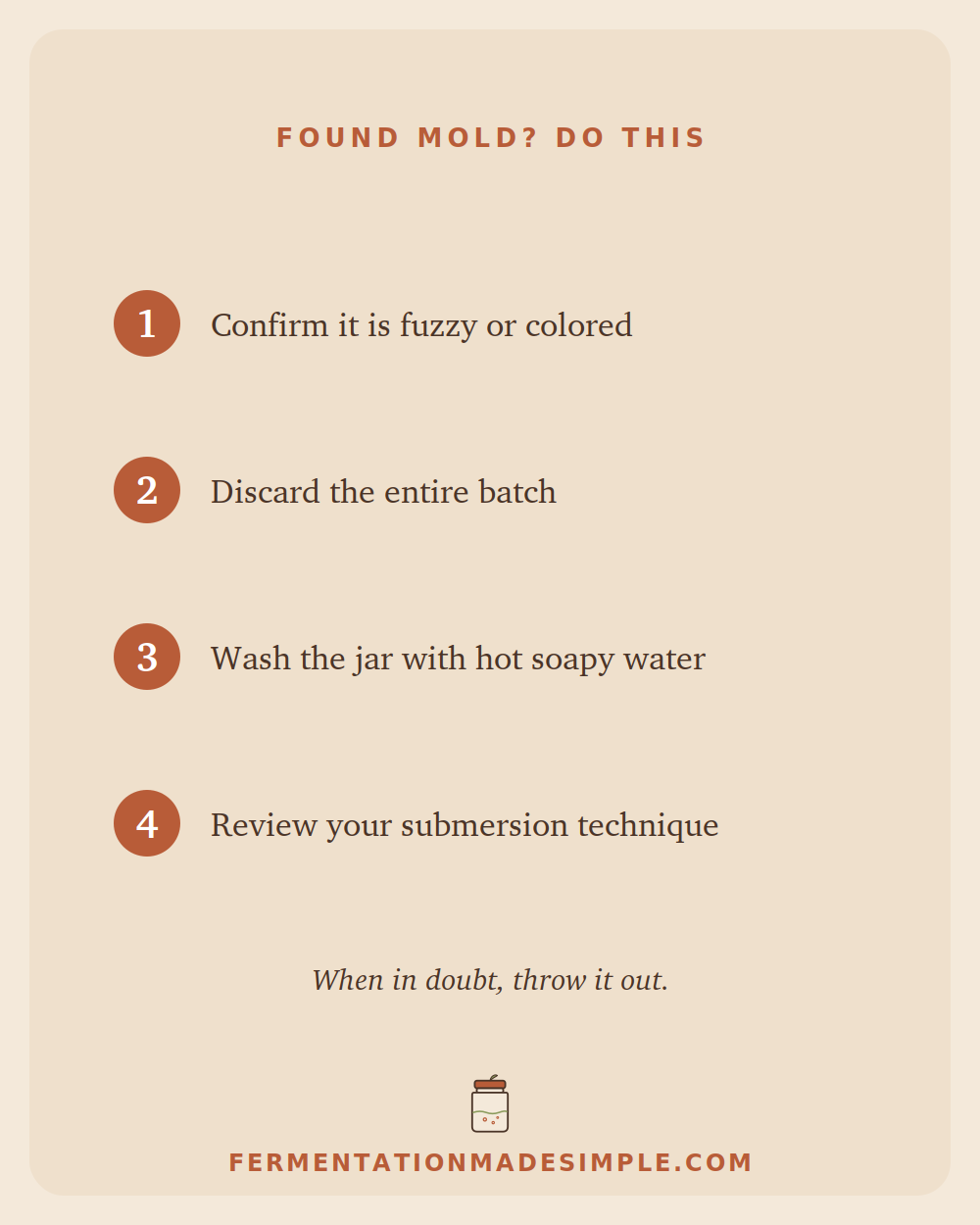
Published guidance on fuzzy, raised mold in a home ferment is to discard the batch, not to skim it. Penn State Extension states: do not taste if you see mold on the surface. USDA FSIS puts high-moisture foods such as cucumbers in the discard-entirely group, because contamination can extend below what you can see. First, though, confirm it is really mold and not a flat surface film.
Is It Actually Mold?
Most of what alarms people is not mold. Illinois Extension describes a white film that is not fuzzy or in round patches as kahm yeast, calling it very common on vegetables and safe. Mold looks and behaves differently: raised, dry, fuzzy, and arranged in discrete circles that expand outward. Run through the table before you do anything else.
| Check | Points to mold | Points to surface yeast |
|---|---|---|
| Surface texture | Fuzzy or hairy, dry | Flat, slick, sometimes wrinkled |
| Shape | Round patches with defined edges | One continuous sheet across the brine |
| Height | Stands up off the liquid | Lies flush on the liquid |
| Location | Often on a piece sticking above the brine | On the brine itself |
| When disturbed | Holds together, keeps its fuzz | Breaks up and sinks as an oily skin |
Color is the least reliable signal of the five. Green, black, blue and pink are common mold colors, but white mold exists too, and kahm yeast picks up tints from turmeric, paprika or chili in the jar. Our kahm yeast vs. mold guide goes through the comparison in more detail.
What Do the Sources Say to Do?
They converge on discarding the batch. Penn State Extension’s fermentation guidance says not to taste a ferment if mold is visible on the surface, and to discard pickles that become soft, slimy or develop a disagreeable odor. The BC Centre for Disease Control treats mold as evidence that submersion failed, and directs readers to discard damaged product.
USDA’s Food Safety and Inspection Service explains why trimming does not transfer here. It allows cutting at least 1 inch around and below a mold spot only for hard cheese and firm produce, noting it is difficult for mold to penetrate dense foods. Everything else falls under a different rule: foods with high moisture content can be contaminated below the surface. Soft fruits and vegetables, including cucumbers, fall in the discard group; moldy foods may have bacteria growing along with the mold, and some molds produce mycotoxins.
Why Did Mold Grow in the First Place?
Mold needs oxygen; a properly submerged ferment does not offer much. The BC Centre for Disease Control notes that surface molds and oxidative yeasts grow readily on the surface of fermenting vegetables, and asks for vegetables fully submerged under at least 3 cm (about 1¼ inches) of brine. The causes come down to a short list.
| Cause | What goes wrong | Fix for next batch |
|---|---|---|
| Vegetables above the brine | Vegetables are not submerged in brine — a listed scum cause, and mold is tied to failed submersion | Weight everything; top up brine |
| Container left open | The pickling container is not sealed | Cover or use an airlock lid |
| Fermenting too warm | Temperature above 75°F during fermentation | 70–75°F (21–23°C) is optimal |
| Too much salt | Excess salt prevents adequate lactic acid production | 1–3% for cabbage, 2.25% optimal |
| Unclean covers | The cloth on top of the kraut was not kept clean | Clean jar, clean weights, clean hands |
| Surface film left to build | Check kraut two to three times weekly and remove scum if it forms | Skim as it appears |
One row surprises people: too much salt is a listed cause, not a defense. Salt slows the lactic acid bacteria — Leuconostoc mesenteroides early, then Lactiplantibacillus plantarum — and a jar that acidifies slowly stays hospitable to molds for longer. BCCDC expects a room-temperature ferment’s pH to fall to 4.6 within 48 hours.
How Do You Set Up So It Does Not Recur?
- Leave headspace for brine, not for air. Cabbage should be covered by 1 to 2 inches of brine, in a container whose rim sits at least 4 to 5 inches above the cabbage.
- Weigh, then check the next morning. Shreds and florets rise overnight as gas builds, and that first 24 hours is when a floating piece usually appears.
- Measure the salt. A standard sauerkraut ratio is 3 tablespoons of canning or pickling salt per 5 pounds of cabbage, and 1½ tablespoons per quart of water for topping-up brine.
- Hold the temperature. 70–75°F (21–23°C) is optimal; below 60°F (15°C) kraut may not ferment, and above 80°F (26°C) it may become soft and spoil.
If you want to rebuild the routine from the ground up, our beginner’s guide covers salt and submersion, and the sauerkraut recipe shows the packing and weighting step by step.
This article summarizes what published home-preservation guidance says about mold in ferments. It is not an assessment of your batch, and no article can inspect a jar it cannot see. If a ferment looks, smells or tastes wrong to you, discard it.
FAQ
Can I scrape off the mold and keep the rest?
That is not what the guidance supports. USDA FSIS limits cut-around-it treatment to dense foods such as hard cheese and firm produce, and places high-moisture foods, including cucumbers, in the discard group because contamination can extend below the surface. Penn State says not to taste a ferment with visible mold.
Does mold mean I did something badly wrong?
Usually it means one mechanical thing slipped — a weight that shifted, a piece that floated, a warm stretch of weather. Troubleshooting lists center on submersion, temperature and cleanliness, all of which are straightforward to correct next time.
Can I reuse the jar and the weights?
Yes, after a thorough wash in hot soapy water, including the lid, the gasket and the weight. Unclean covers are a listed cause of mold during fermentation, so anything porous — a cloth cover, a wooden lid — deserves more scrutiny than glass does.
What about mold on kombucha or a sourdough starter?
Different ferments, same reasoning. FSIS bases its discard guidance on moisture content rather than on the food’s name, and both of those are high-moisture. Kombucha adds its own complication, since a new SCOBY layer is easily mistaken for surface growth.
Sources: USDA FSIS, Molds on Food · Penn State Extension, Let’s Preserve: Fermentation · BC Centre for Disease Control, Fermented Vegetables Guidance · NC State Extension, Pickle and Pickle Product Problems
Related: Kahm Yeast vs. Mold · Fermentation for Beginners · Sauerkraut for Beginners