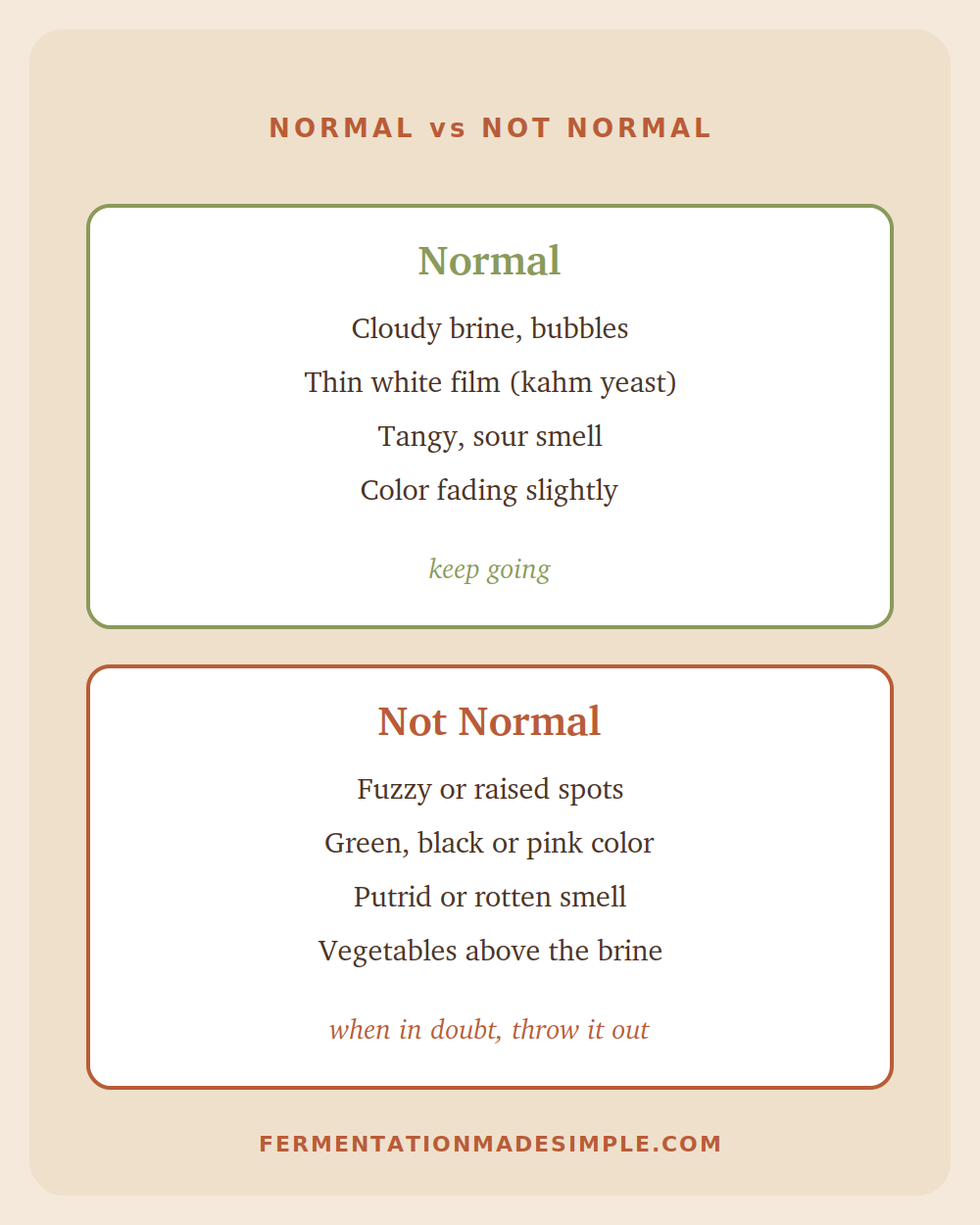
A thin, flat, wrinkled white or cream film sitting flush on the brine is kahm yeast. Mold is fuzzy, raised off the surface and grows in round patches, often green, black, blue or pink. Illinois Extension describes a white film that is not fuzzy or in round patches as kahm yeast. For anything fuzzy or patchy, published guidance points to discarding the batch rather than skimming it.
How Do You Tell Kahm Yeast from Mold?
Texture and growth pattern decide it, not color. Kahm yeast spreads as a continuous flat sheet across the whole surface and looks wet or waxy. Mold starts as separate raised circles that grow outward and look dry and fuzzy, like mold on bread. That is exactly where the line falls: not fuzzy and not in round patches means kahm yeast.
| What you check | Kahm yeast | Mold |
|---|---|---|
| Texture | Flat, smooth or wrinkled, often waxy | Fuzzy, hairy, dry-looking |
| Growth pattern | Continuous sheet across the surface | Separate round patches that spread outward |
| Height | Sits flush on the brine | Raised above the surface |
| Color | White, cream, sometimes faintly beige | Green, black, blue, pink, grey; white is possible |
| Where it grows | On the liquid, where air meets brine | Usually on a vegetable piece poking above the brine |
| Published guidance | Illinois Extension: common and safe | Penn State: “Do not taste if you see mold on the surface” |
Color alone will mislead you: white mold exists, and kahm yeast picks up a beige tint from turmeric or chili. Poke the film with a clean spoon. Kahm yeast breaks into a slick skin and sinks; mold holds its shape and stays fuzzy.
Why Does a Film Form at All?
Because the top of the brine is the one place in the jar with oxygen. Surface molds and oxidative yeasts grow readily on the surface of fermenting vegetables, which is why the standing instruction is to keep everything fully submerged with at least 3 cm (about 1¼ inches) of brine above the vegetables. The two triggers for surface scum are plain enough: vegetables not submerged in brine, and a container that is not sealed.
Below the surface, the fermentation itself is anaerobic and unbothered. The succession runs like this: Leuconostoc mesenteroides starts things off, producing gas and acid up to roughly 0.25 to 0.3 percent acidity, then Lactobacillus plantarum (now Lactiplantibacillus plantarum) carries acidity to about 1.5 to 2 percent.
What Do the Sources Say to Do About Mold?
They say discard, not skim. Penn State Extension states directly: do not taste if you see mold on the surface. Visible mold is treated as a sign that submersion failed, and the instruction that follows is to discard damaged product.
USDA’s Food Safety and Inspection Service explains the reasoning in its guidance on molds in food. Foods with high moisture content can be contaminated below the surface, which is why soft fruits and vegetables such as cucumbers fall in the discard-entirely category rather than the cut-an-inch-around-it category reserved for hard cheese and firm produce. Moldy foods may also have bacteria growing alongside the mold, and some molds produce mycotoxins. A jar of brined vegetables is about as high-moisture as food gets, so the surface patch is a poor guide to what is elsewhere in the jar.
Is Cloudy Brine Part of the Same Problem?
No, and the two get confused constantly. Cloudiness happens throughout the liquid; a film happens only at the top. The expected pattern for a vegetable ferment is that the brine becomes cloudy as fermentation proceeds in week one, then clears by around week four. White sediment is separately listed as a normal result of bacterial fermentation activity, or of salt containing anti-caking agents.
How Do You Keep the Surface Clear Next Time?
- Keep the brine deep enough. At least 3 cm (1¼ in) of brine above the vegetables; for sauerkraut, cabbage covered by 1 to 2 inches of brine.
- Weight everything down. A single cabbage shred floating above the line is the usual launch pad for a mold patch.
- Watch the temperature. The optimum for sauerkraut is 70–75°F (21–23°C), and above 80°F (26°C) kraut may become soft and spoil. Fermentation above 75°F is one of the listed causes of mold during fermentation.
- Do not over-salt. Too much salt is another listed mold cause, because it holds back the lactic acid production that would otherwise dominate the jar. For cabbage the range is 1 to 3 percent, with 2.25 percent noted as optimal.
- Use clean equipment and additive-free salt. Dirty covers and cloths are a route in, and canning or pickling salt is the recommendation.
Our beginner’s guide covers the salt and submersion basics, and the sauerkraut recipe shows the weighting setup in practice.
This article summarizes published guidance on identifying surface growth in home ferments. It is not an assessment of any particular jar, and nothing here can tell you what is in yours. If a batch looks, smells or tastes wrong to you, discard it.
FAQ
Can kahm yeast turn into mold if I leave it?
They are different organisms, so one does not become the other. But a thick film means the surface has ongoing oxygen exposure, which is the same condition molds need. The published instruction is to remove scum as it appears rather than letting it build.
Does kahm yeast change how the ferment tastes?
It can. Surface yeasts consume acid, which is why unremoved scum is linked to soft, slippery pickles. A heavy film left for weeks tends to leave a flatter, slightly yeasty flavor behind.
Why does my kimchi get a film but my sauerkraut never does?
Usually packing, not the recipe. Shredded cabbage compacts under a weight and holds a deep brine layer; chunkier kimchi pieces trap air and float. Pressing the vegetables down and topping up the brine addresses both.
Is white mold really mold, or just kahm yeast?
White mold exists, so color cannot settle it. Judge by texture and shape: fuzzy and raised, growing in distinct round patches, is the description the sources use for mold, and that is the case where the guidance is to discard rather than skim.
Sources: Illinois Extension, Fermenting FAQ · BC Centre for Disease Control, Fermented Vegetables Guidance · USDA FSIS, Molds on Food · Penn State Extension, Let’s Preserve: Fermentation
Related: Fermentation for Beginners · Sauerkraut for Beginners · Easy Kimchi Recipe